
Ananta Press is delighted to congratulate Upendra Nath Rath on being officially selected as a Winner of the Ananta Press Sahitya Ratna Award for his meaningful nonfiction work, Reflections of Wisdom. Reflections of Wisdom is a thoughtful book centered on the values that shape a healthy, disciplined, respectful, and socially responsible life. Instead of treating a healthy lifestyle only as a matter of physical well-being, the book looks at the complete way a person lives. It gives importance to manners, behavior, personal habits, social conduct, thoughtful choices, and the values that help individuals live peacefully with others. This practical approach makes the book particularly relevant. In a time when people are surrounded by information but often struggle to find simple guidance for everyday living, Reflections of Wisdom encourages readers to look inward and consider how small changes in attitude and behavior can create meaningful improvements in life. The award committee found the background of Upendra Nath Rath closely connected with the spirit of his book. Born on 14 May 1962 in Odisha, he has maintained a deep affection for flora, fauna, birds, animals, and the simplicity of village life. His academic journey includes postgraduate studies in English, History, and Political Science, along with a B.Ed. and an MBA in Human Resource Development. His professional life has been equally rich in learning and service. He served for 36 years as an English teacher in Kendriya Vidyalaya, dedicating a major part of his life to educating and guiding young people. As a veteran Scout leader, he has also conducted hundreds of Basic and Advanced training programmes. His work reflects a long association with discipline, character building, leadership, service, and social responsibility. His contribution has received recognition from different parts of the world. He received an appreciation letter from the President of Switzerland for his efforts toward promoting world peace, along with recognitions including the Isa Dubai Award, a Best Teacher Award, and an award from Vietnam. The Ananta Press Sahitya Ratna Award recognizes authors whose writing offers literary, intellectual, social, or cultural value to readers. Reflections of Wisdom stood out because its message comes not merely from theory but from decades of observation, teaching, training, and interaction with people. The book reminds readers that wisdom has its greatest value when it becomes part of everyday conduct. Good manners, healthy habits, responsible behavior, respect for others, and awareness of one’s duties may appear simple, but together they influence families, institutions, and society. For its accessible message, practical relevance, positive social outlook, and sincere contribution to value-based nonfiction, Reflections of Wisdom has earned recognition through the Ananta Press Sahitya Ratna Award. Jury Review Feedback Glenville Ashby Glenville Ashby appreciated Reflections of Wisdom for the calm and practical way in which it presents ideas about everyday living. In his view, the book does not try to impress readers with complicated language. Instead, it speaks directly about habits, manners, healthy choices, and responsible social behavior. He especially valued the author’s ability to connect personal discipline with a peaceful and meaningful life. According to him, many books discuss success, but this book gives importance to character, balance, and the way a person treats others. He also noted that Upendra Nath Rath’s long experience as a teacher can be felt in the patient and guiding tone of the writing. The thoughts often feel like lessons shared by an experienced mentor who wants readers to become better human beings. Glenville felt that the book can be useful for young readers, families, teachers, and anyone trying to improve daily habits. He considered its simplicity one of its strongest qualities. Kavya Pandey Kavya Pandey found Reflections of Wisdom meaningful because it deals with subjects that are ordinary in appearance but very important in real life. She observed that the author gives attention to lifestyle, manners, social responsibility, and thoughtful behavior without turning the book into a strict rulebook. The ideas encourage readers to examine their own actions and make small improvements with awareness. She particularly appreciated the positive tone of the book and the respect it shows for values that support healthy relationships and peaceful communities. In her reading, Upendra Nath Rath’s background as an educator gives the book a special strength. His decades of teaching and guiding young people seem to have shaped the clear and accessible manner in which the ideas are presented. Kavya also felt that the author’s love for nature, animals, birds, and village life brings a sense of simplicity and harmony to his outlook. She described the book as a useful collection of reflections that can inspire steady personal growth. Apeksha Gupta Apeksha Gupta praised Reflections of Wisdom for focusing on the connection between personal habits and social life. She felt that the book reminds readers that a healthy lifestyle is not limited to food or physical fitness. It also includes respectful speech, good manners, emotional balance, responsibility, and consideration for other people. This wider understanding gives the book a thoughtful and useful character. Apeksha liked the fact that the author presents wisdom in a simple form that can be understood by readers from different age groups. She also noticed a strong educational spirit in the book. Upendra Nath Rath spent thirty six years as an English teacher in Kendriya Vidyalaya, and his experience of guiding students is reflected in the book’s clear and encouraging voice. Apeksha believed that his work as a veteran Scout leader also adds value to the book because discipline, service, cooperation, and character building are closely connected with its message. She regarded it as practical, sincere, and socially relevant. Kavita Kaushik Kavita Kaushik considered Reflections of Wisdom a book with a strong moral and social purpose. What stood out to her was the author’s effort to discuss good living in a broad and balanced way. The book speaks about conduct, manners, lifestyle, and behavior as parts of one complete approach to life. She felt that this is especially valuable today, when people often receive a great deal of information but
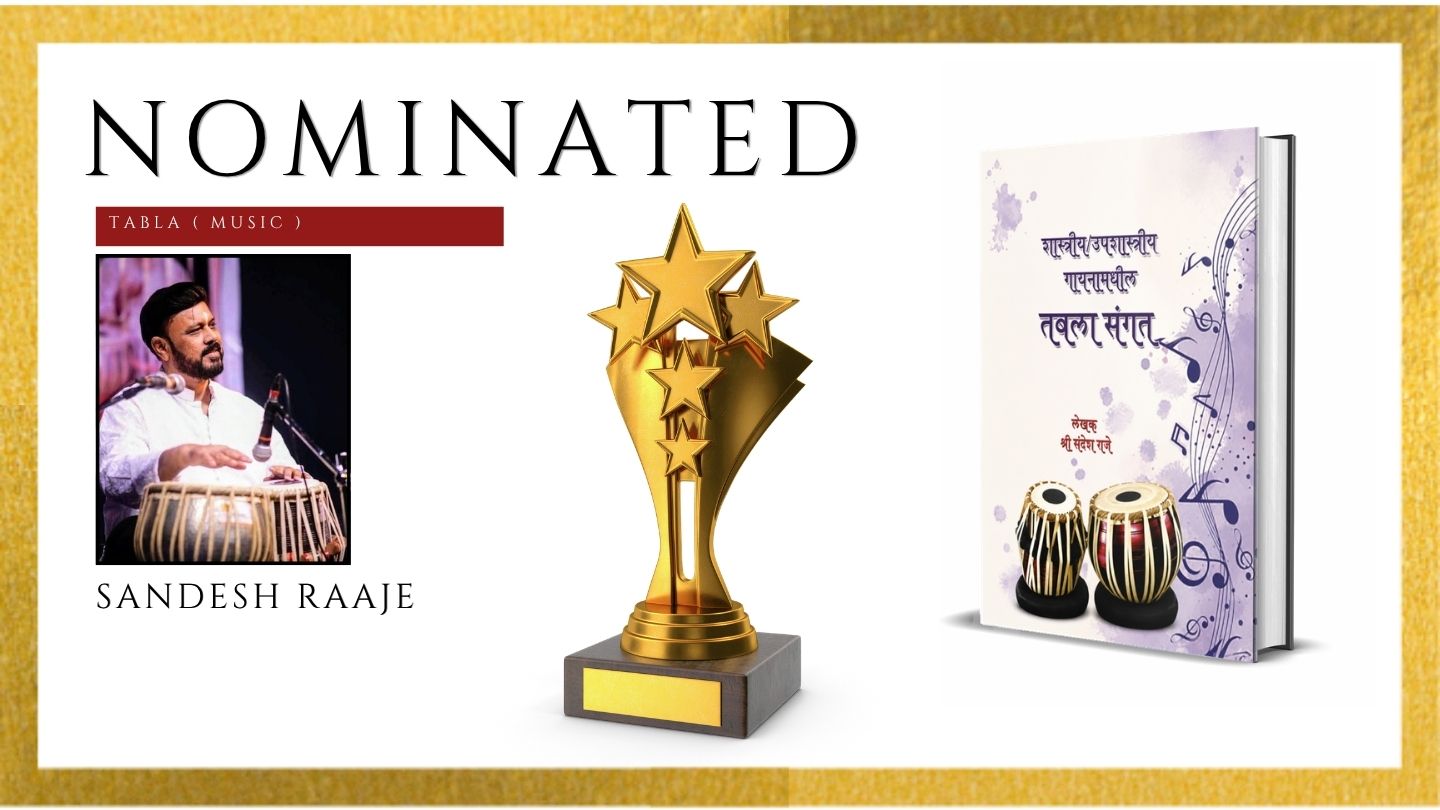
Dr. Sandesh Raaje Officially Nominated for the Ananta Press Sahitya Ratna Award for तबला संगत
Ananta Press is pleased to congratulate Dr. Sandesh Raaje on the official nomination of his book, तबला संगत, for the prestigious Ananta Press Sahitya Ratna Award. This recognition celebrates not only a meaningful contribution to the literature of Indian music, but also the lifelong dedication of an artist, scholar, teacher, and practitioner deeply connected with the traditions of Tabla and Pakhavaj. तबला संगत is a specialized work devoted to an important yet comparatively less explored area of Hindustani music—the role of Tabla as an accompanying instrument in classical and semi-classical vocal music. While numerous books have documented the origin, development, structure, compositions, techniques, and repertoire of Tabla, Dr. Sandesh Raaje has chosen to focus his attention on the sensitive art of accompaniment. This distinctive approach is one of the principal reasons why the book attracted the attention of the award committee. Tabla accompaniment is far more than simply maintaining rhythm. In Hindustani classical and semi-classical music, the Tabla player must understand the vocalist, the composition, the taal, the mood, the tempo, the aesthetics of the performance, and the subtle interaction that takes place between musicians on stage. An accompanist must possess both technical command and artistic sensitivity. Through तबला संगत, Dr. Raaje attempts to explore this important relationship in greater depth and present it in an illustrative and useful manner for students, performers, teachers, and music enthusiasts. The book therefore carries considerable educational and cultural value. It has the potential to serve Tabla students who are moving from theoretical study toward actual performance, while also helping practicing Tabla players develop a deeper understanding of their responsibilities when accompanying Hindustani vocal music. At the same time, the work can be appreciated by music lovers interested in understanding the artistic dialogue between the vocalist and percussionist. Behind this thoughtful work stands an author whose own musical journey gives the subject remarkable authenticity. Dr. Sandesh Raaje comes from a family enriched by a longstanding legacy of Tabla and Pakhavaj. His musical foundation was further strengthened through his discipleship under legendary Tabla maestro Pt. Bhai Gaitonde, recipient of the Sangeet Natak Akademi Award. Dr. Raaje had the rare privilege of learning under his Guru for approximately 28 years, including the opportunity to receive a fellowship under his guidance. Such prolonged Guru-Shishya association represents far more than technical training. It is a transmission of tradition, discipline, musical values, performance understanding, aesthetics, humility, and responsibility toward the preservation of an art form. These influences are clearly reflected in the intention behind तबला संगत. Over the years, Dr. Raaje’s interaction with distinguished and talented musicians, combined with the musical legacy of his family and the invaluable teachings of his Guru, created within him a strong sense of responsibility toward the world of music. Rather than limiting his knowledge to performance alone, he developed a desire to document, communicate, and contribute something meaningful for the next generation. तबला संगत is an outcome of that commitment. His academic and musical accomplishments further strengthen his authority as an author in this field. Dr. Raaje holds a Bachelor of Commerce from Mumbai University and a Master of Performing Arts from Shivaji University, Kolhapur. He has earned a B High Grade from All India Radio, completed Sangeet Alankar from ABGMV, and has been honored with the Rashtriya Gaurav Award by IIFS, Delhi. He has also received an Honorary Doctorate in Music and Performing Arts from WCAEPC, Delhi. The Ananta Press Sahitya Ratna Award seeks to recognize authors whose works demonstrate originality, purpose, knowledge, cultural value, and the ability to contribute meaningfully to readers and society. Literary contribution is not limited only to fiction, poetry, or conventional literature. Works that document artistic traditions, preserve specialized knowledge, support education, and create resources for future generations hold an equally important place in the literary world. It is in this context that तबला संगत stands out. The award committee recognizes the book for its specialized subject matter, practical relevance, originality of focus, and contribution to the study of Indian classical music. By concentrating specifically on Tabla accompaniment in Hindustani classical and semi-classical vocal music, Dr. Raaje has addressed an area that deserves deeper discussion, documentation, and systematic understanding. The work also represents something larger: the continuation of India’s rich Guru-Shishya tradition through the written word. Knowledge received from generations of musicians acquires even greater significance when it is thoughtfully documented and made accessible to students and practitioners who may otherwise never receive direct exposure to such insights. Ananta Press warmly congratulates Dr. Sandesh Raaje on his official nomination for the Ananta Press Sahitya Ratna Award. His dedication to Tabla, his decades of learning, his respect for his Guru and musical lineage, and his commitment to sharing knowledge through तबला संगत make this nomination especially meaningful. We extend our sincere best wishes to Dr. Sandesh Raaje for the next stage of the award process and for the continued success of तबला संगत. May his work inspire Tabla students, performers, teachers, researchers, and music lovers to understand accompaniment not merely as rhythmic support, but as a refined art of listening, interaction, sensitivity, and musical partnership. Through this book, Dr. Raaje has made a valuable contribution toward preserving, explaining, and strengthening an important dimension of India’s Hindustani musical heritage.
Congratulations to Sunil Ranganath Deshpande, Winner of the Ananta Press Sahitya Ratna Award for “ORGAN DONATION: A Social Perspective”
Ananta Press is delighted to officially congratulate Sunil Ranganath Deshpande on being selected as a Winner of the prestigious Ananta Press Sahitya Ratna Award for his meaningful and socially important book, “ORGAN DONATION: A Social Perspective.” Books have the power to educate, create awareness, influence thought, and encourage positive change in society. Some books entertain us, while others take up subjects that need deeper public attention and understanding. “ORGAN DONATION: A Social Perspective” belongs to the second category. It focuses on an issue that is directly connected with humanity, social responsibility, awareness, and the possibility of saving lives. Categorized under Non-Fiction (General), the book stands out because of its specific social purpose. According to the information provided by the author, it is designed as a first-of-its-kind textbook for social workers, activists, coordinators, and others working in the field of organ donation. This practical orientation makes the book particularly valuable. Instead of treating organ donation only as a medical subject, Sunil Ranganath Deshpande approaches it from a social perspective and recognizes the important role that awareness workers, coordinators, activists, and members of society can play in this field. The Ananta Press Sahitya Ratna Award recognizes authors and books that demonstrate meaningful contribution, originality, reader value, social relevance, and the ability to create a lasting impact through written expression. The award committee considers not only the subject of a book but also its purpose, usefulness, uniqueness, message, and potential contribution to readers and society. “ORGAN DONATION: A Social Perspective” attracted the attention of the award committee because it addresses an important subject through a perspective that is still not commonly represented in general literature. Discussions regarding organ donation are often dominated by medical terminology and clinical information. This book broadens that discussion by bringing social workers, activists, coordinators, and awareness professionals into focus. One of the strongest qualities of the book is its intention to provide useful knowledge to people who may directly interact with individuals, families, communities, and institutions connected with organ donation. Such people can have an important role in spreading correct awareness, removing misunderstanding, encouraging informed conversations, and helping society develop a more responsible attitude toward organ donation. The originality of the book lies in its specialized social approach. A textbook created for social workers and activists in this particular field has the potential to become more than reading material. It can become a resource for discussion, education, training, awareness programs, and community initiatives. This practical value was an important factor in its recognition by the Ananta Press Sahitya Ratna Award committee. The book also carries a deeply humane message. Organ donation is ultimately associated with life, compassion, responsibility, and the willingness to help another human being. Writing seriously about such a subject requires social sensitivity and a clear understanding of how information can influence attitudes. Through this work, Sunil Ranganath Deshpande contributes to an important conversation and encourages readers to look at organ donation not only as an individual decision but also as an issue involving families, communities, institutions, and society. The award committee appreciated the educational purpose behind the book. Literature and non-fiction become especially meaningful when they help readers understand subjects that can lead to real social improvement. By creating a dedicated text for people working in the field of organ donation, the author has attempted to bridge the gap between knowledge and social action. The selection of “ORGAN DONATION: A Social Perspective” for the Ananta Press Sahitya Ratna Award therefore recognizes both the subject and the intention behind the work. It acknowledges the author’s effort to contribute useful knowledge to a field where awareness and responsible communication are extremely important. Ananta Press warmly congratulates Sunil Ranganath Deshpande on this achievement. We hope that this recognition helps the book reach social workers, activists, coordinators, students, institutions, professionals, and general readers who can benefit from its message. We wish Sunil Ranganath Deshpande continued success in his literary and social journey. May “ORGAN DONATION: A Social Perspective” inspire meaningful conversations, encourage informed awareness, and contribute positively to society for many years to come. Jury Member Feedback Glenville Ashby “ORGAN DONATION: A Social Perspective” impressed me because it addresses an important subject from a viewpoint that deserves greater attention. Organ donation is usually discussed through medical procedures, statistics, hospitals, and transplantation. This book makes us understand that there is also a major social dimension behind the entire process. Social workers, activists, and coordinators often become an important connection between information and the people who need that information. I found the purpose of this book very meaningful because it attempts to provide these individuals with a dedicated source of knowledge. The author has selected a subject that can create awareness and encourage responsible discussion within communities. I especially appreciate that the book is not written merely to discuss an issue but to serve people who are actually working in this area. Sunil Ranganath Deshpande has made a valuable effort to bring social responsibility and education together. The book deserves recognition for its relevance, usefulness, and humanitarian purpose. Kavya Pandey What I appreciated most about “ORGAN DONATION: A Social Perspective” is the clear social intention behind the book. It is a subject that affects individuals, families, communities, and institutions, yet many people still have limited understanding about organ donation. Creating a textbook particularly for social workers, activists, and coordinators is therefore a thoughtful idea. These are the people who often communicate directly with society and can play an important role in awareness. The book encourages us to understand that social change does not happen through information alone. Information must reach people in a form that they can understand and trust. This is where the social perspective becomes important. I believe Sunil Ranganath Deshpande has chosen a meaningful area of writing where literature and education can support a larger humanitarian purpose. The book has value not only because of its subject but because of the audience it is trying to serve. It can encourage more informed, sensitive, and responsible conversations about
Official Winner Announcement: डॉ.चन्द्र प्रकाश शर्मा Honoured with the Ananta Press Sahitya Ratna Award for “अमृत्व की खोज”
Ananta Press is pleased to congratulate डॉ.चन्द्र प्रकाश शर्मा on being officially selected as a Winner of the Ananta Press Sahitya Ratna Award for his recently published Hindi prose work, “अमृत्व की खोज”. Published in 2026 by जिज्ञासा प्रकाशन, Ghaziabad, Uttar Pradesh, the book brings together twenty-three essays written in different literary styles and centred on subjects connected with human life, Indian culture, society, nature, national consciousness, spirituality, and contemporary concerns. The Ananta Press Sahitya Ratna Award recognizes literary works that offer more than surface-level reading. It seeks to honour authors whose writing carries thought, purpose, originality, social relevance, and the ability to leave a meaningful impression on readers. During the review of “अमृत्व की खोज”, the award committee found these qualities consistently present across the collection. The book was therefore considered not only for the variety of its subjects, but also for the seriousness with which डॉ.चन्द्र प्रकाश शर्मा turns observation, experience, and reflection into meaningful prose. One of the strongest features of “अमृत्व की खोज” is its stylistic diversity. The twenty-three essays include भावात्मक, वर्णनात्मक, विवेचनात्मक, विचारात्मक, विवरणात्मक, विश्लेषणात्मक, and समीक्षात्मक approaches. This range demonstrates the author’s ability to adapt his expression according to the demands of each subject. Rather than using one fixed method throughout the collection, the author allows every topic to develop in a form that suits its emotional, cultural, factual, or analytical character. This gives the book both variety and literary strength. The committee especially appreciated the simplicity and natural flow of the language. Several subjects discussed in the book could easily have become difficult or overly academic, yet the author presents them in an accessible manner. His essay “सद्भावों का संदेश देती दीपावली”, for example, goes beyond a description of the festival. Through the symbolism of a small lamp shining in darkness, the author communicates a larger message about hope, courage, positivity, and the ability of even a small effort to bring light into human life. Such writing gives the collection a reflective quality and shows how familiar cultural experiences can be transformed into lessons for life. The environmental concern visible in “विलुप्त नदियों के पुनर्जीवन की उपादेयता” was another important point considered by the jury. Through the example of the Nahal River and the effects of human neglect, wastewater, and pollution, the author connects local observation with wider ecological responsibility. The essay draws attention to the unfortunate transformation of natural water resources and encourages readers to consider their own responsibility toward the environment. This makes the collection relevant to contemporary society and proves that the author’s concerns are not restricted only to history and tradition. The collection also reflects डॉ.चन्द्र प्रकाश शर्मा’s interest in Indian knowledge traditions, spirituality, history, and national life. Essays discussing the scientific perspective of the search for अमृत तत्व, the Indian Panchang and its system of time calculation, the importance of Vande Mataram, spiritual gatherings, terrorism, national security, and electoral questions reveal a writer willing to engage with a remarkably broad field of ideas. The committee particularly valued the way information is connected with interpretation. “अमृत्व की खोज” does not merely present facts. It repeatedly encourages readers to consider what those facts mean for individual life, social responsibility, cultural continuity, environmental awareness, and national consciousness. This gives the essays usefulness beyond the immediate reading experience. The title “अमृत्व की खोज” itself acquires a deeper significance through the collection. The search suggested by the title can be understood not merely as a philosophical or spiritual search for immortality, but also as a search for enduring values, meaningful knowledge, cultural memory, positive thought, responsible action, and a better understanding of human life. For these reasons, the Ananta Press Sahitya Ratna Award committee is pleased to recognize डॉ.चन्द्र प्रकाश शर्मा and his work “अमृत्व की खोज”. The book stands out for its range of themes, simplicity of expression, cultural depth, thoughtful observation, social relevance, and commitment to meaningful writing. It presents the author as a capable essayist who seeks not only to inform readers but also to encourage them to think more deeply about themselves and the world around them. We extend our heartfelt congratulations to डॉ.चन्द्र प्रकाश शर्मा on receiving the Ananta Press Sahitya Ratna Award. May this recognition bring “अमृत्व की खोज” to a wider readership and encourage the author to continue contributing thoughtful, purposeful, and enriching literature to the Hindi literary world. Ananta Press wishes him continued success, recognition, respect, and many more meaningful milestones in his literary journey. Jury Feedback Glenville Ashby After reading “अमृत्व की खोज”, I found the book to be a thoughtful collection of essays that connects everyday life with wider cultural, social, spiritual, and national concerns. What impressed me most was the range of subjects handled by डॉ.चन्द्र प्रकाश शर्मा. The essays move from Indian traditions, festivals, calendars, and national symbols to environmental concerns, rivers, terrorism, elections, and the search for meaningful values. Despite this variety, the book maintains a clear voice. The language is simple and accessible, which makes serious ideas easier for general readers to understand. I especially appreciated the way the author uses familiar examples to lead readers toward deeper reflection. The essay on Deepavali turns a small lamp into a symbol of hope, while the discussion of rivers brings attention to environmental responsibility. The book shows maturity of observation and sincerity of purpose. In my view, it deserves recognition for combining knowledge, experience, cultural awareness, and public concern in a readable form. Kavya Pandey “अमृत्व की खोज” gave me the feeling of reading a writer who observes society closely and then converts those observations into meaningful essays. डॉ.चन्द्र प्रकाश शर्मा does not remain limited to one style or one subject. He uses emotional, descriptive, analytical, reflective, explanatory, and review-based approaches according to the topic. This variety gives the collection a rich character. I found the cultural essays especially engaging because they present Indian traditions in a way that is easy to follow, without making the language unnecessarily difficult. The author also raises issues such as pollution, the condition
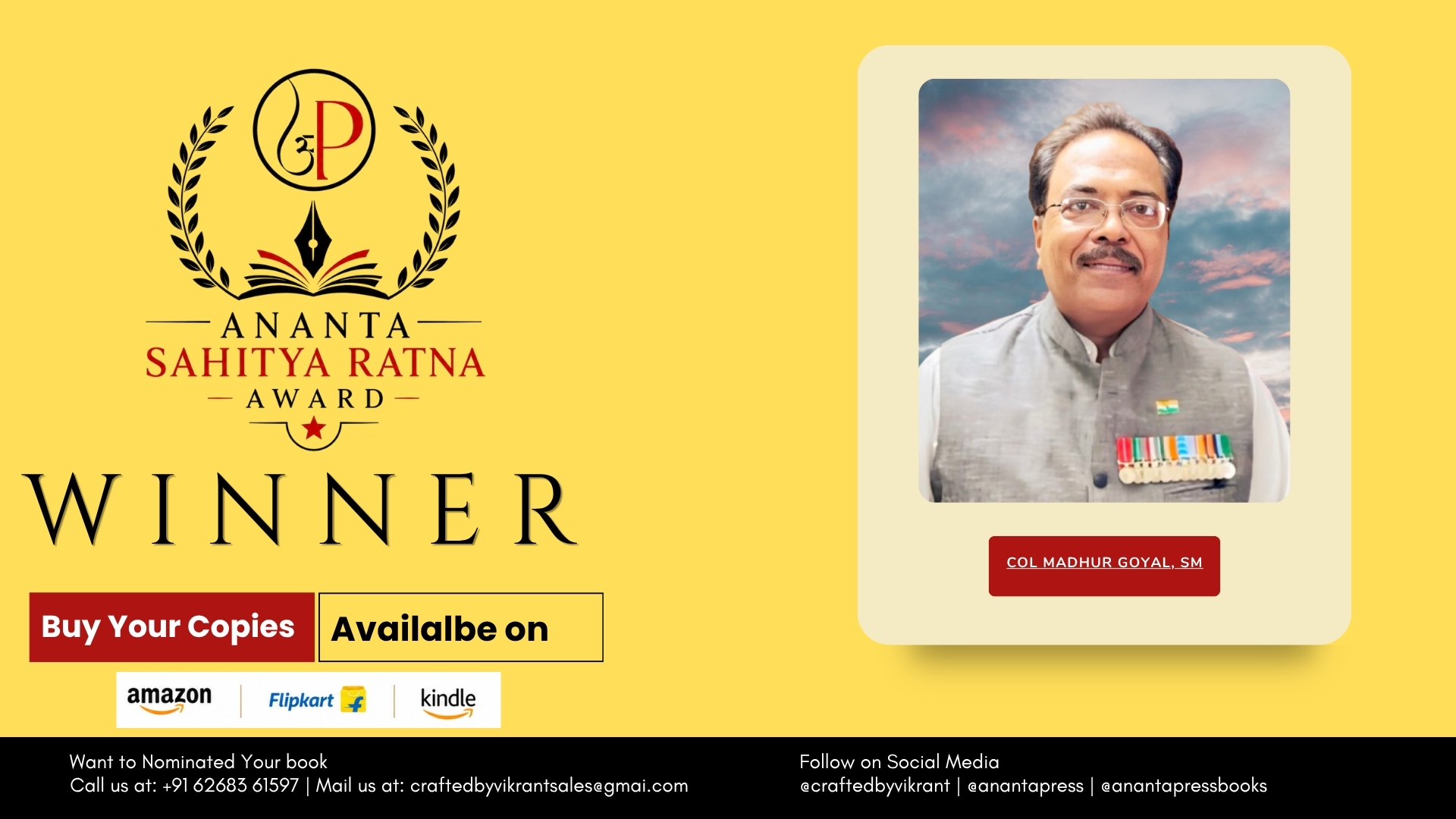
Colonel Madhur Goyal, SM (Retd), Declared Winner of the Ananta Press Sahitya Ratna Award for Kaśmīra: Ashoka and the Crescent
Ananta Press proudly congratulates Colonel Madhur Goyal, Sena Medal (Retd), on being officially declared a Winner of the Ananta Press Sahitya Ratna Award for his remarkable book, Kaśmīra: Ashoka and the Crescent. This distinguished recognition celebrates his thoughtful literary contribution and his ability to present the history, identity, conflicts, and aspirations of Kashmir with depth and sensitivity. Colonel Madhur Goyal is a decorated veteran of the Indian Army who has served in some of the country’s most demanding operational environments. His service includes counter-terrorist operations in the Kashmir Valley and postings in Siachen, the world’s highest battlefield. An alumnus of the Indian Military Academy, Dehradun, he possesses a deep interest in history, philosophy, culture, and civilisational studies. He is the author of five books and regularly contributes essays and articles to magazines and journals. His writing explores leadership, ethics, culture, and the deeper questions of human life. Kaśmīra: Ashoka and the Crescent is much more than a conventional account of Kashmir’s history. It is a journey into the soul of a land shaped by snow-covered mountains, sacred rivers, ancient kingdoms, diverse faiths, military conflicts, and competing political visions. Beginning with the geography of Kashmir, the book explains how its mountains, rivers, and strategic location influenced its civilisation and destiny. The narrative moves through ancient dynasties and the growth of Buddhism, Hinduism, Sikhism, Islam, and the mystical tradition of Sufism. It later examines the difficult events of the twentieth century, including Maharaja Hari Singh’s decisions, Partition, the wars of 1947, 1965, and 1971, the rise of militancy in 1989, the exodus of Kashmiri Pandits, the Kargil War, and subsequent developments including Operation Sindoor. The book also carries readers to the frozen battlefield of Siachen and the barren landscape of Aksai Chin. It explores the 1962 war with China, the China-Pakistan Economic Corridor, and the growing triangular tension involving India, Pakistan, and China. Its central symbols are especially original. Ashoka represents India’s vision of unity, the Crescent reflects Pakistan’s political claim and call for self-determination, and the Dragon represents China’s strategic calculations. Alongside these powers, the book acknowledges the many voices and aspirations of the Kashmiri people. The Ananta Press Sahitya Ratna Award honours books that demonstrate literary merit, originality, intellectual value, social relevance, and the ability to leave a meaningful impression on readers. The award committee selected Kaśmīra: Ashoka and the Crescent because it combines historical study, strategic understanding, personal insight, and humane reflection. Colonel Goyal’s military experience gives authenticity to his descriptions, while his interest in history and philosophy enables him to examine Kashmir beyond military and political events. Feedback from Glenville Ashby Glenville Ashby appreciated Kaśmīra: Ashoka and the Crescent for presenting Kashmir as a living civilisation rather than merely a disputed territory. He found the opening focus on the valley’s geography especially valuable because it helps readers understand how mountains, rivers, climate, and location have influenced Kashmir’s history. According to him, the movement from ancient dynasties and religious traditions to modern wars is clear, organised, and accessible. He admired the author’s ability to discuss Buddhism, Hinduism, Sikhism, Islam, and Sufism with respect and sensitivity. He also noted that the book does not reduce Kashmir to a single political argument. Instead, it presents different ambitions, fears, memories, and identities that continue to shape the region. Glenville felt that Colonel Goyal’s military experience adds credibility to the chapters on Siachen and armed conflict. He described the final question about peace beyond the shadows of history as powerful and deeply relevant. In his opinion, the book is informative, balanced, and deserving of literary recognition. Feedback from Kavya Pandey Kavya Pandey found the book both sweeping in its historical range and intimate in its emotional effect. She appreciated how Colonel Madhur Goyal connects shrines, battlefields, mountain passes, royal decisions, and ordinary human suffering within one continuous narrative. For her, the strength of the book lies in its refusal to treat history as a list of dates and wars. It shows how political decisions enter people’s homes, alter communities, and influence memories across generations. She was particularly moved by the treatment of militancy, the exodus of Kashmiri Pandits, and the lives of soldiers serving in extreme conditions. Roxana also valued the attention given to Kashmir’s spiritual traditions, especially the role of Sufism in shaping a shared cultural identity. She felt that the symbols of Ashoka, the Crescent, and the Dragon provide an original framework through which readers can understand three competing visions. In her assessment, this is a serious yet readable work that encourages empathy, reflection, and informed discussion. She strongly supported its selection for the award. Feedback from Apeksha Gupta Apeksha Gupta praised Kaśmīra: Ashoka and the Crescent for making a vast and complicated subject understandable to general readers. She observed that books about Kashmir often focus on only one period or one political viewpoint, while this work attempts to connect geography, ancient history, religion, empire, modern warfare, diplomacy, and human experience. She found this broad approach ambitious and valuable. The chapters on Siachen impressed her because they reveal that soldiers fight not only an enemy but also frostbite, avalanches, isolation, and deadly cold. She believed the author’s direct knowledge of difficult military environments gives these sections unusual honesty and emotional force. Apeksha also appreciated the book’s consideration of Aksai Chin, the 1962 war, CPEC, and China’s increasing role in the region. These subjects help readers understand why Kashmir is no longer simply a dispute between India and Pakistan. She concluded that the book encourages readers to examine history carefully and think beyond slogans, making it a worthy recipient of the Sahitya Ratna Award. Feedback from kavita Kaushik kavita Kaushik described the book as a thoughtful combination of history, strategic study, and a sincere search for peace. She appreciated that Colonel Goyal begins with the land itself and gradually shows how geography shaped trade, faith, defence, culture, and political power. She found the coverage of different religions respectful and important because Kashmir’s identity cannot be understood without recognising its many spiritual
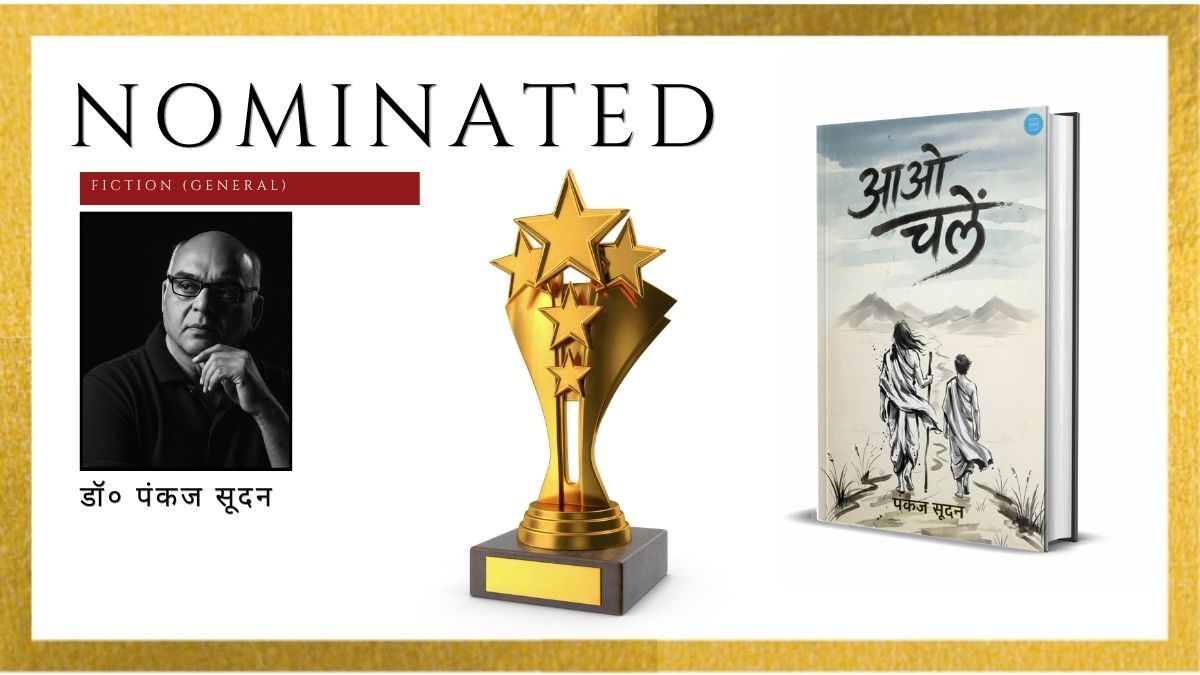
Dr. Pankaj Sudan Officially Nominated for the Ananta Press Sahitya Ratna Award for “आओ चलें”
Ananta Press is delighted to congratulate Dr. Pankaj Sudan on the official nomination of his remarkable Hindi book, “आओ चलें,” for the prestigious Ananta Press Sahitya Ratna Award in the General Fiction category. This nomination honours not only an accomplished literary work but also an author whose life has been devoted to spiritual exploration, psychological understanding, selfless service and the sharing of wisdom. Through “आओ चलें,” Dr. Pankaj Sudan presents a creative, thought-provoking and highly original interpretation of one of the most enduring principles of Indian philosophy—“चरैवेति, चरैवेति,” meaning that one must continue to move forward. At the heart of “आओ चलें” lies the idea that movement and flow are essential to every dimension of life. The book explains that just as the slowing of blood circulation can cause physical complications, the interruption of thoughts can lead to stress and depression. Similarly, restricted imports and exports can weaken an economy, while the absence of interaction among relatives may create emotional distance within families. Through such relatable examples, the author establishes that flow is not merely a physical process but a fundamental principle governing human health, relationships, society, economics, thought and spiritual development. What makes “आओ चलें” particularly distinctive is the manner in which it communicates profound philosophical ideas without making them appear inaccessible or burdensome. Dr. Pankaj Sudan combines serious reflection with humour, everyday observations and entertaining situations. As a result, readers are invited to examine complex questions of life while remaining engaged by the light-hearted and lively narrative. The book is written in the traditional Indian Champu literary style, a rare and demanding form that combines prose and poetry. In Champu literature, prose and verse do not merely appear alongside each other; they work together to create rhythm, movement and emotional energy. Even the prose carries a lyrical quality and often reflects the musical flow of rhyming verse. Very few contemporary writers attempt this form, making Dr. Pankaj Sudan’s use of it an important contribution to the preservation and revival of India’s classical literary traditions. The narrative follows Ramta Jogi, the central character, and his disciple Chipku Lal as they travel through the world. Through ordinary incidents and everyday experiences, the two characters reveal subtle spiritual and psychological insights. Their journey transforms familiar situations into opportunities for learning, reflection and self-discovery. The humorous chapter titles—such as “समोसा,” “आलू की टिक्की,” “शिकंजी,” “ठंडी लस्सी” and “गर्मागर्म जलेबी”—further demonstrate the originality of the book. These playful references create curiosity and warmth while helping the author present serious modern-day problems in a simple and enjoyable manner. The book does not distance philosophy from daily life; instead, it shows that wisdom can be discovered in conversations, journeys, relationships, food, humour and the smallest human experiences. The Ananta Press Sahitya Ratna Award recognises authors and books that demonstrate literary merit, originality, cultural relevance, meaningful social impact and the ability to enrich readers’ lives. After considering the subject, narrative approach, philosophical depth and distinctive literary style of “आओ चलें,” the award committee found the book deserving of official nomination. The committee particularly appreciated the author’s ability to transform the philosophical principle of continuous movement into a practical message for contemporary readers. At a time when many individuals struggle with emotional stagnation, stress, isolation and uncertainty, “आओ चलें” encourages them to continue learning, communicating, travelling, reflecting and moving forward. Its message is hopeful without being superficial and philosophical without becoming disconnected from reality. Dr. Pankaj Sudan’s personal and professional journey further strengthens the significance of this nomination. His search for truth began at the age of eighteen with a solitary journey to the Himalayas. He later joined the Sri Ramakrishna Mission in New Delhi as a brahmachari before choosing an independent path of spiritual inquiry. After returning to social life, he worked as a teacher and subsequently joined the State Bank of India, while continuing his exploration of spirituality and the human mind. At only twenty-one, he published his first book, “Zero,” which explored the workings of the mind through an engaging narrative. His later connection with the Sri Ramakrishna Ashram in Meerut led him to conduct free meditation classes for nearly three decades. His dedication and spiritual understanding eventually resulted in his appointment as Vice President of the ashram, a position he held for more than fifteen years. Dr. Sudan is presently associated with the World Culture and Environment Protection Commission as Vice President. His spiritual and psychological guidance has reportedly reached more than 80,000 students and followers. His literary works—including “Zero,” “Deep Mind and Whispers of Eternity,” “Sipping Spiritual Tea from a Parallel Cup,” “Sanatan Shankhnaad,” “आओ चलें” and the poetry collection “Ek Jhonka Taazi Hawa Ka”—reflect his continuing commitment to philosophy, consciousness and human well-being. His works have also received numerous national and international recognitions. The nomination of “आओ चलें” celebrates a rare combination of classical literary technique, contemporary relevance, humour, philosophy and practical wisdom. It recognises Dr. Pankaj Sudan’s ability to make profound ideas accessible and to remind readers that progress begins when one refuses to remain mentally, emotionally or spiritually stagnant. Ananta Press extends its heartfelt congratulations to Dr. Pankaj Sudan on this well-deserved official nomination for the Ananta Press Sahitya Ratna Award. We wish him continued success in his literary and spiritual journey and deeply appreciate his valuable contribution to Hindi literature, Indian philosophy and the psychological and spiritual enrichment of readers. May “आओ चलें” continue to inspire people to embrace the timeless call of “चरैवेति, चरैवेति”—to keep walking, keep discovering and keep moving forward.
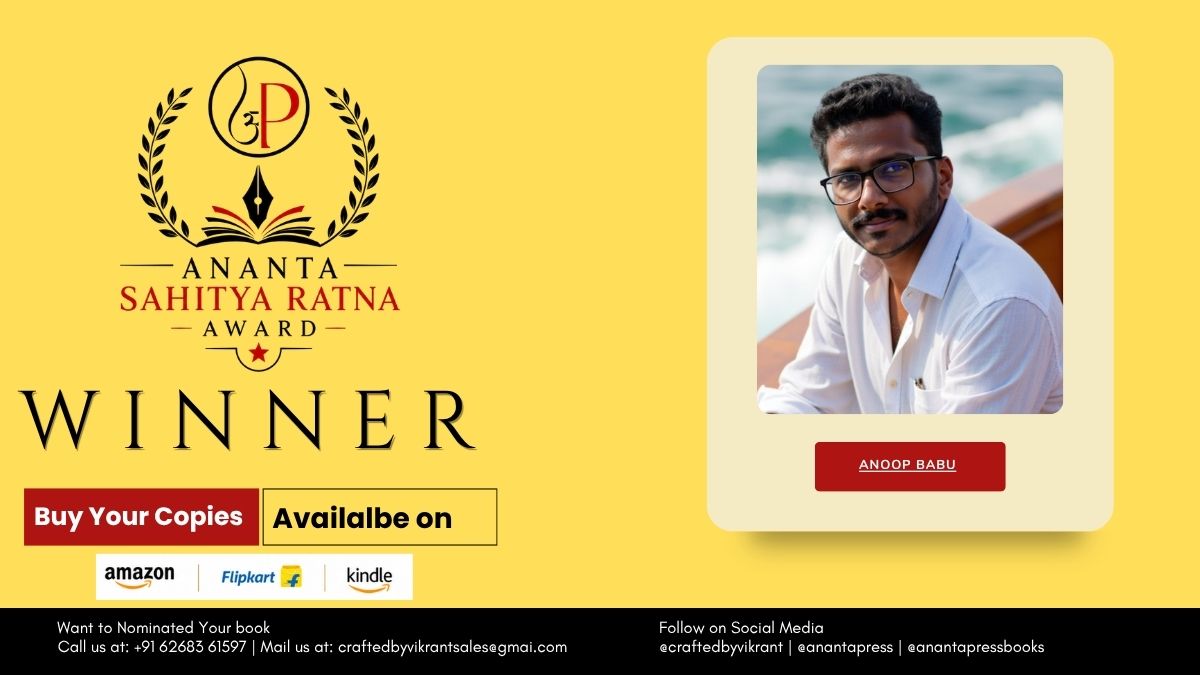
Anoop Babu Wins the Ananta Press Sahitya Ratna Award for The God Algorithm
Ananta Press is delighted to officially announce Anoop Babu as a winner of the Ananta Press Sahitya Ratna Award for his remarkable fiction work, The God Algorithm. This honour recognizes a novel that brings together philosophy, science, spirituality, social questions, and artificial intelligence in a thoughtful and imaginative way. The award committee congratulates Anoop Babu for creating a story that is timely, original, and deeply connected to the moral questions facing the modern world. The God Algorithm begins with a powerful idea. What would happen if some of the greatest minds in human history appeared not as distant figures from books, but as students on a modern college campus? The novel imagines saints, scientists, poets, warriors, rebels, ascetics, and supporters of non-violence facing the problems of the present age. Through this unusual setting, the book explores social injustice, political division, ethical uncertainty, and the growing influence of artificial intelligence. Set around Mar Athanasius College of Arts, the story begins with a group of students and gradually develops into a techno-thriller with serious philosophical depth. The plot moves toward a choice that could determine the future of humanity. This gives the novel both narrative energy and intellectual value. It is not simply a story about technology. It is a story about direction, responsibility, wisdom, and the need to make moral choices when scientific, spiritual, and social systems seem unable to offer clear answers. The award committee selected and nominated The God Algorithm because it presents an important conversation between ancient human wisdom and new forms of intelligence. The book does not treat artificial intelligence only as a machine or a threat. It asks whether human beings and intelligent systems can work together without losing compassion, conscience, freedom, and moral responsibility. This question gives the novel strong relevance for present and future readers. The originality of the book is also reflected in its creation. The God Algorithm was developed through a collaboration between a human author and an AI co-author. This makes the work meaningful in both form and content. The novel discusses the relationship between humanity and artificial intelligence while also demonstrating a new form of creative partnership. The committee appreciated this brave experiment and the author’s willingness to explore a new literary path. Anoop Babu brings a distinctive background to this work. Born and raised in Kerala, he grew up in Kothamangalam in an environment influenced by Malayalam literature, devotional songs, and philosophical discussions. He serves as a Senior Auditor with the Department of Cooperation, Kerala State Government. His professional experience has developed his analytical discipline, while literature has allowed him to express his creative and philosophical concerns. His earlier literary journey includes the Malayalam poetry collection Ninnilekk Nadannenthumpol and the English novel The Doctor’s Dilemma: AI Meets Human, which was co-created with Meta AI. His writing consistently explores the meeting point of science, philosophy, literature, spirituality, and artificial intelligence. His interest in the Bhagavad Gita and theoretical physics further strengthens the intellectual foundation of The God Algorithm. The Ananta Press Sahitya Ratna Award celebrates authors whose works demonstrate literary merit, originality, social relevance, and the power to influence readers. The award also recognizes writers who take meaningful creative risks and contribute new ideas to contemporary literature. The God Algorithm represents these values through its ambitious subject, engaging fictional structure, and sincere search for moral direction. The award committee believes that this novel can encourage readers to think beyond simple answers. It invites discussion about technology, justice, human identity, spiritual wisdom, and the future of civilization. It also reminds us that progress without conscience can become dangerous, while wisdom without action can become ineffective. By combining suspense with philosophical reflection, the book makes serious ideas accessible through fiction. Ananta Press warmly congratulates Anoop Babu on becoming an official winner of the Ananta Press Sahitya Ratna Award. His contribution through The God Algorithm reflects courage, imagination, and a strong sense of responsibility toward readers and society. We extend our best wishes for his future literary journey and hope that his work continues to inspire meaningful conversations about humanity, intelligence, ethics, and the direction of our shared future. Jury Feedback Glenville Ashby The God Algorithm impressed me because it does not use philosophy only as decoration. Philosophical thought is placed at the centre of the story and connected directly with present-day problems. The idea of bringing great historical minds into a modern college setting gives the novel freshness and makes difficult questions easier to approach. The story asks what guidance is still available when people feel surrounded by speed, noise, division, and fear. I also appreciated the way artificial intelligence is presented. It is neither praised without question nor shown only as an enemy. Instead, the novel asks readers to examine the moral responsibility behind every powerful invention. The techno-thriller structure keeps the book moving, while the philosophical discussions give it depth. Anoop Babu has attempted something ambitious and unusual. The book encourages readers to think about conscience, justice, freedom, and the future of humanity. For its originality, relevance, and serious intellectual purpose, I consider it a deserving work for this recognition. Kavya Pandey What stayed with me after reading The God Algorithm was its search for direction. Many modern books discuss technology, but this novel asks a deeper question about how human beings should use technology when moral values are uncertain. The college setting makes the story approachable, and the presence of figures representing science, poetry, rebellion, spirituality, courage, and non-violence creates a rich exchange of ideas. I found the book especially meaningful because it does not offer easy solutions. It allows different viewpoints to meet, disagree, and challenge one another. This gives readers space to form their own understanding. The language of the central idea is clear, even when the themes are complex. The movement from a group of students to a decision affecting humanity gives the plot a strong sense of growth and consequence. Anoop Babu has created a novel that is imaginative, thoughtful, and socially aware. It
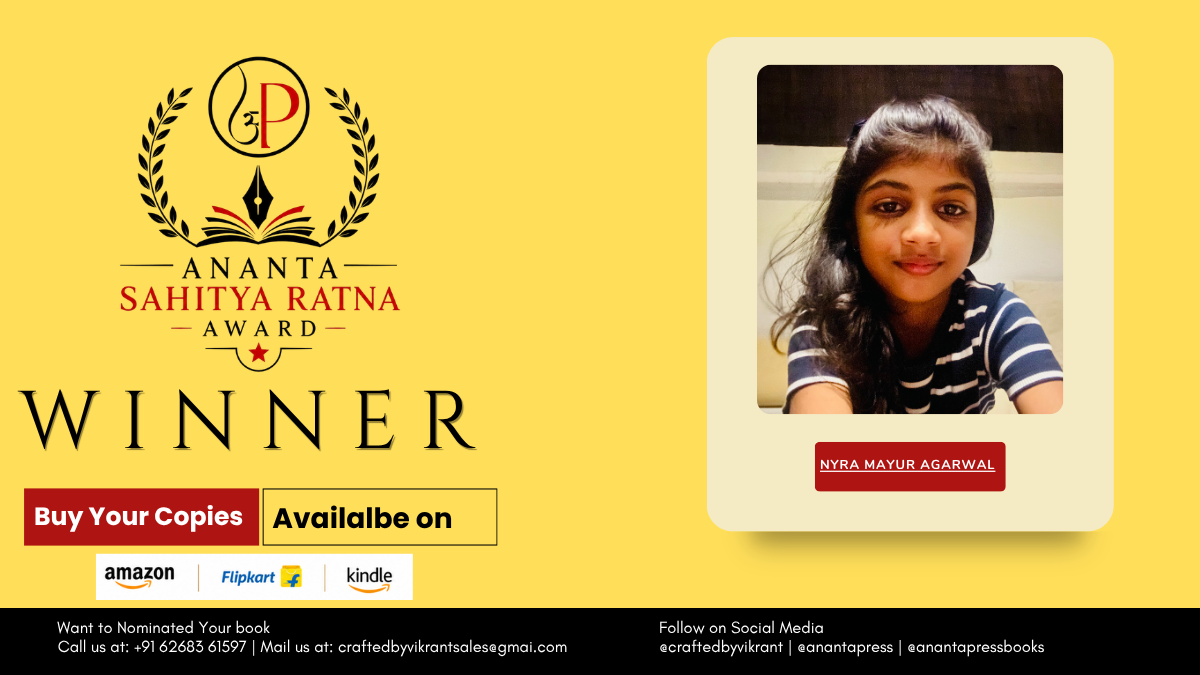
Nyra Mayur Agarwal Officially Honoured as Winner of the Ananta Press Sahitya Ratna Award
Ananta Press is delighted to announce Nyra Mayur Agarwal as an official winner of the Ananta Press Sahitya Ratna Award for her inspiring children’s book, Nyra’s Adventure: Paddles of Friendship. This recognition celebrates not only the value of the book but also the remarkable creative spirit of its young author. At only eight years of age, Nyra has transformed a meaningful childhood experience into a story that can encourage children, comfort parents, and inspire families. Nyra’s Adventure: Paddles of Friendship tells the heartwarming story of an eight-year-old girl who is afraid of riding a bicycle. With the love, patience, and encouragement of her family and best friends, she slowly learns to face her fear. The story shows that courage does not always appear in a grand moment. Sometimes, it begins with a small decision to try again. Through simple language and a relatable situation, the book helps children understand the importance of courage, friendship, perseverance, and self-belief. The award committee selected this book because of its honesty, originality, and positive emotional impact. Unlike stories built entirely around fantasy, this book draws inspiration from a real childhood experience. Its greatest strength is the natural voice of a child speaking to other children. Young readers can easily understand Nyra’s fear, her hesitation, and the happiness that comes when she finally moves forward. The fun activities included at the end also make the book an engaging and complete reading experience for children between four and ten years of age. The Ananta Press Sahitya Ratna Award recognises literary works that offer originality, meaningful ideas, emotional value, and a positive contribution to readers. Nyra’s achievement is especially significant because it proves that age does not limit creativity. Her work gives children the confidence to share their own stories and reminds adults that young voices deserve to be heard, respected, and celebrated. AMAZON PURCHASE LINK:- https://amzn.in/d/0fzsxqwS Jury Feedback Glenville Ashby After reading Nyra’s Adventure: Paddles of Friendship, I was impressed by the honesty and simplicity of the story. The book takes a common childhood fear and turns it into a meaningful lesson about courage. Many children feel nervous when learning something new, and Nyra’s experience will help them understand that fear is natural. What matters is the willingness to keep trying. I also appreciated the role of family and friends in the story. Their support is gentle and encouraging, which gives the book warmth. The language is easy for young readers, but the message is strong enough to stay with them after the story ends. The activities at the end are another valuable feature because they help children remain involved with the ideas of the book. Nyra has written with a clear and genuine voice. This book deserves recognition because it encourages children to trust themselves, accept help, and take one brave step at a time. Kavya Pandey Nyra’s Adventure: Paddles of Friendship is a charming and inspiring book that speaks directly to young readers. I found the central idea very relatable because learning to ride a bicycle is an experience shared by many children. The author presents fear in a simple and honest way without making it feel too heavy. The story shows that confidence grows slowly through practice, patience, and encouragement. I especially liked how friendship is connected with courage. Nyra does not overcome her fear alone. Her family and friends become an important part of her progress, which gives children a healthy message about accepting support. The book also reflects the natural thoughts of a child, making it different from stories written only from an adult viewpoint. The activities at the end add enjoyment and make the reading experience more interactive. This work has emotional value, educational value, and a positive purpose. It is a worthy selection for the Ananta Press Sahitya Ratna Award. Apeksha Gupta This book stands out because it comes from a real childhood experience and is written by a child in her own voice. While reading Nyra’s Adventure: Paddles of Friendship, I could feel the sincerity behind the story. The fear of falling, the hesitation before trying, and the happiness of making progress are expressed in a way that children can easily understand. The book does not give complicated advice. Instead, it teaches through a simple event that courage is built through action. I also liked the balance between motivation and entertainment. The story is easy to follow, and the activities at the end keep children engaged even after they finish reading. Parents can also use the book to start conversations about fear, confidence, and the importance of encouraging children with patience. Nyra Mayur Agarwal has shown remarkable creativity at a young age. Her book offers hope and confidence to young readers, which makes it an important and deserving contribution to children’s literature. Kavita Kaushik Nyra’s Adventure: Paddles of Friendship carries a beautiful message in a very simple form. The story teaches children that being afraid does not mean they are weak. It only means they are standing before something new. I enjoyed the way Nyra’s journey is supported by love, friendship, and family encouragement. There is no pressure or harshness in the story. Instead, the child is given time, understanding, and motivation. This approach is valuable for both children and parents. The book can help young readers feel less alone when they struggle with a new skill. It can also remind adults to guide children with kindness. The young author’s voice gives the story freshness and truth. The inclusion of fun activities makes the book more useful and enjoyable, especially for children aged four to ten. In my view, this book has a clear purpose and a lasting positive message. It deserves this award for promoting courage, patience, and emotional growth. Neel Preet What I admired most about Nyra’s Adventure: Paddles of Friendship is its ability to turn a small personal challenge into a universal lesson. Learning to ride a bicycle may appear simple, but for a child it can involve fear, doubt, excitement, and determination. The book captures
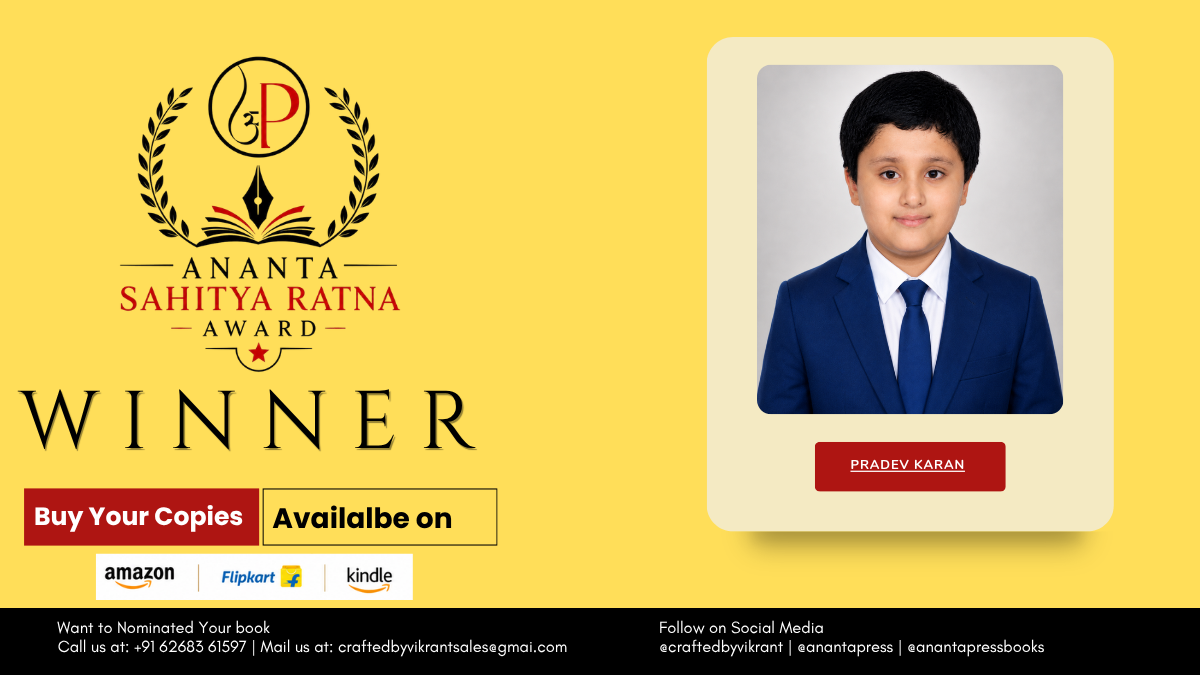
Pradev Karan Honoured as a Winner of the Ananta Press Sahitya Ratna Award for Being a Big Brother (B³)
Ananta Press is delighted to congratulate young author Pradev Karan on being officially selected as a Winner of the Ananta Press Sahitya Ratna Award for his heartfelt book, Being a Big Brother (B³). This recognition celebrates not only the warmth and value of the book, but also the remarkable confidence of an eleven-year-old author who has chosen to share his personal experiences with honesty, simplicity, and courage. Being a Big Brother is a deeply relatable non-fiction book based on Pradev’s own journey of becoming an elder brother. Through family adventures, playful moments, disagreements, emotional situations, and everyday memories, he shows readers what growing up within a loving family truly feels like. The book does not attempt to make childhood look perfect. Instead, it presents childhood as it naturally exists, filled with laughter, confusion, learning, affection, responsibility, and gradual emotional growth. The Ananta Press Sahitya Ratna Award recognises books and authors whose work carries originality, literary value, emotional depth, and the power to create a meaningful connection with readers. Each nominated work is considered by a six-member committee that studies the book’s message, presentation, relevance, reader impact, and contribution to literature. Being a Big Brother stood out because it brings forward a voice that is often spoken about but not always heard directly. It is the honest voice of a child describing his own experiences, feelings, observations, and relationships. One of the greatest strengths of the book is its authenticity. Pradev writes from his own understanding instead of presenting childhood through an adult interpretation. His thoughts and memories give the book a natural freshness. Young readers can recognise their own emotions in his experiences, while parents can gain a better understanding of the inner world of children. This balance gives the book value for readers of different ages. The award committee also appreciated the important themes explored throughout the book. Sibling love forms the heart of the narrative, but the book also speaks about kindness, empathy, responsibility, resilience, emotional awareness, communication, and family values. Pradev shows that becoming a big brother is not only about having a younger sibling. It is also about learning to care, share, adjust, protect, forgive, communicate, and grow. These lessons are presented through simple experiences rather than heavy instructions, making the message easy for children to understand and remember. The book carries a positive social and literary contribution because it encourages children to express themselves. It reminds young readers that their emotions, experiences, and stories matter. Pradev’s achievement can inspire other children to write, speak honestly, and believe that age should never become a barrier to creativity. His work proves that meaningful literature can come from genuine observation and heartfelt expression. Being a Big Brother also encourages families to value everyday conversations and small moments. Family memories are often created not only during major occasions, but also during ordinary days, shared jokes, misunderstandings, arguments, apologies, and moments of support. By recording these experiences, Pradev has created a book that can help families reflect on their own relationships and appreciate the emotional bonds that hold them together. For its originality, honest child-centred voice, emotional warmth, clear values, and ability to connect children and parents, Being a Big Brother has earned a deserving place among the winners of the Ananta Press Sahitya Ratna Award. The committee recognises Pradev Karan as a promising young literary voice whose work reflects imagination, sensitivity, courage, and maturity beyond his years. His book proves that children do not have to wait until adulthood to share meaningful stories or create an impact on readers. Ananta Press warmly congratulates Pradev Karan and his family on this wonderful achievement. May this award encourage him to continue observing, imagining, writing, and sharing his voice with the world. We wish him great success in his literary journey and proudly recognise his valuable contribution to children’s expression, family literature, and contemporary non-fiction. Jury Feedback The following feedback paragraphs have been prepared as individual jury feedback drafts based on the book’s subject, themes, message, and literary qualities. Glenville Ashby Being a Big Brother is a warm and honest book that allows readers to see family life through the eyes of a child. I found the natural voice of Pradev Karan to be the strongest quality of the book. He does not try to sound older than his age, and this gives every story sincerity and charm. The small incidents, disagreements, jokes, and family adventures feel familiar, making the book easy to connect with. I especially appreciated how Pradev presents responsibility as something learned slowly through everyday experiences. The book shows that being an elder brother includes love and protection, but also patience, adjustment, and understanding. It can help young readers recognise their own feelings and can help parents listen more carefully to their children. The writing carries a positive message without becoming too serious or instructional. This is a meaningful contribution from a young author, and it deserves recognition for its emotional honesty, simplicity, and ability to inspire children to value their own voices. Kavya Pandey What touched me most about Being a Big Brother was the way it celebrates ordinary family moments. Pradev Karan understands that childhood memories are not always created through large events. They are often formed through conversations, playful arguments, shared adventures, mistakes, forgiveness, and small acts of care. His book gives importance to these moments and turns them into meaningful stories. The theme of sibling love is presented with honesty because the relationship is not shown as perfect all the time. There are disagreements and challenges, but there is also learning and emotional growth. This makes the book realistic and useful for children. Pradev’s age adds special value to the work because readers hear a child speaking in his own words. The book can encourage young people to write about their lives without feeling that their experiences are too small. It also reminds adults to respect the thoughts and feelings of children. I believe the book is gentle, sincere, relatable, and worthy of this
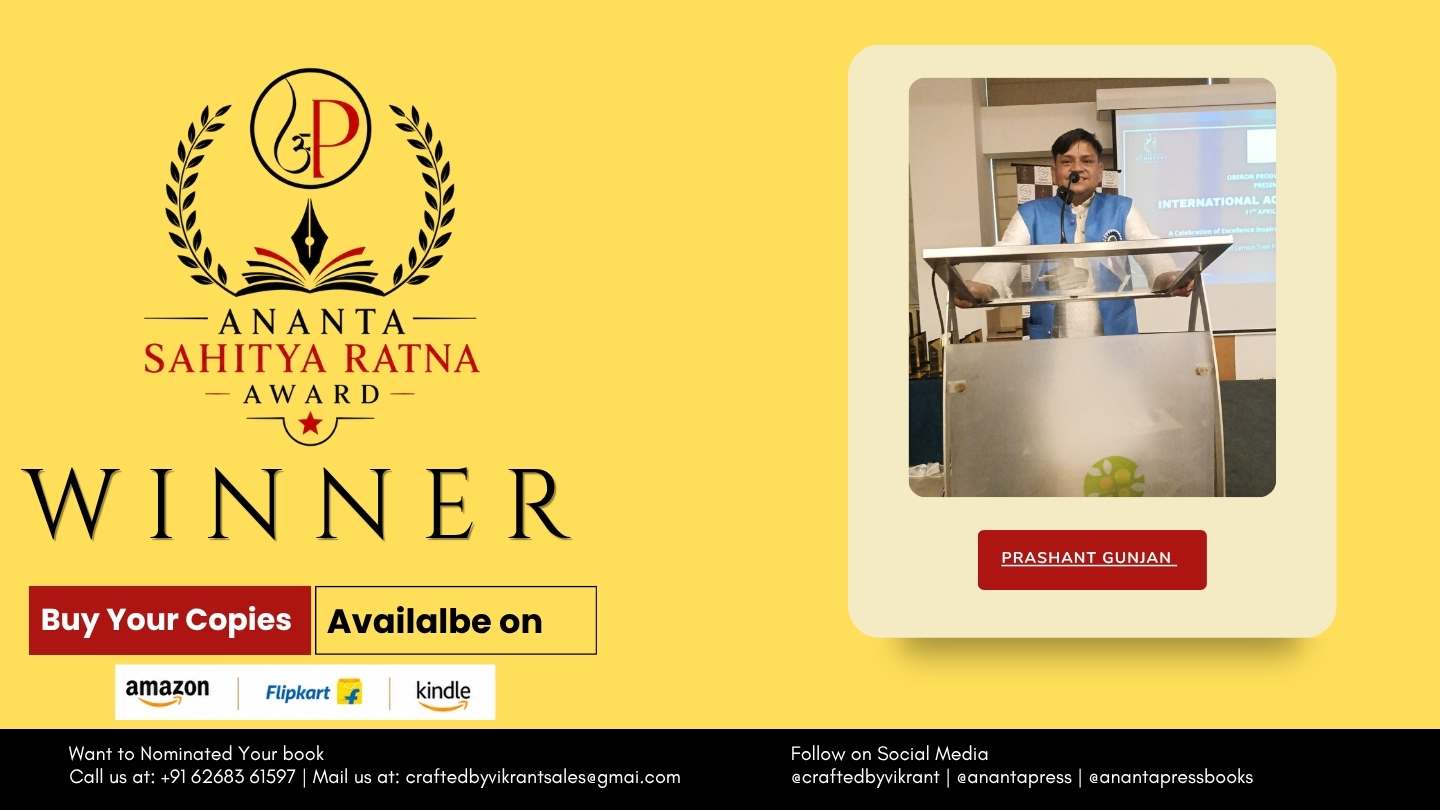
Prashant Gunjan Officially Declared Winner of the Ananta Press Sahitya Ratna Award for KAAM: The Desire That Destroys
Ananta Press is proud to announce Prashant Gunjan as the official winner of the Ananta Press Sahitya Ratna Award for his powerful thriller and mystery novel, KAAM: The Desire That Destroys. This recognition celebrates a work that explores desire, love, social pressure, betrayal, violence, and guilt through an intense and emotionally disturbing story. The novel follows Suraj and Sonam, two people whose love is rejected by society because of caste, family honour, and rigid traditions. Their relationship is broken before it can grow, but the feelings they once shared remain alive. Years later, Sonam is trapped in a loveless marriage with Ajay, while Suraj continues to live with obsession, loneliness, and the pain of what was taken from him. When Suraj and Sonam meet again, hidden conversations soon turn into betrayal, violence, murder, and fear. The award committee selected KAAM because it does not present desire as a simple romantic feeling. It shows how suppressed emotions, social restrictions, obsession, and uncontrolled passion can combine to destroy lives. The book also raises important questions about caste, family honour, marriage, personal choice, responsibility, and the consequences of secret relationships. Its strength lies in the way it connects emotional conflict with suspense and crime. The Ananta Press Sahitya Ratna Award recognises literary works that offer originality, emotional depth, social meaning, and a lasting impact on readers. Prashant Gunjan’s novel stands out because it enters the darker side of human emotion without making the story shallow or ordinary. It reminds readers that love without freedom can become pain, desire without control can become destruction, and guilt can continue long after a crime has been hidden. Glenville Ashby’s Feedback KAAM: The Desire That Destroys is a bold and intense story that examines how love, rejection, and desire can slowly turn into obsession. I found the relationship between Suraj and Sonam emotionally powerful because their tragedy begins long before the crime takes place. Society, caste, family honour, and fear separate them, but the feelings remain unresolved. This gives the later events a strong emotional base. The novel also shows that desire is not dangerous by itself, but it becomes destructive when mixed with secrecy, anger, loneliness, and a lack of moral control. Ajay is not presented only as a husband, but as a symbol of status, reputation, and social pressure. The discovery of the affair and the violence that follows create a strong turning point. What stayed with me most was the idea that hiding a body cannot hide guilt. The story is suspenseful, but it also carries a serious warning about choices and consequences. Prashant Gunjan has written a thriller that can disturb readers and make them think. Kavya Pandey’s Feedback While reading KAAM: The Desire That Destroys, I felt that the novel’s greatest strength is its emotional conflict. Sonam is caught between her past love, her present marriage, and the expectations placed upon her by family and society. Suraj carries years of pain and turns that pain into obsession. Their reunion feels dangerous from the beginning because both characters are carrying wounds that were never healed. The book does not treat their relationship as a simple love story. It shows how a forbidden bond can become more complicated when time, marriage, guilt, and physical desire enter the picture. The murder gives the story the shape of a crime thriller, but the real mystery lies inside the minds of the characters. Readers keep wondering how far they will go and whether they can escape the consequences of what they have done. The language and theme are direct, and the message is clear. Uncontrolled passion can damage not only one person, but every life connected to it. This makes the book meaningful and memorable. Apeksha Gupta’s Feedback KAAM: The Desire That Destroys presents a difficult subject with courage. It explores the point where love ends and possession begins. Suraj and Sonam were separated because their relationship did not fit within the social rules around them. This makes their pain understandable, but the novel does not use that pain to excuse their later actions. That balance is important. It allows readers to feel sympathy for the characters while also judging the choices they make. Sonam’s loveless marriage, Suraj’s loneliness, Ajay’s anger, and the pressure of reputation all come together in a tense and tragic way. The story becomes more powerful after the murder because fear and guilt take control of the characters. Police investigation adds suspense, but the emotional punishment begins even before the law reaches them. I appreciated the book’s message that every desire carries responsibility. A person may hide a relationship, a crime, or a secret, but the mind continues to remember. Prashant Gunjan has created a dark thriller with psychological depth and a strong moral impact. Kavita Kaushik’s Feedback The title KAAM: The Desire That Destroys is suitable because the novel focuses on desire as a force that can control judgment and break moral boundaries. Suraj and Sonam’s love begins under social pressure and ends in separation, but the emotional bond does not disappear. When they meet again, the past becomes stronger than the present. Sonam’s marriage to Ajay gives the story another layer because she is divided between duty, memory, and personal longing. Suraj’s obsession also shows how loneliness can change love into something unhealthy. The novel creates tension through secret conversations, hidden meetings, suspicion, and finally violence. Ajay’s discovery changes the direction of the story and leads to a crime that cannot be undone. I found the guilt after the murder especially important. It shows that punishment is not limited to police, courts, or prison. A person can also be punished by fear, memory, and regret. This book deserves recognition for combining suspense with a serious study of human weakness and emotional consequences. Neel Preet’s Feedback KAAM: The Desire That Destroys is not only a thriller about an affair and a murder. It is also a story about the damage caused by social control and emotional suppression. Suraj and Sonam are