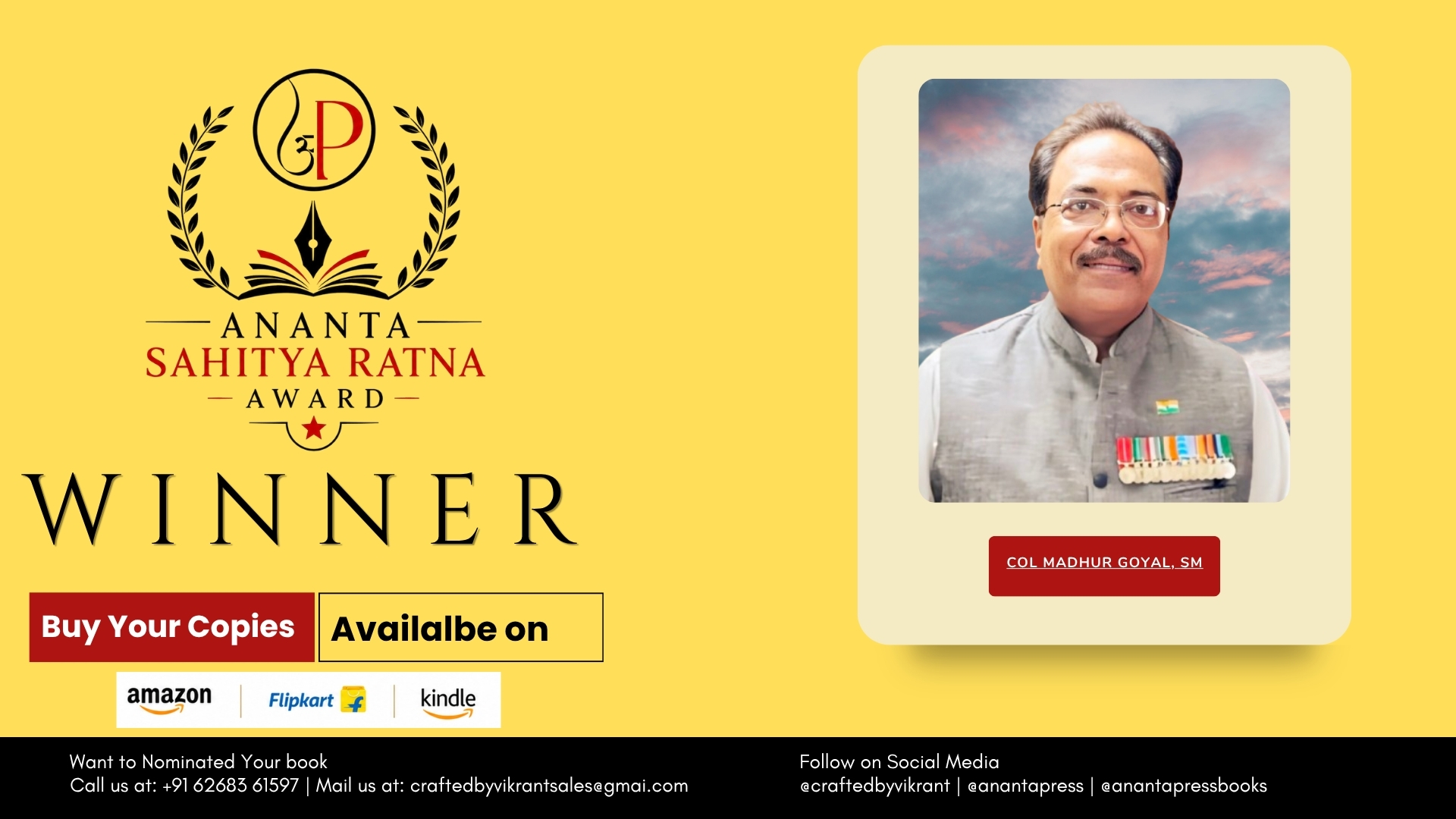
Ananta Press proudly congratulates Colonel Madhur Goyal, Sena Medal (Retd), on being officially declared a Winner of the Ananta Press Sahitya Ratna Award for his remarkable book, Kaśmīra: Ashoka and the Crescent. This distinguished recognition celebrates his thoughtful literary contribution and his ability to present the history, identity, conflicts, and aspirations of Kashmir with depth and sensitivity.
Colonel Madhur Goyal is a decorated veteran of the Indian Army who has served in some of the country’s most demanding operational environments. His service includes counter-terrorist operations in the Kashmir Valley and postings in Siachen, the world’s highest battlefield. An alumnus of the Indian Military Academy, Dehradun, he possesses a deep interest in history, philosophy, culture, and civilisational studies. He is the author of five books and regularly contributes essays and articles to magazines and journals. His writing explores leadership, ethics, culture, and the deeper questions of human life.
Kaśmīra: Ashoka and the Crescent is much more than a conventional account of Kashmir’s history. It is a journey into the soul of a land shaped by snow-covered mountains, sacred rivers, ancient kingdoms, diverse faiths, military conflicts, and competing political visions. Beginning with the geography of Kashmir, the book explains how its mountains, rivers, and strategic location influenced its civilisation and destiny.
The narrative moves through ancient dynasties and the growth of Buddhism, Hinduism, Sikhism, Islam, and the mystical tradition of Sufism. It later examines the difficult events of the twentieth century, including Maharaja Hari Singh’s decisions, Partition, the wars of 1947, 1965, and 1971, the rise of militancy in 1989, the exodus of Kashmiri Pandits, the Kargil War, and subsequent developments including Operation Sindoor.
The book also carries readers to the frozen battlefield of Siachen and the barren landscape of Aksai Chin. It explores the 1962 war with China, the China-Pakistan Economic Corridor, and the growing triangular tension involving India, Pakistan, and China. Its central symbols are especially original. Ashoka represents India’s vision of unity, the Crescent reflects Pakistan’s political claim and call for self-determination, and the Dragon represents China’s strategic calculations. Alongside these powers, the book acknowledges the many voices and aspirations of the Kashmiri people.
The Ananta Press Sahitya Ratna Award honours books that demonstrate literary merit, originality, intellectual value, social relevance, and the ability to leave a meaningful impression on readers. The award committee selected Kaśmīra: Ashoka and the Crescent because it combines historical study, strategic understanding, personal insight, and humane reflection. Colonel Goyal’s military experience gives authenticity to his descriptions, while his interest in history and philosophy enables him to examine Kashmir beyond military and political events.
Feedback from Glenville Ashby
Glenville Ashby appreciated Kaśmīra: Ashoka and the Crescent for presenting Kashmir as a living civilisation rather than merely a disputed territory. He found the opening focus on the valley’s geography especially valuable because it helps readers understand how mountains, rivers, climate, and location have influenced Kashmir’s history. According to him, the movement from ancient dynasties and religious traditions to modern wars is clear, organised, and accessible. He admired the author’s ability to discuss Buddhism, Hinduism, Sikhism, Islam, and Sufism with respect and sensitivity. He also noted that the book does not reduce Kashmir to a single political argument. Instead, it presents different ambitions, fears, memories, and identities that continue to shape the region. Glenville felt that Colonel Goyal’s military experience adds credibility to the chapters on Siachen and armed conflict. He described the final question about peace beyond the shadows of history as powerful and deeply relevant. In his opinion, the book is informative, balanced, and deserving of literary recognition.
Feedback from Kavya Pandey
Kavya Pandey found the book both sweeping in its historical range and intimate in its emotional effect. She appreciated how Colonel Madhur Goyal connects shrines, battlefields, mountain passes, royal decisions, and ordinary human suffering within one continuous narrative. For her, the strength of the book lies in its refusal to treat history as a list of dates and wars. It shows how political decisions enter people’s homes, alter communities, and influence memories across generations. She was particularly moved by the treatment of militancy, the exodus of Kashmiri Pandits, and the lives of soldiers serving in extreme conditions. Roxana also valued the attention given to Kashmir’s spiritual traditions, especially the role of Sufism in shaping a shared cultural identity. She felt that the symbols of Ashoka, the Crescent, and the Dragon provide an original framework through which readers can understand three competing visions. In her assessment, this is a serious yet readable work that encourages empathy, reflection, and informed discussion. She strongly supported its selection for the award.
Feedback from Apeksha Gupta
Apeksha Gupta praised Kaśmīra: Ashoka and the Crescent for making a vast and complicated subject understandable to general readers. She observed that books about Kashmir often focus on only one period or one political viewpoint, while this work attempts to connect geography, ancient history, religion, empire, modern warfare, diplomacy, and human experience. She found this broad approach ambitious and valuable. The chapters on Siachen impressed her because they reveal that soldiers fight not only an enemy but also frostbite, avalanches, isolation, and deadly cold. She believed the author’s direct knowledge of difficult military environments gives these sections unusual honesty and emotional force. Apeksha also appreciated the book’s consideration of Aksai Chin, the 1962 war, CPEC, and China’s increasing role in the region. These subjects help readers understand why Kashmir is no longer simply a dispute between India and Pakistan. She concluded that the book encourages readers to examine history carefully and think beyond slogans, making it a worthy recipient of the Sahitya Ratna Award.
Feedback from kavita Kaushik
kavita Kaushik described the book as a thoughtful combination of history, strategic study, and a sincere search for peace. She appreciated that Colonel Goyal begins with the land itself and gradually shows how geography shaped trade, faith, defence, culture, and political power. She found the coverage of different religions respectful and important because Kashmir’s identity cannot be understood without recognising its many spiritual traditions. Asha was also impressed by the author’s handling of painful events such as Partition, repeated wars, militancy, displacement, and the Kargil conflict. In her view, these subjects are presented seriously without losing sight of the individuals and families affected by them. The author’s experience as an Army officer provides authority, but his reflective voice prevents the book from becoming only a military account. She particularly valued the book’s closing question about whether a land marked by both faith and fire can find lasting peace. Asha felt that this question stays with readers and gives the work enduring literary and social value.
Feedback from Neel Preet
Neel Preet admired the originality of the book’s central idea. He found the use of Ashoka, the Crescent, and the Dragon to represent the visions of India, Pakistan, and China memorable and intellectually effective. These symbols help readers understand how history, national identity, security, and strategy meet in Kashmir. He also appreciated that the author includes the diverse voices of Kashmiris rather than presenting them as a single and uniform group. In his opinion, this gives the book greater fairness and depth. Neel was impressed by the wide timeline, extending from ancient dynasties and religious developments to Partition, wars, militancy, Kargil, Siachen, Aksai Chin, CPEC, and recent events. Despite this wide scope, he found the main purpose of the book clear. It seeks to understand how the past continues to influence the present. He believed Colonel Goyal’s background as a decorated veteran, writer, and student of civilisation makes him especially qualified to tell this story. Neel considered the book relevant, original, and highly deserving of the award.
Feedback from Deepak Seth
Deepak Seth regarded Kaśmīra: Ashoka and the Crescent as an important contribution to contemporary non-fiction. He appreciated the author’s courage in addressing a subject that is historically complex, politically sensitive, and emotionally painful. He felt that Colonel Goyal approaches the subject with discipline, experience, and a genuine desire to understand rather than merely judge. The book’s treatment of ancient Kashmir, its religious traditions, and its modern conflicts creates a strong foundation for readers who want a wider understanding of the region. Deepak found the sections on the frozen battlefield of Siachen particularly powerful because they communicate the physical and emotional cost of defending such difficult terrain. He also valued the discussion of China, Aksai Chin, and CPEC, which expands the reader’s understanding of Kashmir’s international importance. According to him, the book’s greatest achievement is that it leaves readers with questions about identity, justice, memory, and peace. He strongly recommended the book for recognition because it informs readers while inspiring serious reflection and responsible dialogue.
The award committee believes that Kaśmīra: Ashoka and the Crescent possesses strong literary, historical, and social value. It offers readers a broad understanding of Kashmir while preserving the human emotions beneath political events. Its originality lies in connecting civilisational history with modern strategy and personal military insight. Its message is not limited to conflict. It encourages readers to examine competing narratives, respect the complexity of the region, and consider the possibility of peace.
Ananta Press extends its heartfelt congratulations to Colonel Madhur Goyal, Sena Medal (Retd), on winning the Ananta Press Sahitya Ratna Award. We wish him continued success in his literary journey and hope that his work reaches readers across India and beyond. His contribution strengthens the field of historical and strategic writing while reminding society that literature can help us understand even the most difficult chapters of our shared past.