
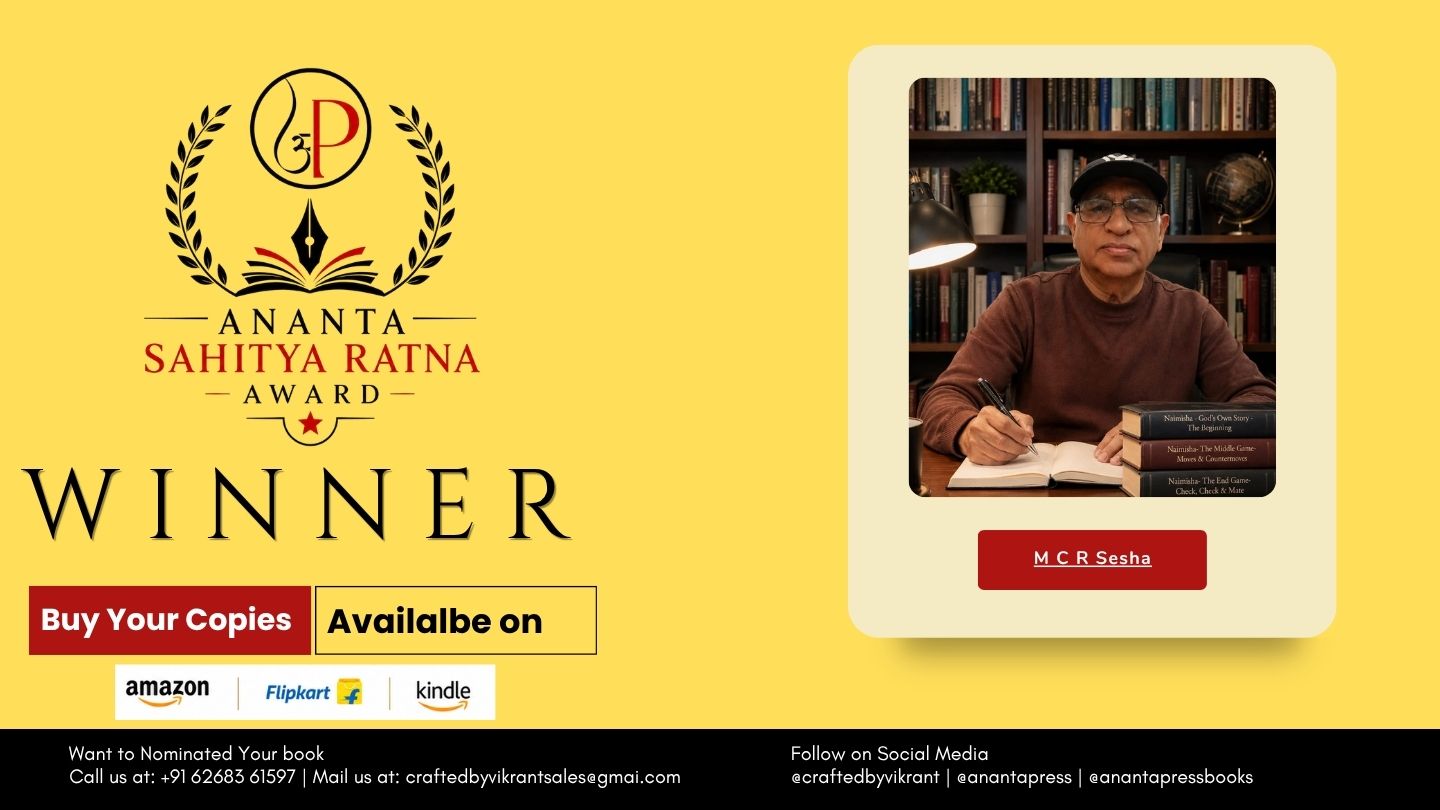
Ananta Press is delighted to officially announce M C R Sesha as a Winner of the prestigious Ananta Press Sahitya Ratna Award for the historical fiction work, NAIMISHA – GOD’S OWN STORY – THE END GAME: CHECK, CHECK & MATE. This recognition celebrates not only the literary strength of the book but also the author’s thoughtful engagement with one of India’s greatest epics. As the third and concluding volume of the Naimisha Trilogy, the book brings together history, mythology, imagination, philosophy, and human emotion in an ambitious conclusion. The award committee found the book particularly worthy of recognition because it does not merely retell familiar episodes from the Mahabharata. It approaches them through a wider narrative vision and attempts to provide emotional and philosophical closure to characters whose lives and choices have remained subjects of discussion for generations. NAIMISHA – GOD’S OWN STORY – THE END GAME takes readers into the concluding phase of a carefully developed trilogy. The book explores the Kurukshetra War in detail and further extends its narrative into the wars connected with the Ashwamedha. These important historical and mythological events are presented not simply as scenes of conflict but as turning points in the lives of individuals carrying the burden of decisions, relationships, responsibilities, victories, and losses. One of the strongest aspects of the book is the manner in which it seeks to provide closure to the major characters of the Mahabharata, including Krishna. Readers who have followed these legendary personalities through familiar traditional accounts are invited to look at their final journeys with renewed curiosity. Through this approach, M C R Sesha creates a work that respects the cultural importance of its source material while bringing an individual literary perspective to it. The fictional characters Animish and Asareer further strengthen the originality of the trilogy. Their presence enables the author to move between the familiar world of the epic and a more imaginative narrative space. In the final volume, both characters reach the completion of their respective life journeys in very different ways. Their conclusions encourage readers to think about destiny, purpose, choice, mortality, responsibility, and the consequences of human action. It is this combination of epic history and reflective storytelling that particularly impressed the award committee. Historical fiction becomes memorable when it gives readers more than information about events. It must also create emotional involvement and encourage reflection. NAIMISHA – GOD’S OWN STORY – THE END GAME succeeds in presenting major conflicts while maintaining a philosophical undertone that asks readers to look beyond victory and defeat. The Ananta Press Sahitya Ratna Award recognises authors and literary works that contribute meaningfully to the reading culture through originality, thoughtful expression, literary commitment, and the ability to leave a lasting impression on readers. Books considered for this recognition are evaluated for their concept, narrative quality, reader value, thematic depth, creativity, and contribution to literature. M C R Sesha’s work stood out because of the scale of the literary undertaking. Completing a trilogy based around characters and events associated with the Mahabharata requires considerable narrative discipline. The concluding volume carries an additional responsibility because it must bring together developments from the earlier books while giving readers a satisfying conclusion. The End Game achieves this by connecting the destinies of established epic personalities with those of the fictional characters created by the author. The philosophical undertones of the book also give the work a deeper dimension. The story encourages readers to think about what remains after conflict has ended. It raises questions about fulfilment, consequence, duty, personal journeys, and the meaning of closure. Such questions allow the work to extend beyond historical fiction and become a reflective reading experience. The award committee also appreciated the courage involved in working creatively with a narrative tradition as significant as the Mahabharata. The epic has been interpreted across centuries through poetry, theatre, scholarship, fiction, television, philosophy, and oral storytelling. To contribute another interpretation requires both respect for the source tradition and confidence in one’s own creative voice. M C R Sesha demonstrates this balance through a narrative that combines known epic events with fictional characters and personal philosophical reflections. As the final part of the Naimisha Trilogy, this book represents the culmination of the author’s larger literary thought process. It brings together the questions, characters, conflicts, and ideas developed throughout the trilogy and leads them toward their final destinations. The result is a conclusion that aims not only to complete a story but also to leave readers with thoughts that continue after the final page. Ananta Press warmly congratulates M C R Sesha on being selected as a Winner of the Ananta Press Sahitya Ratna Award. This honour recognises the dedication required to imagine, develop, and complete a substantial literary trilogy while engaging with one of the most culturally significant narrative traditions of India. We extend our sincere best wishes to M C R Sesha for continued success in the literary journey ahead. May NAIMISHA – GOD’S OWN STORY – THE END GAME reach a wider community of readers and encourage meaningful conversations about history, mythology, philosophy, human nature, and the lasting relevance of the Mahabharata. Jury Feedback Glenville Ashby Reading NAIMISHA – GOD’S OWN STORY – THE END GAME was an interesting experience because the book attempts something difficult. It enters the world of the Mahabharata while still creating its own narrative identity. I particularly appreciated the effort made to give closure to the characters. The Kurukshetra War is familiar to many readers, but this book encourages us to think about what happens emotionally and philosophically when the great conflict has ended. The inclusion of the Ashwamedha wars gives the story a wider historical and narrative scope. I also found Animish and Asareer important because they allow the author to bring an original fictional dimension into a world readers already know. Their different journeys add emotional variety to the conclusion. The philosophical reflections are another strength of the book. The story is not only concerned with who wins or loses.
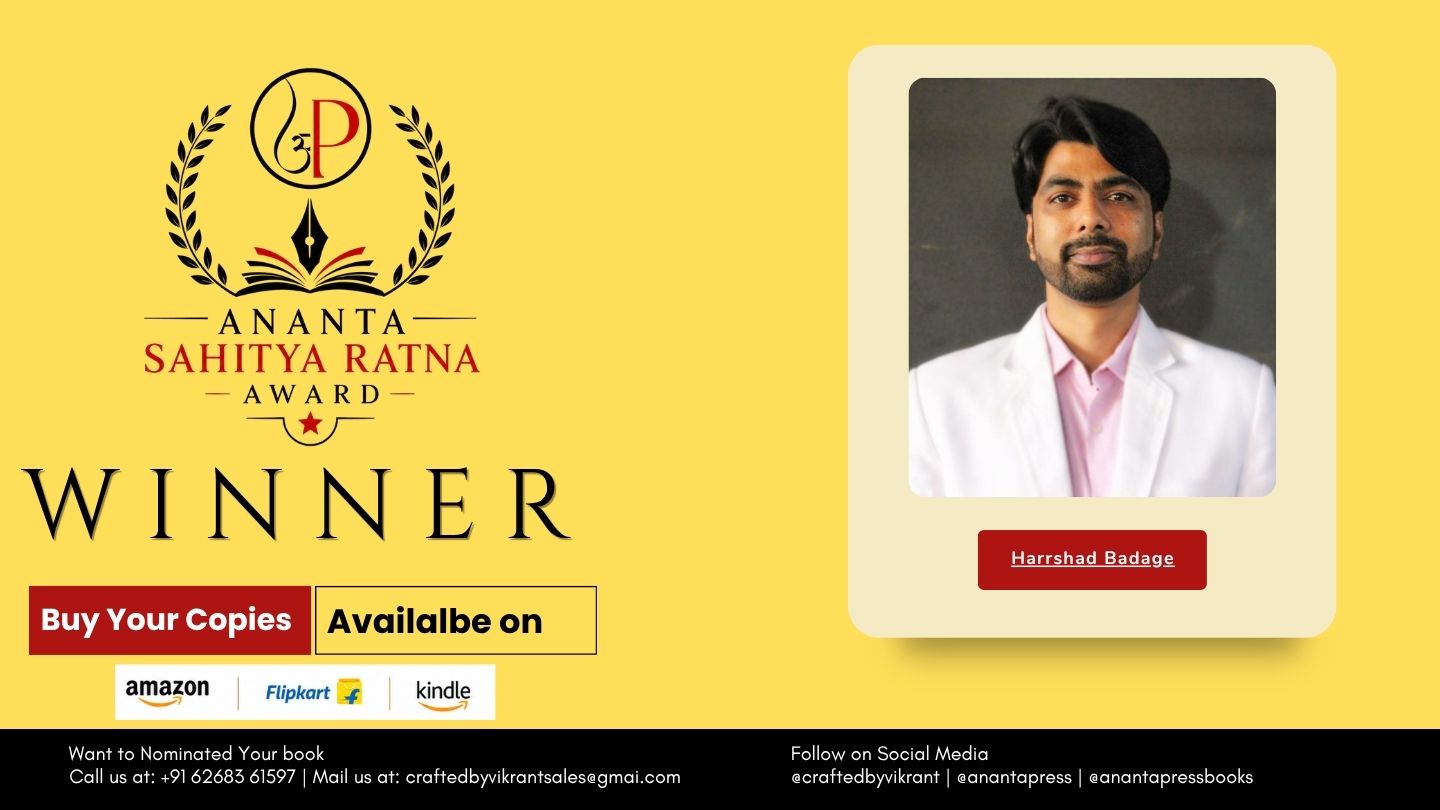
Harrshad Badage Honoured as Winner of the Ananta Press Sahitya Ratna Award for I’m Ready for Anything (IRA)
Ananta Press is delighted to congratulate author Harrshad Badage on being officially declared a Winner of the Ananta Press Sahitya Ratna Award for his valuable non-fiction book, I’m Ready for Anything (IRA). This recognition celebrates a book that goes beyond conventional reading and offers knowledge that can directly influence the safety, confidence, and preparedness of its readers. I’m Ready for Anything stands out because it addresses an area of everyday life that is extremely important but often overlooked. Harrshad Badage has created a practical guide that encourages individuals and families to understand emergencies before they occur and to respond to difficult situations with awareness rather than panic. The Ananta Press Sahitya Ratna Award recognizes authors and books that demonstrate originality, meaningful contribution, reader value, thoughtful presentation, and the ability to create a positive impact through literature. During the evaluation process, the award committee considers not only the subject of a book but also its relevance, clarity, purpose, originality, and contribution to readers and society. I’m Ready for Anything successfully reflects these qualities. One of the strongest features of the book is its India-first approach to personal safety and emergency preparedness. Many survival and preparedness books are designed around circumstances, environments, and resources found outside India. Harrshad Badage takes a different path. He concentrates on situations that Indian readers may realistically experience in their homes, workplaces, schools, cities, towns, and communities. From fires, floods, earthquakes, road accidents, gas leaks, and blackouts to cyber scams, workplace emergencies, and situations involving civil unrest, the book covers a remarkably relevant range of concerns. These are not distant or imaginary dangers. They are situations that ordinary people may encounter unexpectedly, which makes the information presented in the book practical and immediately useful. The award committee particularly appreciated the way difficult safety concepts have been converted into understandable and actionable information. Preparedness can easily become a technical subject filled with complicated terminology and instructions. In I’m Ready for Anything, however, the author presents information conversationally and supports it through relatable examples, Indian case studies, practical checklists, first-aid guidance, and emergency planning strategies. This accessibility significantly increases the value of the book. Information about safety becomes truly meaningful only when readers can understand it, remember it, and use it when required. Harrshad Badage succeeds in bringing that knowledge closer to everyday readers. Another reason the book attracted the attention of the Ananta Press Sahitya Ratna Award committee is its central philosophy. The author does not encourage people to become frightened of everything that could go wrong. Instead, he presents preparedness as a source of confidence. The idea that preparedness is not about living in fear but about living with confidence gives the book a positive and empowering identity. Readers are encouraged to become proactive rather than reactive. Instead of waiting for an emergency and then struggling to respond, they are encouraged to develop awareness, basic skills, useful habits, and simple plans beforehand. This message carries importance far beyond the individual reader. Preparedness can strengthen families, educational institutions, workplaces, residential communities, and society as a whole. A person who understands basic emergency response may be able not only to protect themselves but also to assist another person during a critical moment. For this reason, I’m Ready for Anything can also be viewed as a valuable life skills book. It brings together personal responsibility, public awareness, practical knowledge, and community consciousness. Its purpose is not simply to inform readers about emergencies but to encourage a culture in which preparedness becomes a normal part of responsible living. The book also demonstrates originality through its localization. By placing Indian circumstances at the centre of the discussion, Harrshad Badage has made emergency preparedness more relatable to readers who may otherwise find traditional survival literature disconnected from their everyday realities. The jury members appreciated this combination of relevance, simplicity, purpose, and social value. The book offers knowledge that can be useful to students, parents, professionals, teachers, institutions, families, young adults, and general readers. Its potential audience is broad because safety is not limited to a particular profession, age group, or social background. Through I’m Ready for Anything, Harrshad Badage reminds readers that awareness itself can become a form of protection. A few minutes of planning, some basic first-aid knowledge, an understanding of emergency procedures, or awareness of common risks can make a meaningful difference when circumstances suddenly become difficult. Ananta Press proudly recognizes Harrshad Badage for creating a work that combines information with responsibility and practical guidance with an encouraging message. The Ananta Press Sahitya Ratna Award celebrates not only accomplished writing but also books that give readers something valuable to carry into their lives. I’m Ready for Anything achieves that purpose by helping readers become more aware, prepared, responsible, and confident. We extend our heartfelt congratulations to Harrshad Badage on becoming a Winner of the Ananta Press Sahitya Ratna Award. May this recognition introduce I’m Ready for Anything to an even wider readership and inspire more individuals, families, schools, workplaces, and communities to understand the importance of preparedness. Ananta Press wishes Harrshad Badage continued success in his literary journey and appreciates his meaningful contribution to practical non-fiction and reader awareness. Jury Feedback Glenville Ashby I found I’m Ready for Anything to be a purposeful book because it discusses safety in a manner that an ordinary reader can understand and apply. What impressed me most was the decision to place Indian situations at the centre of the discussion. Emergency preparedness is often presented through examples that may not feel familiar to Indian readers, but this book makes the subject much closer to everyday life. The coverage of fires, floods, earthquakes, road accidents, blackouts, gas leaks, cyber scams, and other situations gives the book considerable practical value. I also appreciated the author’s message that preparedness should create confidence instead of fear. That is an important distinction. A good safety book should make readers more capable rather than more anxious, and Harrshad Badage has maintained that balance effectively. The checklists, examples, case studies, and
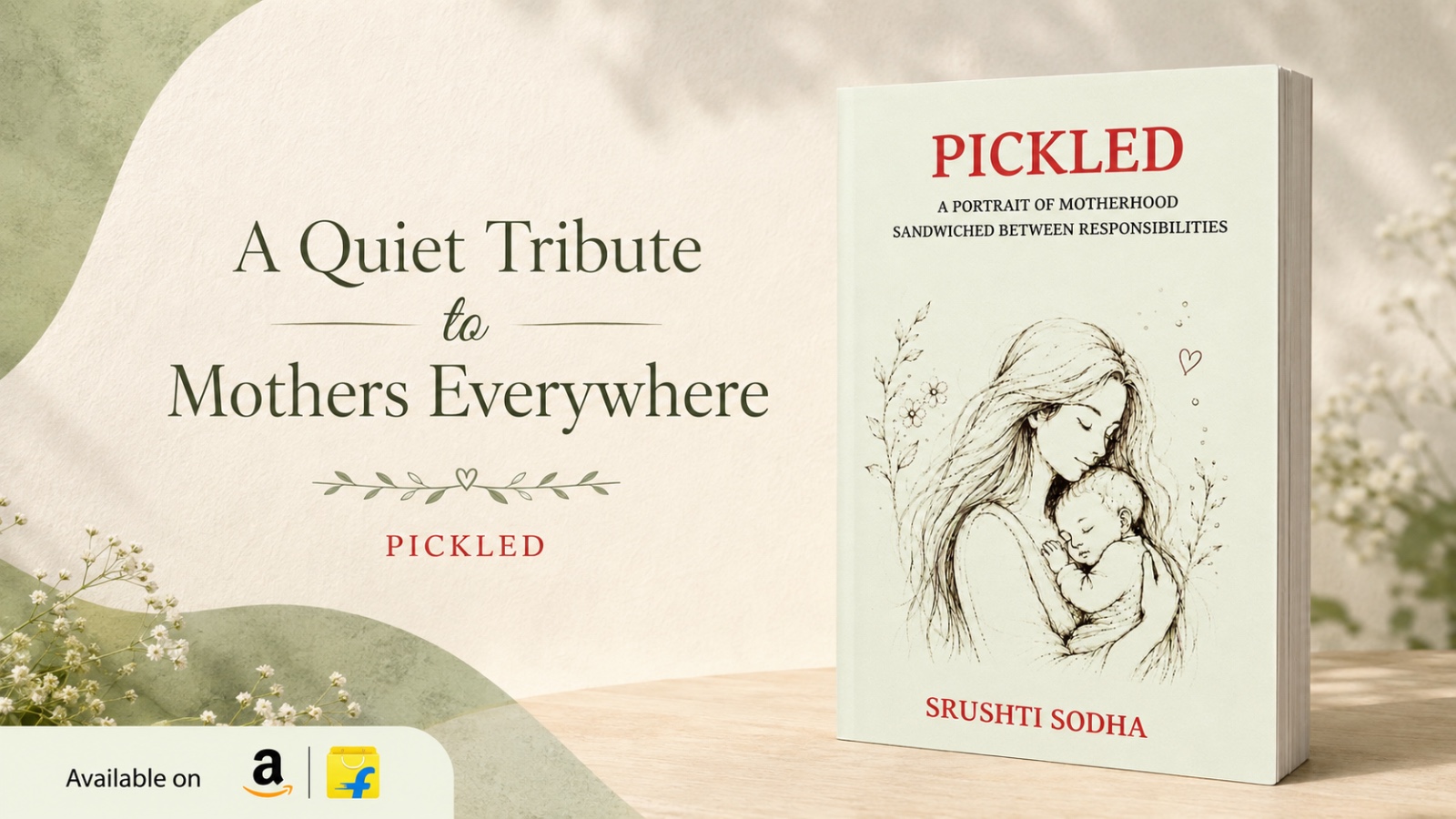
Between Generations: Why Pickled Speaks to Every Daughter and Mother
Book: Pickled: A Portrait of Motherhood Sandwiched Between Responsibilities Author: Srushti Sodha Pickled: A Portrait of Motherhood Sandwiched Between Responsibilities by Srushti Sodha begins in a deeply recognizable emotional space: the moment when an adult daughter looks at her mother and realizes she has never fully known her. She has known the mother who cooked, called, worried, advised, remembered, sacrificed, and held the household together. But beneath that role lived a woman with her own ambitions, fears, tastes, limitations, and unlived possibilities. Pickled explores the distance between those two understandings and turns it into a moving reflection on inheritance. The book is important because it does not treat motherhood as a single experience. It looks at motherhood across generations. One generation learned that love meant being endlessly available. Another is beginning to ask whether love can remain deep while allowing a woman to maintain a stronger sense of self. Between them lies gratitude, misunderstanding, guilt, tenderness, admiration, and change. Sodha does not ask readers to choose which generation is “right.” Instead, she examines what each inherited and what each is trying to transform. The phrase “sandwich generation” usually refers to adults caring for children while also supporting aging parents. In Pickled, that phrase becomes emotionally vivid. The women at the center of the book are not balancing responsibilities on a calendar; they are living inside overlapping claims of love. Their children need guidance. Their parents need attention. Their partners need support. Homes need maintenance. Traditions need preserving. Social expectations continue to operate. The self must somehow survive in whatever space is left. The book’s great sensitivity comes from understanding that these responsibilities are rarely experienced as purely external burdens. They are tied to love. That is what makes them difficult to refuse. A mother may be exhausted by cooking for everyone, but food is also how she communicates care. She may resent the assumption that she will remember every detail, yet remembering is part of how she creates belonging. The same act can be both labor and affection. Pickled refuses to simplify that contradiction. Sodha’s use of pregnancy as a reflective threshold gives the book a strong emotional frame. Standing at the edge of motherhood herself, the narrator begins to revisit her childhood differently. She thinks not only about what her mother did but about what her mother was building. Safety, she realizes, is not an abstract quality. It is created by repeated acts of attention. A child grows up believing that home is dependable because someone has absorbed uncertainty on their behalf. This insight is especially powerful for readers who have reached adulthood and begun recognizing the hidden work of their parents. Childhood naturally centers the child. Food appears. Festivals happen. Problems are solved. Someone remembers appointments. Someone knows when the family is tense and quietly changes the atmosphere. Only later do many of us understand that these things did not happen automatically. Pickled captures the emotional shock of that realization without turning it into accusation. The book also asks readers to reconsider sacrifice. In many cultures, particularly within traditional family structures, maternal sacrifice is praised so often that it becomes almost invisible. A mother who gives up an ambition is called devoted. A mother who does not rest is called strong. A mother who places herself last is praised for love. The language is flattering, but the consequence can be severe: the woman inside the role becomes difficult to see, even to herself. Pickled does not condemn mothers for having lived that way. This is crucial. The book recognizes that people make choices within the limits of their time, family, culture, and available opportunities. The woman who did not travel far for education or who placed family expectations ahead of a personal dream may not have experienced those decisions as simple coercion. Life is more complicated. People adapt, find meaning, become skillful, and build identities within the paths available to them. The book’s compassion comes from honoring that complexity. At the same time, the book makes space for daughters who want something different. A daughter can be grateful for what her mother gave and still decide that she does not want exhaustion to be the proof of her own love. She can preserve tenderness without preserving silence. She can remain emotionally available while protecting parts of herself that are not defined by caregiving. This is one of the most contemporary and necessary messages in the book. The title Pickled captures the generational theme brilliantly. Pickling preserves, but preservation also changes the thing being preserved. It absorbs flavor. It becomes sharper, deeper, sometimes stronger. The mothers in the book are similarly shaped by years of responsibility. They are “marinated” in other people’s needs, but they are not reduced to those needs. They emerge with humor, authority, instinct, patience, and a particular kind of emotional intelligence that could only have been developed through lived experience. The domestic imagery gives this theme warmth. Pressure cookers, chai, family meals, parcels, newspaper mornings, temple sounds, and the routines of a Gujarati household create a world where identity is built through repetition. These details matter because intergenerational relationships are rarely shaped by grand speeches. They are shaped by who makes tea when someone is upset, who remembers the preferred snack, who knows when a silence means anger, and who continues calling after a child has moved away. The book is equally compelling in its understanding of distance. One of the bittersweet achievements of motherhood is that good parenting often produces independence. Children leave home, study elsewhere, build careers, and create adult identities. Mothers who once managed every detail can become spectators to lives unfolding far away. The emotional challenge is enormous: to encourage freedom while remaining the place of return. Pickled captures this paradox with affection rather than melodrama. Its humor also deserves attention. The book understands that family life is funny precisely because people care so much. Hunger can become theatrical. A snack parcel can become an international operation. Technology changes, but parental concern
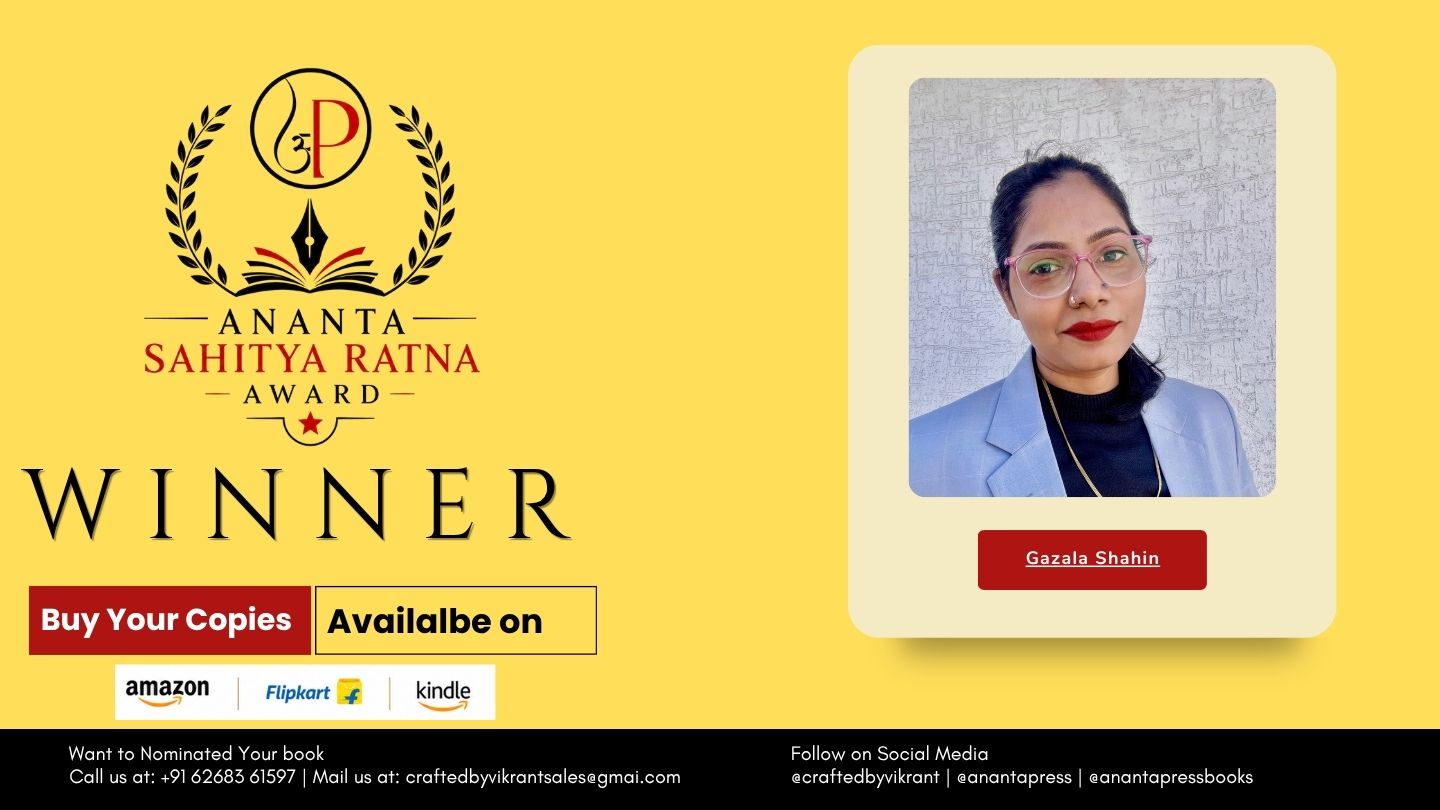
Echoes of Heart by Gazala Shahin Wins the Ananta Press Sahitya Ratna Award
Ananta Press is delighted to congratulate author Gazala Shahin on the official recognition of her book, Echoes of Heart – A Journey of Healing, Family, and Love, as a Winner of the Ananta Press Sahitya Ratna Award. This recognition celebrates not only a work of fiction, but also a thoughtful exploration of human emotions, relationships, healing, family bonds, and the quiet strength that allows people to rebuild themselves. Through Echoes of Heart, Gazala Shahin presents a story that looks closely at emotions many people experience but often struggle to express. At the centre of the novel is Reyna, a compassionate psychologist who spends her professional life helping others understand their pain while quietly moving through her own emotional journey. Her character gives the novel both sensitivity and psychological depth. Through Reyna’s interactions with patients, readers encounter children carrying the burden of expectations, marriages weakened by years of unspoken emotions, and families trying to rediscover trust and connection. These experiences allow Echoes of Heart to move beyond the boundaries of a conventional fictional story. The book encourages readers to think about communication, emotional dignity, understanding, forgiveness, and the importance of listening to what people may not always be able to say directly. The relationship between Reyna and Aariv adds another meaningful dimension to the novel. Instead of depending on exaggerated conflicts or artificial drama, their relationship develops through patience, empathy, trust, and emotional stillness. Aariv’s quiet strength reflects Reyna’s own emotional sensitivity, creating a relationship that feels mature and grounded. This quality is one of the major reasons Echoes of Heart attracted the attention of the Ananta Press Sahitya Ratna Award committee. The Ananta Press Sahitya Ratna Award recognises literary works that demonstrate originality, meaningful storytelling, reader impact, creative value, and a genuine contribution to contemporary literature. The selection process considers not only how effectively a story is written, but also what the work leaves behind in the mind and heart of the reader. Echoes of Heart stands out because of its focus on emotional intelligence and psychological understanding. Rather than treating emotional struggles merely as dramatic events, the book examines why people behave as they do, why relationships become distant, how expectations affect children and adults, and how genuine communication can become the beginning of healing. The award committee also recognised the relevance of the book’s themes to modern readers. Families today often live with pressures that remain invisible to people outside them. Expectations, misunderstandings, emotional distance, professional stress, loneliness, and unresolved experiences can deeply influence relationships. Through fiction, Gazala Shahin creates a space where these realities can be observed with compassion rather than judgement. Another important quality of the book is its emotional restraint. Echoes of Heart does not need constant dramatic events to maintain its emotional power. Much of its strength comes from silence, observation, conversations, small changes in relationships, and the gradual understanding of another person’s emotional world. This approach gives the novel its distinctive identity. The book also communicates an important message about healing. Healing does not always happen through one dramatic moment. Sometimes it begins when someone feels heard. Sometimes it starts with an honest conversation, an act of patience, forgiveness, or the decision to understand another person before judging them. Through Reyna’s journey, readers are also reminded that people who help others can have their own emotional struggles. Strength and vulnerability can exist together. A person can guide others while continuing to discover and heal parts of themselves. Gazala Shahin deserves appreciation for choosing themes that require emotional sensitivity and careful observation. Through Echoes of Heart, she has created a fictional world that encourages readers to reflect upon their own relationships while remaining emotionally connected to the characters and their journeys. The selection of Echoes of Heart as a Winner of the Ananta Press Sahitya Ratna Award therefore recognises its literary value, emotional depth, psychological awareness, originality, and ability to communicate meaningful ideas through an accessible human story. Ananta Press warmly congratulates Gazala Shahin on this achievement. We hope this recognition introduces Echoes of Heart to many more readers and encourages meaningful conversations about emotional health, relationships, family, communication, love, and healing. We extend our best wishes to Gazala Shahin for her continued literary journey and look forward to seeing her voice reach an even wider readership. Through Echoes of Heart – A Journey of Healing, Family, and Love, she has made a thoughtful contribution to contemporary fiction and created a story that reminds readers of a simple but powerful truth: sometimes healing begins when human beings truly listen to one another. Proposed Jury Feedback for Individual Approval Glenville Ashby Echoes of Heart impressed me because it treats emotional healing as something deeply human rather than something that can be explained through simple answers. Reyna’s profession as a psychologist gives the story an interesting foundation, but what makes her memorable is that she is also someone going through her own emotional journey. The stories involving children, couples, and families show how easily people can become disconnected even when they care about one another. I particularly appreciated the way the book gives importance to silence and emotional restraint. Every important relationship does not need loud conflict to feel meaningful. Reyna and Aariv’s relationship demonstrates this beautifully through patience, understanding, and trust. The book encourages readers to pay attention to emotions that often remain hidden beneath ordinary conversations. For me, its strongest quality is its compassion. It does not judge its characters quickly. Instead, it allows readers to understand their fears, expectations, mistakes, and desire to be understood. Kavya Pandey While reading Echoes of Heart, what stayed with me most was the author’s understanding of relationships and the emotions people often leave unspoken. Reyna works with people who are facing very different problems, yet their experiences are connected by a common need to feel heard and understood. Children struggling under expectations, couples experiencing emotional distance, and families trying to reconnect all make the story relevant to everyday life. I also liked that Reyna is not
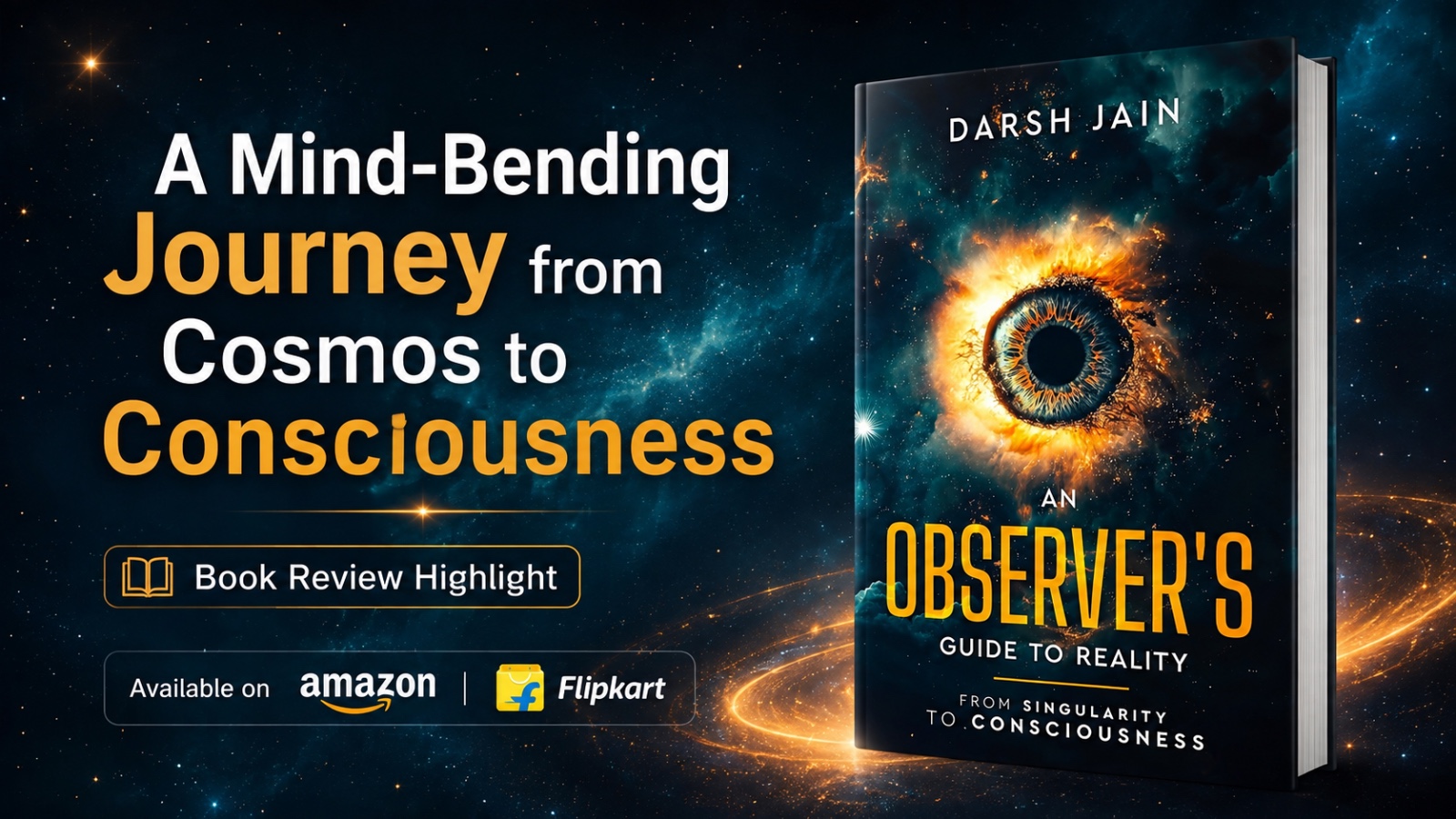
Observe the Observer: A Book About Understanding Before Judging
The final message of An Observer’s Guide to Reality can be expressed in one word: understanding. Darsh Jain spends much of the book teaching the reader how the universe, life, evolution, society, and the brain can be understood through causes rather than through inherited explanations. In the last chapter, that method is turned inward. The reader is asked to observe thoughts and emotions with the same curiosity used earlier to observe atoms, species, or human history. This is where the book becomes more than a collection of scientific and philosophical ideas. It becomes a practice of attention. Instead of asking only, “What is reality?” it asks, “How does my mind create the reality I experience?” That is a question with direct value in everyday life. Consider something simple such as anger. A person cuts you off in traffic, interrupts you, or says something insulting. The event happens quickly, but the emotional reaction can feel immediate and complete. We usually say, “You made me angry.” The final chapter asks us to separate the event from the interpretation. The body may react. The nervous system may prepare for conflict. A thought may appear: this person disrespected me. Memory and cultural ideas about pride may strengthen that thought. Then anger becomes the lens through which the whole moment is seen. Observing the observer means noticing this process instead of assuming that the emotion is the world itself. The book makes the same point with joy, grief, fear, love, jealousy, and identity. Two people can walk through the same street and experience different worlds because perception is not a camera. The brain filters sensory information through expectation, memory, attention, and emotion. Someone newly in love may find ordinary things beautiful. Someone in grief may find the same environment empty. Nothing outside needs to change for the experienced world to change. This is one of the most useful ideas in the book because it reminds us that our emotional reality is real to us without necessarily being an objective description of everything around us. Why does this matter? Because many conflicts begin when people treat their interpretations as facts. We assume that our anger proves another person intended harm. We assume that our fear proves danger. We assume that our identity proves superiority. We assume that a belief feels true because it is true. Jain’s broader scientific method teaches the opposite habit: pause, observe, ask what evidence exists, and ask what processes may be shaping the conclusion. In personal life, this can create a small space between reaction and response. That space may be one of the most practical forms of freedom available to us. The book also connects understanding with compassion. If behaviour emerges from biology, development, learning, environment, and social conditioning, then other people become more complicated. A person shouting in anger may be acting through a nervous system shaped by stress, fear, and past experience. A person holding tightly to a belief may connect that belief with family, safety, identity, and love. Understanding these causes does not require accepting harmful behaviour. It simply prevents us from reducing a human being to one action or one label. The book suggests that the more we understand the machinery behind behaviour, the less quickly we judge. This ethical direction is important because the book’s scientific worldview could otherwise feel cold. If people are biological systems, does morality disappear? Jain argues the opposite. Suffering remains real because conscious beings experience it. We do not need a supernatural command to recognise pain. Compassion can be grounded in the fact that other nervous systems can be hurt, frightened, isolated, or supported. Morality can become less about earning reward or avoiding punishment and more about understanding consequences between living beings. The book’s final chapters therefore move from determinism toward empathy. The author’s personal reflections also explain why “understanding” became so important to him. He describes a period of intense civil-services preparation in which he gathered large amounts of information across geography, history, economics, polity, science, and current affairs. After not clearing the examination, he began questioning whether knowledge alone was enough. The experience led him toward a different kind of learning—one based on reflection, curiosity, and seeing connections. He writes that knowing can fill the mind while understanding can transform the way we relate to people. That personal journey gives the book’s final message a lived context rather than making it sound like a slogan. His curiosity then moved across disciplines. History raised questions about repeated wars and the “us versus them” pattern. Anthropology raised questions about human origins. Evolution led to genes and biology. Biology led deeper into molecules and atoms. Quantum mechanics raised questions about matter and reality. Philosophy brought him to absurdism, existentialism, and questions of purpose. This path is reflected in the architecture of the book. The reader is not being shown separate subjects. The reader is watching one question open into another. What began as curiosity about the cosmos eventually becomes curiosity about the mind that is curious. That makes the book particularly suitable for readers who dislike intellectual boxes. A person may begin with astronomy and end up thinking about morality. Another may begin with philosophy and discover an interest in evolution. A psychology reader may find the chapters on imagined orders useful for understanding identity. A student may discover that science can be a story rather than a syllabus. The book’s value lies in connection. It shows that learning becomes more meaningful when we see how different fields illuminate the same human questions. Observe the Observer is also a helpful phrase because it does not ask readers to suppress emotion. Observation is not denial. The book does not say, “Do not feel anger,” or “Do not feel grief.” It asks us to notice what is happening without immediately turning the feeling into identity or action. An emotion can be observed as a process. A thought can be seen as an event in the mind. A belief can be traced back to
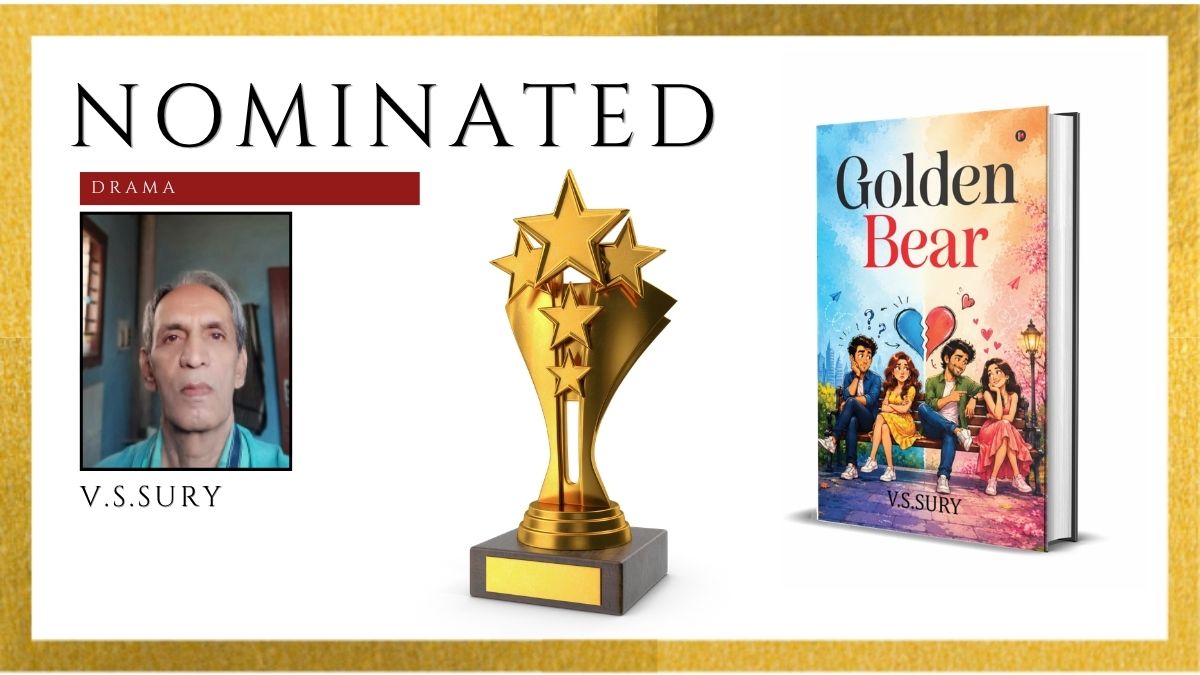
V.S. Sury’s Golden Bear Officially Nominated for the Ananta Press Sahitya Ratna Award
Ananta Press is delighted to congratulate distinguished author V.S. Sury on the official nomination of his drama, Golden Bear, for the Ananta Press Sahitya Ratna Award. The nomination recognizes a work that combines originality, humour, emotional complexity, and an inventive approach to one of literature’s most familiar themes—the complications of love. At the heart of Golden Bear is a wonderfully unusual romantic arrangement. Readers are familiar with the classic love triangle, but V.S. Sury playfully expands the idea into what might best be described as a “love rectangle.” One man loves a woman who loves another man; that man, in turn, loves a different woman; and the circle becomes complete when that woman gives her heart to the first man. What could easily become a conventional tale of unrequited love is transformed into an entertaining and emotionally engaging dramatic puzzle. The question that drives the story is simple yet compelling: how can such a complicated circle of emotions be resolved without leaving everyone disappointed? The answer arrives through the intervention of an almost magician-like figure who handles the situation with flair, intelligence, and dramatic charm. Adding another memorable dimension to the narrative is the striking appearance of a golden bear, which helps lead the story toward what promises to be a deeply satisfying conclusion. It is this combination of imagination and emotional observation that drew the attention of the Ananta Press Sahitya Ratna Award committee. Why Golden Bear Was Selected for Nomination The award committee recognized Golden Bear for its ability to take a universally understood theme and present it through an unconventional structure. Love, attraction, rejection, longing, and emotional misunderstanding have inspired literature for centuries. Yet originality lies not only in discovering entirely new subjects, but also in finding fresh ways of interpreting familiar human experiences. V.S. Sury accomplishes precisely that. By transforming the familiar romantic triangle into a moving circle of four interconnected hearts, Golden Bear introduces both humour and dramatic tension. The arrangement creates curiosity because every character’s happiness appears dependent upon someone whose own desires point elsewhere. Such a structure allows the story to explore an important truth about human relationships: emotions rarely follow logic, and affection cannot simply be arranged according to convenience. At the same time, the book does not appear interested merely in presenting romantic confusion. Its central concern is resolution—finding a way toward peace, emotional balance, and satisfaction for those involved. This gives the narrative a hopeful quality and allows readers to consider relationships not only through the lens of possession or heartbreak, but also through understanding, creativity, and acceptance. The dramatic role of the “magician” figure and the intriguing golden bear further distinguish the work. These elements give the story a theatrical and imaginative quality while demonstrating the author’s willingness to move beyond predictable storytelling conventions. A Writer Whose Literary Journey Began After Retirement The nomination also recognizes the remarkable literary journey of V.S. Sury. Born in Karnataka, Sury graduated as an electrical engineer in 1967 and spent his professional life in service before retiring. A bachelor by choice and now in his early eighties, he lives in Kolar and leads a largely reclusive life devoted to reading, writing, and contemplating life. What makes his journey particularly inspiring is that his serious passion for writing developed after retirement. At a stage when many people choose to slow down, Sury began an entirely new creative chapter. His first novel, JESTUS, was published in 2010. Since then, his literary output has expanded across genres. His works include the sequel Jestus on Rampage, the non-fiction book Parallels, the short-story collection Impossible Tales, and FENTOSCIENCE. His writing has also received recognition from several literary platforms. FENTOSCIENCE received the Sahitya Sparsh Award 2024, while Impossible Tales earned first place, second place, and honourable mentions across different categories from Outstanding Creator.com. JESTUS received a Book of the Year 2024 mention from Literary Insider and subsequently received a Golden Book Award 2025. These accomplishments reflect not merely productivity, but a continued willingness to experiment with ideas, genres, and storytelling. Celebrating Original Voices Through the Sahitya Ratna Award The Ananta Press Sahitya Ratna Award is dedicated to recognizing writers whose works demonstrate literary merit, creative individuality, meaningful engagement with readers, and a distinctive contribution to contemporary literature. The nomination process seeks to celebrate books that possess a voice of their own—works that entertain, provoke thought, communicate something meaningful, or offer readers an experience they are unlikely to find elsewhere. Golden Bear represents these qualities through its inventive romantic structure, dramatic storytelling, emotional accessibility, humour, and imaginative resolution. The book reminds readers that even the most complicated human relationships can become fertile ground for creativity, reflection, and ultimately hope. For the award committee, the nomination also acknowledges V.S. Sury’s enduring commitment to literature. His journey demonstrates that creativity has no retirement age and that a writer’s most productive or meaningful period may begin at any stage of life. Ananta Press warmly congratulates V.S. Sury on the official nomination of Golden Bear for the Ananta Press Sahitya Ratna Award. We extend our best wishes to him for the award journey ahead and recognize his continued contribution to literature through stories marked by imagination, curiosity, unconventional ideas, and a thoughtful understanding of human life. May Golden Bear reach many readers, inspire smiles and reflection, and add another memorable achievement to V.S. Sury’s remarkable literary journey.
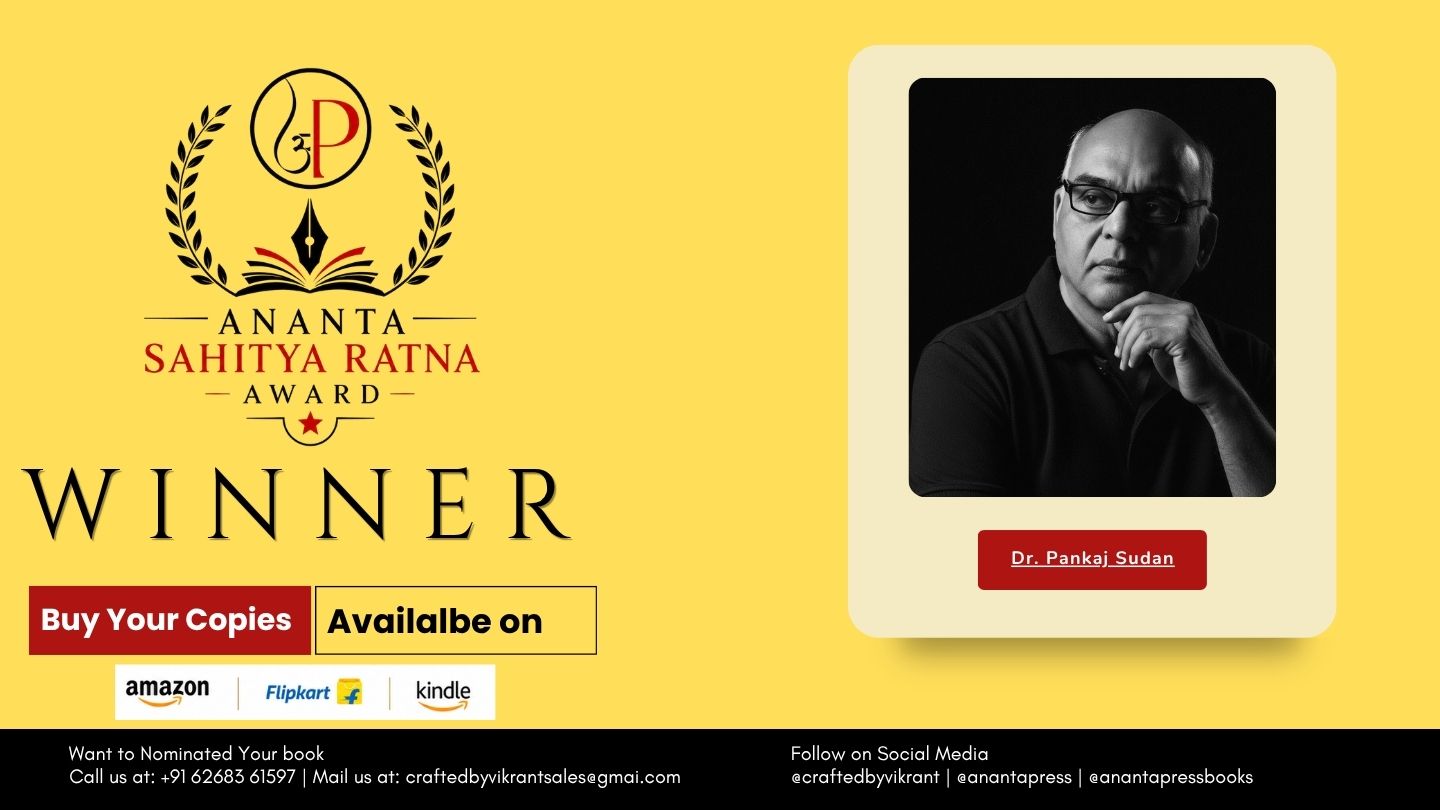
Ananta Press proudly congratulates Dr. Pankaj Sudan on being officially selected as a Winner of the Ananta Press Sahitya Ratna Award for his thoughtful and distinctive book, “आओ चलें”.
The recognition celebrates a work that brings together Indian philosophical thought, literary experimentation, humour, observation, and practical reflections on everyday life. At the heart of “आओ चलें” is the timeless Indian philosophical idea of “चरैवेति, चरैवेति”, which encourages human beings to continue moving forward. Dr. Pankaj Sudan develops this idea beyond physical movement and presents flow as an essential principle of life. The book explains that when blood circulation slows, the human body may face serious complications. In the same way, when thoughts stop moving because of a problem, stress and emotional difficulties can develop. When the movement of imports and exports decreases, an economy can suffer. When visits and communication between relatives stop, emotional and family distances can increase. Through such examples, the book demonstrates that movement, exchange, communication, and continuity are connected with almost every aspect of human existence. One of the strongest reasons for the award committee’s appreciation of “आओ चलें” is the way the author makes philosophical ideas accessible to ordinary readers. Instead of presenting philosophy only through difficult explanations, the book connects deeper questions of life with situations that people can immediately recognize. The result is a work that invites reflection without making the reader feel burdened by the seriousness of its subject. The literary structure of the book also gives it a special identity. “आओ चलें” draws inspiration from the ancient Indian Champu tradition, in which prose and poetry appear together. The prose itself carries rhythm, movement, and at places a quality similar to rhyming verse. In contemporary literature, the use of this style is relatively uncommon, which makes Dr. Pankaj Sudan’s attempt especially noteworthy. By bringing an old literary technique into a modern context, the author establishes a connection between Indian literary heritage and present-day concerns. The characters रमता जोगी and his disciple चिपकु लाल further strengthen the personality of the book. As they move through the world, they observe ordinary events and discover subtle lessons hidden within them. Their journey allows the author to discuss serious subjects through conversation, experience, humour, and observation rather than through formal preaching. Another memorable feature is the playful naming of chapters after familiar food and drink items such as समोसा, आलू की टिक्की, शिकंजी, ठंडी लस्सी, and गर्मागर्म जलेबी. This creative choice reflects the spirit of the book. It reminds readers that wisdom does not always need to arrive in a heavy or intimidating form. Serious reflection can also emerge from ordinary surroundings, humour, companionship, food, travel, and everyday experiences. The Ananta Press Sahitya Ratna Award recognizes literary works that demonstrate originality, meaningful thought, reader value, cultural relevance, and a distinctive contribution to literature. “आओ चलें” stood out to the award committee because it combines philosophical depth with simplicity, humour with reflection, and a traditional literary form with contemporary life. Its message of continuing movement is both culturally rooted and universally relevant. The committee also appreciated the positive direction of the book. Rather than merely identifying problems, it encourages movement through them. Whether the challenge involves thoughts, relationships, society, work, or personal circumstances, the underlying message remains that stagnation often increases difficulty, while renewed movement can create possibilities. Ananta Press extends its warm congratulations to Dr. Pankaj Sudan for this recognition. Through “आओ चलें”, he has presented readers with an unusual literary journey that respects Indian philosophical tradition while speaking in a language connected to modern daily life. We wish him continued success in his literary journey and hope that his work reaches many more readers, encouraging them to reflect, smile, learn, and most importantly, keep moving forward. Jury Feedback Glenville Ashby After reading “आओ चलें”, I found its central idea very clear and meaningful. The concept of “चरैवेति, चरैवेति” has been connected with daily life in a way that makes philosophy easier for a general reader to understand. What interested me most was the author’s ability to show that flow is not only about physical movement. It can be seen in blood circulation, thought, economic activity, relationships, communication, and personal growth. These comparisons make the central philosophy practical rather than abstract. I also appreciated the presence of humour because it gives the reader space to enjoy the journey while thinking about serious matters. रमता जोगी and चिपकु लाल work well as characters through whom observations can naturally be presented. The use of the Champu style adds further literary value. Overall, I found the book thoughtful, unusual, and accessible. It carries an old philosophical message into modern situations without losing its simplicity or warmth. Kavya Pandey “आओ चलें” impressed me because it does not treat philosophy as something that belongs only to scholars. The author takes a very old and important Indian idea and brings it into situations that we experience regularly. The examples related to health, thoughts, relationships, and economic movement make the idea of continuous flow easy to understand. I especially enjoyed the light-hearted presentation. Chapter names such as समोसा, आलू की टिक्की, शिकंजी, ठंडी लस्सी, and गर्मागर्म जलेबी immediately create curiosity and reduce the distance that some readers may feel from philosophical writing. The interaction between रमता जोगी and चिपकु लाल also gives the book a friendly quality. At the same time, beneath the humour there are meaningful observations about life. The use of prose and poetry together gives the work a distinctive literary character. I believe the book deserves recognition because it respects traditional Indian thought while making that thought relevant, lively, and understandable for contemporary readers. Apeksha Gupta What I appreciated most in “आओ चलें” is the simplicity with which a serious idea is developed. The book repeatedly reminds the reader that life requires movement. When movement stops, whether in our thinking, our relationships, our bodies, or our social and economic systems, difficulties may begin to appear. This central thought is presented through examples that are easy to relate to. The book therefore works not only as philosophical writing but also as a gentle reflection on how people deal with everyday problems. I found रमता जोगी and चिपकु लाल effective
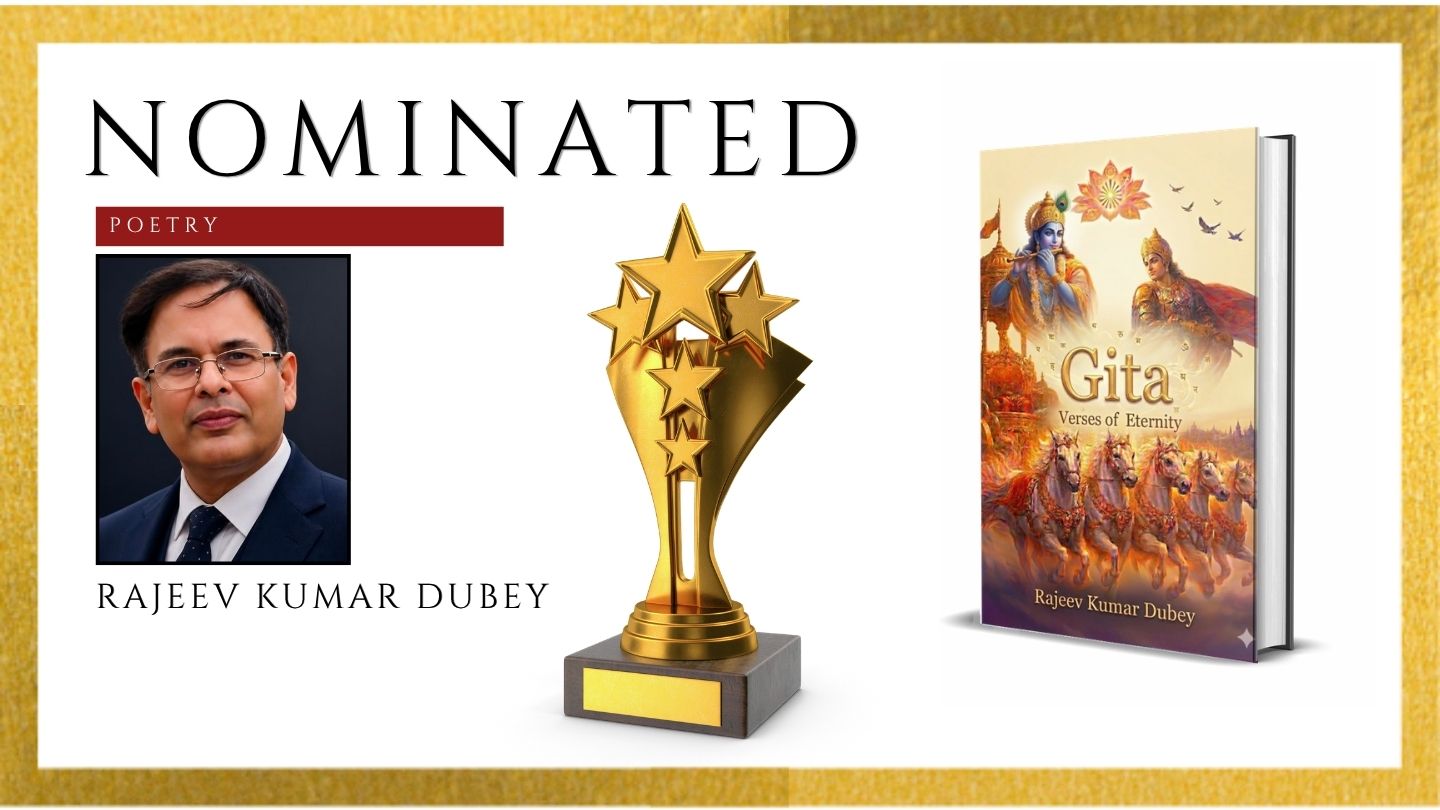
Rajeev Kumar Dubey Officially Nominated for the Ananta Press Sahitya Ratna Award for Gita: Verses of Eternity
Ananta Press is delighted to congratulate Rajeev Kumar Dubey on the official nomination of his poetry book, Gita: Verses of Eternity, for the prestigious Ananta Press Sahitya Ratna Award. This nomination recognises a work that brings together literary sensitivity, spiritual reflection, cultural understanding, and a sincere desire to make the timeless wisdom of the Bhagavad Gita more accessible to contemporary readers. For centuries, the Gita has remained one of the most influential spiritual and philosophical texts in the world. Its teachings have inspired philosophers, saints, reformers, scientists, thinkers, and leaders across generations. Yet, for many modern readers, the beauty and depth of its original Sanskrit verses can sometimes appear difficult to approach. Gita: Verses of Eternity responds thoughtfully to this challenge by presenting the spirit of the Gita through poetry, allowing its enduring ideas to speak to readers in a form that feels engaging, contemplative, and approachable. The Ananta Press Sahitya Ratna Award honours literary works that demonstrate originality, meaningful thought, cultural or social relevance, reader impact, and a significant contribution to literature. The nomination of Gita: Verses of Eternity reflects the award committee’s appreciation for a book that does more than revisit a revered spiritual text. It attempts to create a bridge between an ancient philosophical conversation and the questions faced by people living in the modern world. What particularly distinguishes the book is its inclusive approach. It is written not only for readers already familiar with the Gita, but also for those encountering it for the first time. Spiritual seekers from different backgrounds, young people searching for meaning, professionals confronting ethical choices, and thoughtful readers interested in purpose and self-understanding can all find an entry point into its message. At the heart of the book lies an important understanding of the Gita: spirituality does not necessarily require withdrawal from life. Instead, the Gita encourages individuals to participate fully in life while cultivating wisdom, clarity, responsibility, and inner awareness. Through poetic expression, Rajeev Kumar Dubey brings this message closer to the reader, reminding us that the conversation between Krishna and Arjuna was never limited to one battlefield or one historical moment. Its questions about duty, uncertainty, purpose, action, and understanding continue to resonate today. The award committee also recognises the intellectual and personal background that Rajeev Kumar Dubey brings to this work. He serves as a Professor of Anaesthesiology at the Institute of Medical Sciences, Banaras Hindu University, Varanasi, with an academic background spanning Anaesthesiology, Critical Care, and Hospital Administration. His professional life as a physician and teacher places him in environments where responsibility, human vulnerability, judgement, compassion, and ethical decision-making have profound importance. Alongside his distinguished medical and academic career, he has developed a significant literary identity as a sensitive poet and candid author. His deep engagement with Indian culture, literature, history, spirituality, meditation, yoga, and particularly the Gita provides a strong foundation for Gita: Verses of Eternity. His literary interests are therefore not separate from the book’s subject; they represent a sustained exploration of the philosophical and cultural traditions that have shaped his thinking. His poetry has consistently reflected themes of truth, social harmony, universal brotherhood, and human values. These concerns are particularly relevant to a poetic interpretation inspired by the Gita, a text whose teachings repeatedly invite readers to look beyond narrow self-interest and develop a deeper understanding of action, responsibility, consciousness, and human relationships. Rajeev Kumar Dubey’s poems have appeared in literary journals, have been presented on literary and poetic platforms, and have also been broadcast through All India Radio. The appreciation his poetry has received demonstrates his ability to communicate reflective ideas to audiences beyond purely academic or spiritual circles. The originality of Gita: Verses of Eternity lies in the author’s attempt to preserve the philosophical essence of a timeless work while presenting it through a literary form capable of touching readers emotionally as well as intellectually. Poetry gives the author an opportunity to transform philosophical reflection into an experience of rhythm, imagination, contemplation, and personal connection. For the Ananta Press Sahitya Ratna Award committee, this combination of literary expression and enduring philosophical relevance makes the book especially worthy of recognition. Its contribution lies not in replacing traditional readings of the Gita, but in opening another doorway into them. A reader who may initially feel distant from Sanskrit scripture can encounter its fundamental questions through accessible poetic expression and perhaps be encouraged to explore its wisdom more deeply. The nomination also celebrates literature that strengthens meaningful dialogue between India’s cultural inheritance and contemporary life. At a time when individuals across generations continue to search for clarity, purpose, ethical direction, emotional balance, and a sense of connection, Gita: Verses of Eternity offers a literary invitation to revisit wisdom that has survived for centuries because its questions remain profoundly human. Ananta Press warmly congratulates Rajeev Kumar Dubey on this well-deserved nomination for the Ananta Press Sahitya Ratna Award. His ability to bring together the disciplines of medicine, teaching, poetry, spirituality, and Indian philosophical thought gives his literary contribution a distinctive depth. We extend our best wishes to him as Gita: Verses of Eternity continues its journey towards readers. May his words inspire reflection, encourage meaningful engagement with the wisdom of the Gita, and contribute to the continuing conversation between timeless philosophy and contemporary humanity. Through this nomination, Ananta Press is proud to recognise Rajeev Kumar Dubey’s thoughtful contribution to poetry, spiritual literature, and the enduring literary tradition of exploring the deepest questions of human life.
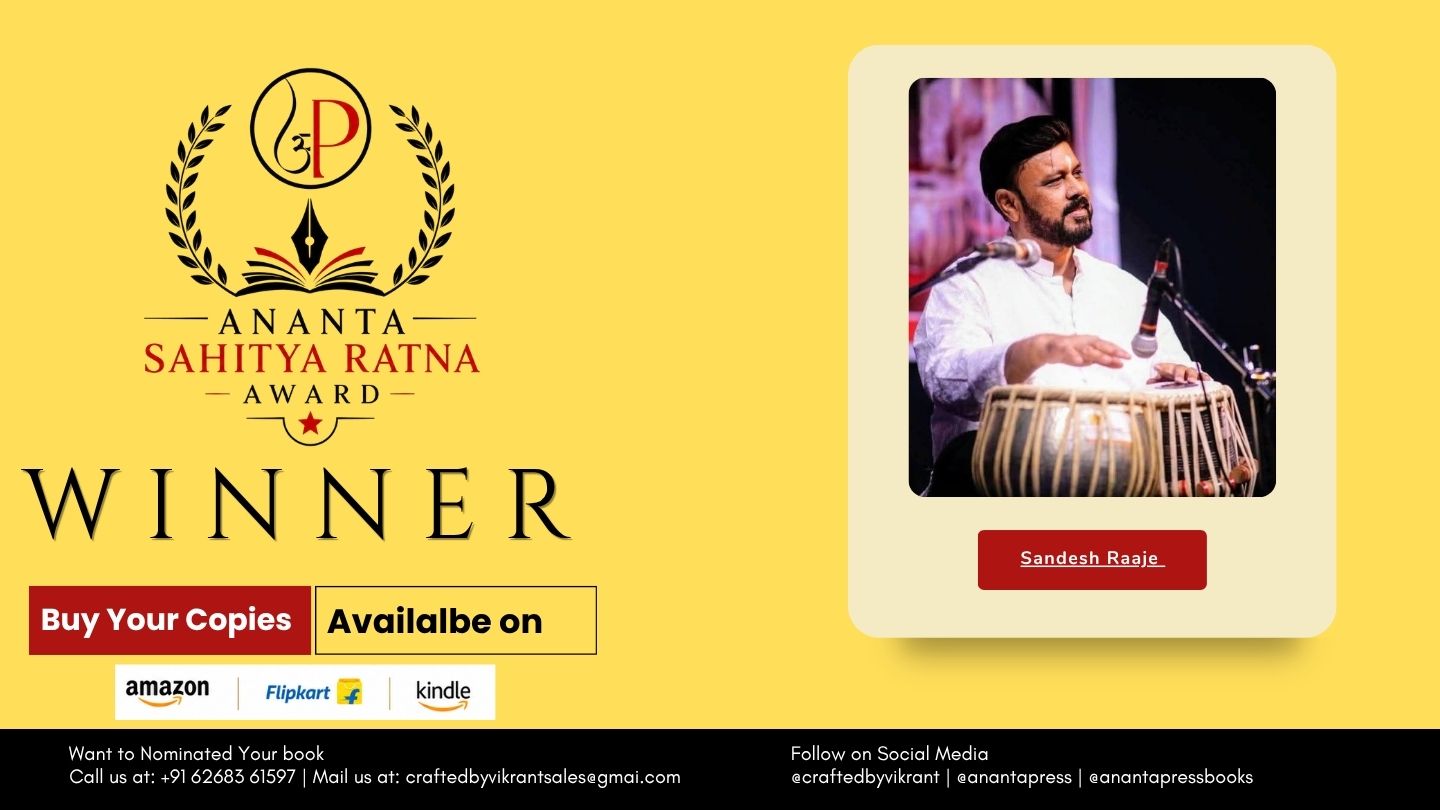
Sandesh Raaje Announced as Official Winner of the Ananta Press Sahitya Ratna Award for शास्त्रीय/उपशास्त्रीय गायना मधील तबला संगत
Ananta Press is pleased to congratulate Sandesh Raaje on being officially recognized as a Winner of the Ananta Press Sahitya Ratna Award for his important musical work, शास्त्रीय/उपशास्त्रीय गायना मधील तबला संगत. The recognition celebrates a book that gives serious attention to the role of tabla accompaniment in classical and semi classical Hindustani vocal music and brings a specialized area of musical knowledge to students, performers, and music lovers. The book focuses on a subject that is central to Hindustani performance but is often understood mainly through direct training and stage experience. Tabla accompaniment is not simply the act of maintaining rhythm. It requires close listening, knowledge of musical form, sensitivity toward the vocalist, control of tempo, and the ability to contribute without overpowering the main performance. By placing this subject at the centre of a dedicated book, Sandesh Raaje gives learners an opportunity to study accompaniment as an art that deserves its own attention, discipline, and understanding. This practical relevance was an important reason for the book’s selection by the Ananta Press Sahitya Ratna Award committee. The book is useful not only for tabla students and tabla players but also for teachers, vocalists, serious listeners, and anyone who wishes to understand how rhythm supports and enriches Hindustani vocal music. It offers readers a way to look beyond the visible performance and appreciate the musical communication that takes place between the singer and the accompanist. Sandesh Raaje’s own musical journey adds special value to the work. He comes from a family with a rich legacy of Tabla and Pakhavaj and has received extensive training in this musical tradition. He has been closely associated with legendary Tabla maestro Pt. Bhai Gaitonde and had the privilege of learning under his guidance for many years. This long period of study, practice, observation, and guru-guided learning gives the subject a strong foundation in lived musical experience. The book therefore carries the value of knowledge shaped not only by theory but also by disciplined engagement with the tradition. The award committee also recognized the originality of the book’s focus. Music literature often gives attention to performers, compositions, instruments, or broad theories of rhythm, but the specific art of accompanying classical and semi classical vocal music deserves deeper documentation. शास्त्रीय/उपशास्त्रीय गायना मधील तबला संगत helps address that need. It preserves and communicates knowledge that is frequently passed from teacher to student through demonstration and repeated practice. Recording such knowledge in book form can help it reach readers beyond a single classroom, institution, or generation. The literary and educational value of the book lies in this combination of specialization, practical purpose, and cultural preservation. It encourages students to understand that becoming a capable Tabla player is not only about speed, technique, or individual display. Accompaniment asks for maturity, restraint, musical awareness, and respect for the complete performance. This message has relevance for emerging artists because it presents musicianship as a form of collaboration and responsibility. The Ananta Press Sahitya Ratna Award seeks to recognize authors whose books bring meaningful ideas, knowledge, cultural value, and lasting benefit to readers. Works that preserve specialized traditions and make them more accessible to future learners have an important place in this vision. Sandesh Raaje’s book represents this spirit by contributing to the documentation and understanding of Indian classical music through the focused study of Tabla accompaniment. The six-member award committee considered the book’s subject, usefulness, originality, educational contribution, and connection with a respected musical tradition. Its relevance for both learners and practitioners, together with the author’s deep engagement with Tabla and Pakhavaj heritage, made it a strong candidate for recognition. Ananta Press warmly congratulates Sandesh Raaje on this achievement. We wish him continued success in his musical, educational, and literary journey. May शास्त्रीय/उपशास्त्रीय गायना मधील तबला संगत reach Tabla students, performers, teachers, and music lovers across generations and encourage a deeper understanding of the sensitive and essential role of Tabla in Hindustani vocal music. His contribution is not only to readers but also to the preservation and continuation of a rich musical tradition. Draft Committee Feedback for Reviewer Approval Glenville Ashby शास्त्रीय/उपशास्त्रीय गायना मधील तबला संगत is a focused and useful work because it brings attention to an area of music that is often experienced on stage but not always explained carefully for learners. The author presents the role of Tabla in classical and semi classical Hindustani vocal music as a serious subject of study, not merely as background accompaniment. What I found valuable is the practical relevance of the book for Tabla students, performing Tabla players, and listeners who wish to understand the relationship between rhythm and vocal expression. Sandesh Raaje’s long association with the Tabla tradition gives the subject a sense of authenticity and responsibility. The book also helps readers see that good accompaniment requires sensitivity, discipline, listening, and musical understanding. It can encourage young musicians to look beyond technique and understand the larger responsibility of supporting a vocalist. For these reasons, I consider the book a meaningful contribution to music education and a deserving work for recognition. Kavya Pandey This book stands out for choosing a specialized subject and presenting it with a clear educational purpose. Tabla is widely admired, yet many readers and even students may not fully understand how carefully a Tabla player must respond while accompanying classical and semi classical vocal music. Sandesh Raaje brings this important subject into focus. The strength of the book lies in its usefulness. It can serve students who are learning Tabla, musicians who are beginning to accompany vocalists, and music lovers who want a deeper appreciation of Hindustani performance. The author’s musical background and years of learning under a respected guru add depth to the work. I also appreciate that the book preserves knowledge connected with a living guru-shishya tradition while making it available to a wider audience through writing. Such books are valuable because they connect practice, experience, and documentation. The work has a clear purpose, a distinct subject, and strong relevance for future generations of musicians.
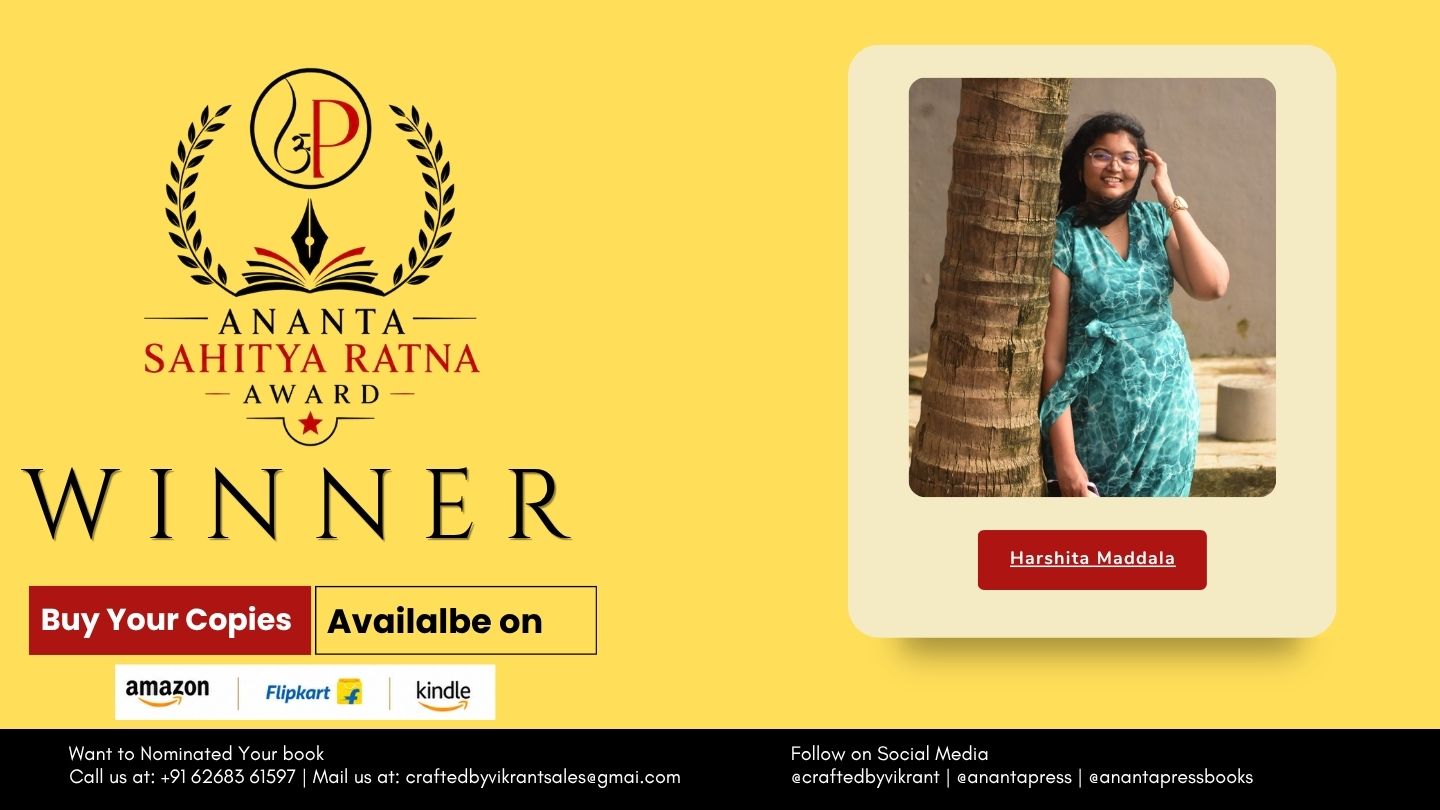
Harshita Maddala Officially Honoured as Winner of the Ananta Press Sahitya Ratna Award for My Orchid
Ananta Press is delighted to congratulate Sree Harshita Maddala on being officially declared a Winner of the Ananta Press Sahitya Ratna Award for the romance fiction novel My Orchid: A Love Story That Destiny Refuses to Complete. This recognition celebrates a story that approaches love through an unusual and emotionally sensitive idea, where two people begin to understand one another without first knowing each other’s identity. My Orchid begins with Hardhik, a young man carrying the pain of heartbreak. Seeking distance from the life he has known, he retreats to a secluded cabin in the woods with the hope of rebuilding himself. His journey changes when he discovers a mysterious diary titled Truth or Dare. What appears at first to be a simple and playful object slowly becomes the beginning of an anonymous exchange. Through diary entries, dares, secrets, emotions, and honest words, Hardhik develops a connection with a stranger he has never met. This central idea gives the novel its strongest literary quality. Instead of building romance only through physical meetings, conversations, or familiar situations, the story gives written words an important role. The diary becomes more than a plot device. It becomes a private space where two people can reveal emotions that may be difficult to speak aloud. This creates curiosity for the reader while also giving the romance a quiet emotional depth. The award committee found the book worthy of recognition because of the way it brings together heartbreak, healing, mystery, emotional intimacy, and the uncertainty of fate. The title itself, My Orchid: A Love Story That Destiny Refuses to Complete, suggests beauty, tenderness, and incompleteness. It prepares the reader for a love story that may not follow the expected path. The book asks a powerful question: what is harder to bury, a memory or a possibility? That question gives the story a reflective quality and allows readers to think beyond the events of the novel. Another important strength of the book is its focus on emotional connection. In a time when relationships are often introduced through immediate identities, appearances, and quick interactions, My Orchid explores what can happen when two people first meet through thoughts and feelings. Their anonymous exchange allows trust to grow slowly. The story reminds readers that sometimes a person can become meaningful through the way they understand us, listen to us, and respond to what we are afraid to say openly. The selection committee also appreciated the emotional contrast at the heart of the novel. Hardhik begins from a place of loss, but the mysterious diary gives him a new possibility. The movement from pain to curiosity and from isolation to connection creates a meaningful emotional journey. At the same time, the presence of fate prevents the story from becoming a simple or predictable romance. The book recognizes that love can be sincere even when it is uncertain, and that some relationships leave a lasting effect even when destiny does not allow them to reach the ending people hope for. The Ananta Press Sahitya Ratna Award seeks to recognize authors and books that bring originality, emotional value, thoughtful storytelling, and a meaningful contribution to readers. My Orchid represents these qualities through its distinctive premise and its focus on the inner experience of love. Its blend of romance, mystery, personal healing, and destiny gives readers both an engaging story and a reason to reflect on memory, possibility, and the emotional traces people leave in one another’s lives. Sree Harshita Maddala deserves appreciation for choosing a concept that is simple to understand but rich in emotional possibilities. The anonymous diary exchange gives the novel its own identity within romance fiction and creates room for tenderness, suspense, and reflection. The book shows how deeply words can connect two strangers and how love can grow in unexpected spaces. On behalf of Ananta Press and the Ananta Press Sahitya Ratna Award committee, we warmly congratulate Sree Harshita Maddala on this achievement. May this recognition bring My Orchid to more readers and encourage the author to continue creating stories that explore human emotions with sensitivity and imagination. We wish Sree Harshita Maddala continued success and proudly recognize this contribution to contemporary romance fiction and literature. Jury Feedback Glenville Ashby My Orchid is an emotionally engaging romance that uses a very interesting idea to bring two people together. I especially liked the use of the diary Truth or Dare because it creates curiosity without making the story feel complicated. Hardhik’s decision to move away after heartbreak gives the novel a believable emotional beginning. His loneliness makes the anonymous diary exchange feel even more meaningful. As the entries continue, the reader can understand how words slowly become a source of comfort, hope, and attachment. I also appreciated that the story does not treat love as something that always follows a perfect path. Fate remains an important part of the novel and adds emotional tension to the relationship. The question about whether a memory or a possibility is harder to bury stays with the reader. For me, the strength of this book lies in its emotional simplicity, unusual romantic setup, and its understanding of how deeply an unseen person can affect someone’s life. Kavya Pandey What stood out to me in My Orchid was the gentle way the story develops its romance. The connection does not begin with appearance, attraction, or a direct meeting. It begins through words written in a diary, which gives the relationship a different kind of honesty. The idea of two strangers sharing dares, secrets, and emotions anonymously is both romantic and full of suspense. Hardhik’s heartbreak also gives the story emotional weight because the reader meets him at a time when he is trying to understand himself again. The diary becomes part of that healing process. I found the theme of incomplete love particularly effective because the book accepts that meaningful relationships do not always end in the way we expect. Sometimes the possibility of what could have been becomes as powerful as the relationship