
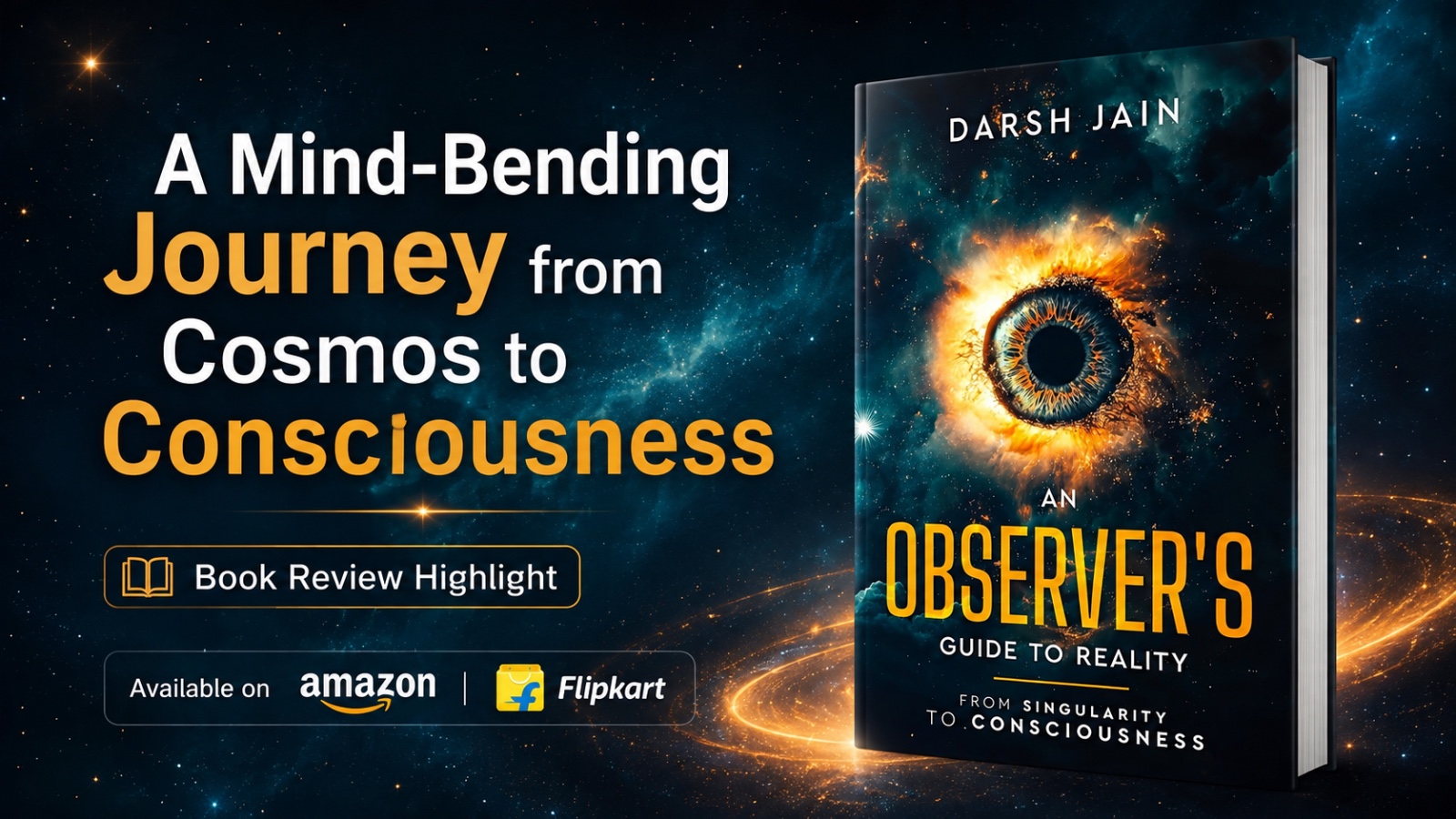
The final message of An Observer’s Guide to Reality can be expressed in one word: understanding. Darsh Jain spends much of the book teaching the reader how the universe, life, evolution, society, and the brain can be understood through causes rather than through inherited explanations. In the last chapter, that method is turned inward. The reader is asked to observe thoughts and emotions with the same curiosity used earlier to observe atoms, species, or human history. This is where the book becomes more than a collection of scientific and philosophical ideas. It becomes a practice of attention. Instead of asking only, “What is reality?” it asks, “How does my mind create the reality I experience?” That is a question with direct value in everyday life.
Consider something simple such as anger. A person cuts you off in traffic, interrupts you, or says something insulting. The event happens quickly, but the emotional reaction can feel immediate and complete. We usually say, “You made me angry.” The final chapter asks us to separate the event from the interpretation. The body may react. The nervous system may prepare for conflict. A thought may appear: this person disrespected me. Memory and cultural ideas about pride may strengthen that thought. Then anger becomes the lens through which the whole moment is seen. Observing the observer means noticing this process instead of assuming that the emotion is the world itself.
The book makes the same point with joy, grief, fear, love, jealousy, and identity. Two people can walk through the same street and experience different worlds because perception is not a camera. The brain filters sensory information through expectation, memory, attention, and emotion. Someone newly in love may find ordinary things beautiful. Someone in grief may find the same environment empty. Nothing outside needs to change for the experienced world to change. This is one of the most useful ideas in the book because it reminds us that our emotional reality is real to us without necessarily being an objective description of everything around us.
Why does this matter? Because many conflicts begin when people treat their interpretations as facts. We assume that our anger proves another person intended harm. We assume that our fear proves danger. We assume that our identity proves superiority. We assume that a belief feels true because it is true. Jain’s broader scientific method teaches the opposite habit: pause, observe, ask what evidence exists, and ask what processes may be shaping the conclusion. In personal life, this can create a small space between reaction and response. That space may be one of the most practical forms of freedom available to us.
The book also connects understanding with compassion. If behaviour emerges from biology, development, learning, environment, and social conditioning, then other people become more complicated. A person shouting in anger may be acting through a nervous system shaped by stress, fear, and past experience. A person holding tightly to a belief may connect that belief with family, safety, identity, and love. Understanding these causes does not require accepting harmful behaviour. It simply prevents us from reducing a human being to one action or one label. The book suggests that the more we understand the machinery behind behaviour, the less quickly we judge.
This ethical direction is important because the book’s scientific worldview could otherwise feel cold. If people are biological systems, does morality disappear? Jain argues the opposite. Suffering remains real because conscious beings experience it. We do not need a supernatural command to recognise pain. Compassion can be grounded in the fact that other nervous systems can be hurt, frightened, isolated, or supported. Morality can become less about earning reward or avoiding punishment and more about understanding consequences between living beings. The book’s final chapters therefore move from determinism toward empathy.
The author’s personal reflections also explain why “understanding” became so important to him. He describes a period of intense civil-services preparation in which he gathered large amounts of information across geography, history, economics, polity, science, and current affairs. After not clearing the examination, he began questioning whether knowledge alone was enough. The experience led him toward a different kind of learning—one based on reflection, curiosity, and seeing connections. He writes that knowing can fill the mind while understanding can transform the way we relate to people. That personal journey gives the book’s final message a lived context rather than making it sound like a slogan.
His curiosity then moved across disciplines. History raised questions about repeated wars and the “us versus them” pattern. Anthropology raised questions about human origins. Evolution led to genes and biology. Biology led deeper into molecules and atoms. Quantum mechanics raised questions about matter and reality. Philosophy brought him to absurdism, existentialism, and questions of purpose. This path is reflected in the architecture of the book. The reader is not being shown separate subjects. The reader is watching one question open into another. What began as curiosity about the cosmos eventually becomes curiosity about the mind that is curious.
That makes the book particularly suitable for readers who dislike intellectual boxes. A person may begin with astronomy and end up thinking about morality. Another may begin with philosophy and discover an interest in evolution. A psychology reader may find the chapters on imagined orders useful for understanding identity. A student may discover that science can be a story rather than a syllabus. The book’s value lies in connection. It shows that learning becomes more meaningful when we see how different fields illuminate the same human questions.
Observe the Observer is also a helpful phrase because it does not ask readers to suppress emotion. Observation is not denial. The book does not say, “Do not feel anger,” or “Do not feel grief.” It asks us to notice what is happening without immediately turning the feeling into identity or action. An emotion can be observed as a process. A thought can be seen as an event in the mind. A belief can be traced back to language and culture. This approach has similarities with contemplative practices, but Jain grounds it in his material and neuroscientific view of the mind.
Readers should read An Observer’s Guide to Reality because it joins outer knowledge with inner attention. Many books teach facts about the universe. Many books teach self-awareness. This one tries to connect the two. The atoms in the stars and the neurons behind thought belong to the same physical story. The social systems outside us and the beliefs inside us are linked through language and imagination. The book’s final challenge is to live with that knowledge without becoming cynical. Reality may not have been designed for us, but we can still look carefully. We can still love, learn, reduce suffering, question inherited divisions, and remain open to wonder. Understanding before judging is not a final answer to existence, but it may be one of the wisest ways to live inside it.
Why readers should consider this book
- It turns scientific understanding into a practical habit of self-observation.
- It shows how emotion and memory can colour perception.
- It argues for understanding before judgment without ignoring accountability.
Book link: https://www.amazon.in/dp/934747276X