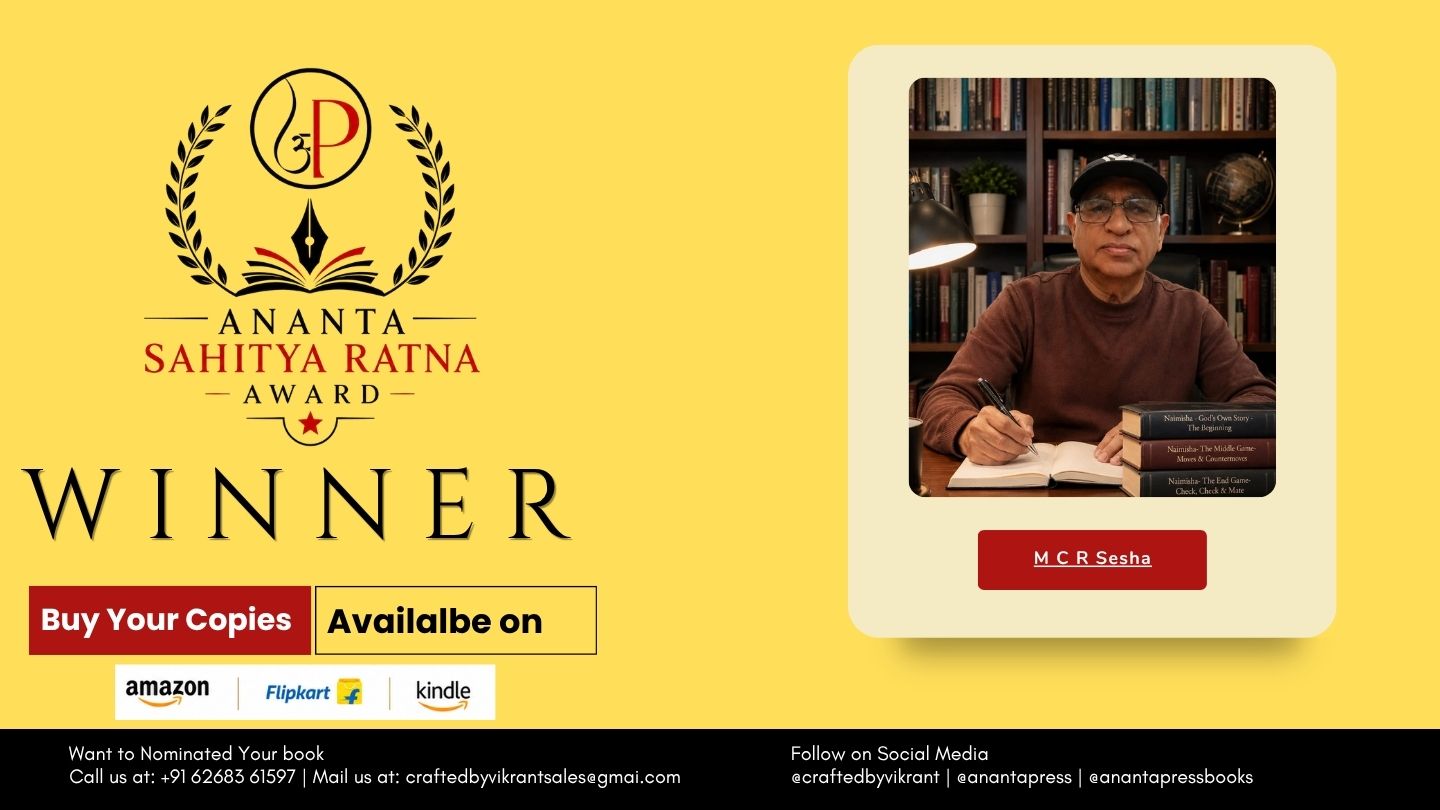
Ananta Press is delighted to officially announce M C R Sesha as a Winner of the prestigious Ananta Press Sahitya Ratna Award for the historical fiction work, NAIMISHA – GOD’S OWN STORY – THE END GAME: CHECK, CHECK & MATE.
This recognition celebrates not only the literary strength of the book but also the author’s thoughtful engagement with one of India’s greatest epics. As the third and concluding volume of the Naimisha Trilogy, the book brings together history, mythology, imagination, philosophy, and human emotion in an ambitious conclusion. The award committee found the book particularly worthy of recognition because it does not merely retell familiar episodes from the Mahabharata. It approaches them through a wider narrative vision and attempts to provide emotional and philosophical closure to characters whose lives and choices have remained subjects of discussion for generations.
NAIMISHA – GOD’S OWN STORY – THE END GAME takes readers into the concluding phase of a carefully developed trilogy. The book explores the Kurukshetra War in detail and further extends its narrative into the wars connected with the Ashwamedha. These important historical and mythological events are presented not simply as scenes of conflict but as turning points in the lives of individuals carrying the burden of decisions, relationships, responsibilities, victories, and losses.
One of the strongest aspects of the book is the manner in which it seeks to provide closure to the major characters of the Mahabharata, including Krishna. Readers who have followed these legendary personalities through familiar traditional accounts are invited to look at their final journeys with renewed curiosity. Through this approach, M C R Sesha creates a work that respects the cultural importance of its source material while bringing an individual literary perspective to it.
The fictional characters Animish and Asareer further strengthen the originality of the trilogy. Their presence enables the author to move between the familiar world of the epic and a more imaginative narrative space. In the final volume, both characters reach the completion of their respective life journeys in very different ways. Their conclusions encourage readers to think about destiny, purpose, choice, mortality, responsibility, and the consequences of human action.
It is this combination of epic history and reflective storytelling that particularly impressed the award committee. Historical fiction becomes memorable when it gives readers more than information about events. It must also create emotional involvement and encourage reflection. NAIMISHA – GOD’S OWN STORY – THE END GAME succeeds in presenting major conflicts while maintaining a philosophical undertone that asks readers to look beyond victory and defeat.
The Ananta Press Sahitya Ratna Award recognises authors and literary works that contribute meaningfully to the reading culture through originality, thoughtful expression, literary commitment, and the ability to leave a lasting impression on readers. Books considered for this recognition are evaluated for their concept, narrative quality, reader value, thematic depth, creativity, and contribution to literature.
M C R Sesha’s work stood out because of the scale of the literary undertaking. Completing a trilogy based around characters and events associated with the Mahabharata requires considerable narrative discipline. The concluding volume carries an additional responsibility because it must bring together developments from the earlier books while giving readers a satisfying conclusion. The End Game achieves this by connecting the destinies of established epic personalities with those of the fictional characters created by the author.
The philosophical undertones of the book also give the work a deeper dimension. The story encourages readers to think about what remains after conflict has ended. It raises questions about fulfilment, consequence, duty, personal journeys, and the meaning of closure. Such questions allow the work to extend beyond historical fiction and become a reflective reading experience.
The award committee also appreciated the courage involved in working creatively with a narrative tradition as significant as the Mahabharata. The epic has been interpreted across centuries through poetry, theatre, scholarship, fiction, television, philosophy, and oral storytelling. To contribute another interpretation requires both respect for the source tradition and confidence in one’s own creative voice. M C R Sesha demonstrates this balance through a narrative that combines known epic events with fictional characters and personal philosophical reflections.
As the final part of the Naimisha Trilogy, this book represents the culmination of the author’s larger literary thought process. It brings together the questions, characters, conflicts, and ideas developed throughout the trilogy and leads them toward their final destinations. The result is a conclusion that aims not only to complete a story but also to leave readers with thoughts that continue after the final page.
Ananta Press warmly congratulates M C R Sesha on being selected as a Winner of the Ananta Press Sahitya Ratna Award. This honour recognises the dedication required to imagine, develop, and complete a substantial literary trilogy while engaging with one of the most culturally significant narrative traditions of India.
We extend our sincere best wishes to M C R Sesha for continued success in the literary journey ahead. May NAIMISHA – GOD’S OWN STORY – THE END GAME reach a wider community of readers and encourage meaningful conversations about history, mythology, philosophy, human nature, and the lasting relevance of the Mahabharata.
Jury Feedback
Glenville Ashby
Reading NAIMISHA – GOD’S OWN STORY – THE END GAME was an interesting experience because the book attempts something difficult. It enters the world of the Mahabharata while still creating its own narrative identity. I particularly appreciated the effort made to give closure to the characters. The Kurukshetra War is familiar to many readers, but this book encourages us to think about what happens emotionally and philosophically when the great conflict has ended. The inclusion of the Ashwamedha wars gives the story a wider historical and narrative scope. I also found Animish and Asareer important because they allow the author to bring an original fictional dimension into a world readers already know. Their different journeys add emotional variety to the conclusion. The philosophical reflections are another strength of the book. The story is not only concerned with who wins or loses. It encourages readers to consider destiny, duty, consequences, and the final meaning of a person’s journey. This makes the book a thoughtful conclusion to the trilogy.
Kavya Pandey
What stayed with me after reading this book was its sense of completion. A final volume has the responsibility of answering questions and giving readers a feeling that the journey they followed has reached its proper destination. M C R Sesha makes a sincere effort to provide that experience. The treatment of the Mahabharata characters, particularly the attempt to provide closure even to Krishna’s journey, gives the book emotional importance. I also enjoyed how the fictional characters Animish and Asareer are brought to the ends of their individual paths. Their conclusions are different, and because of that, readers are encouraged to think about how every human life follows a unique course. The descriptions surrounding Kurukshetra and the Ashwamedha conflicts add historical interest, while the philosophical tone prevents the story from becoming only a record of wars. There is always an effort to look at the human meaning behind events. I believe this balance between epic storytelling, imagination, and reflection gives the book its special literary value and makes it worthy of recognition.
Apeksha Gupta
NAIMISHA – GOD’S OWN STORY – THE END GAME appealed to me because it combines familiar epic material with the author’s own creative thinking. Writing around the Mahabharata is challenging because readers already carry strong images and expectations about its characters. M C R Sesha does not simply repeat those familiar stories. Instead, the book attempts to look at the final stages of these characters and asks readers to consider what their journeys ultimately mean. I found the philosophical undertone especially meaningful. After enormous battles and major decisions, there must eventually be a moment when every character faces the consequences of the path taken. The book explores this idea effectively. Animish and Asareer also contribute greatly to the originality of the story. Their fictional journeys exist alongside the epic characters without feeling unnecessary. Their different conclusions create questions about destiny, purpose, and the choices people make. As the concluding volume of a trilogy, the book carries considerable responsibility, and I feel it succeeds in creating a thoughtful and meaningful ending for readers.
Kavita Kaushik
For me, the strength of this book lies in the way it looks beyond the battlefield. The Kurukshetra War is one of the most discussed conflicts in Indian literature and tradition, but the author is interested not only in the events of war. He is equally interested in what those events do to people and what happens when the fighting is finally over. This gives the book emotional depth. I also appreciated the continuation into the Ashwamedha period because it reminds readers that history does not stop immediately after one major victory. Life, responsibility, politics, relationships, and consequences continue. The fictional journeys of Animish and Asareer add another important layer. Their stories allow readers to experience the larger epic world through different emotional and philosophical perspectives. The book raises questions without always forcing simple answers, which I consider a strength. It encourages readers to reflect on duty, ambition, destiny, sacrifice, and mortality. Overall, the novel feels ambitious in scale and thoughtful in intention, making it a fitting conclusion to the Naimisha Trilogy.
Neel Preet
I found this book valuable because it respects the scale of the Mahabharata while also showing the courage to interpret it creatively. Historical and mythological fiction works best when readers recognise the world being presented but can still discover something new within it. This book achieves that through its combination of established epic personalities and original fictional characters. Animish and Asareer are especially important in this respect. Their presence provides another way of looking at the events and ideas surrounding the larger story. Their final journeys also create some of the book’s most reflective moments. I appreciated the attention given to closure because characters in great epics often remain alive in the reader’s imagination even after their major role in the story has ended. M C R Sesha attempts to address this by considering where these journeys finally lead. The philosophical elements deepen the narrative and encourage reflection about the meaning of action and consequence. The result is a book that offers both storytelling and thought, which is why I believe it deserves recognition.
Deepak Seth
Completing a trilogy successfully is a major literary task because the final book must carry the weight of everything that came before it. NAIMISHA – GOD’S OWN STORY – THE END GAME feels conscious of that responsibility. The author brings together the epic conflicts, the established Mahabharata characters, the fictional characters, and the philosophical ideas developed through the larger narrative. I was particularly interested in the book’s treatment of endings. The title itself suggests that the story has reached a decisive stage, but the ending is not presented only in terms of victory or defeat. Instead, the reader is invited to think about what completion truly means for different characters. Animish and Asareer reach different destinations, and their contrasting journeys give the conclusion emotional and philosophical weight. The sections connected with Kurukshetra and Ashwamedha also add scale and historical interest. At the same time, the book continues to ask questions about duty, consequence, destiny, and the purpose of individual life. For these reasons, I found it a thoughtful and deserving literary work.