
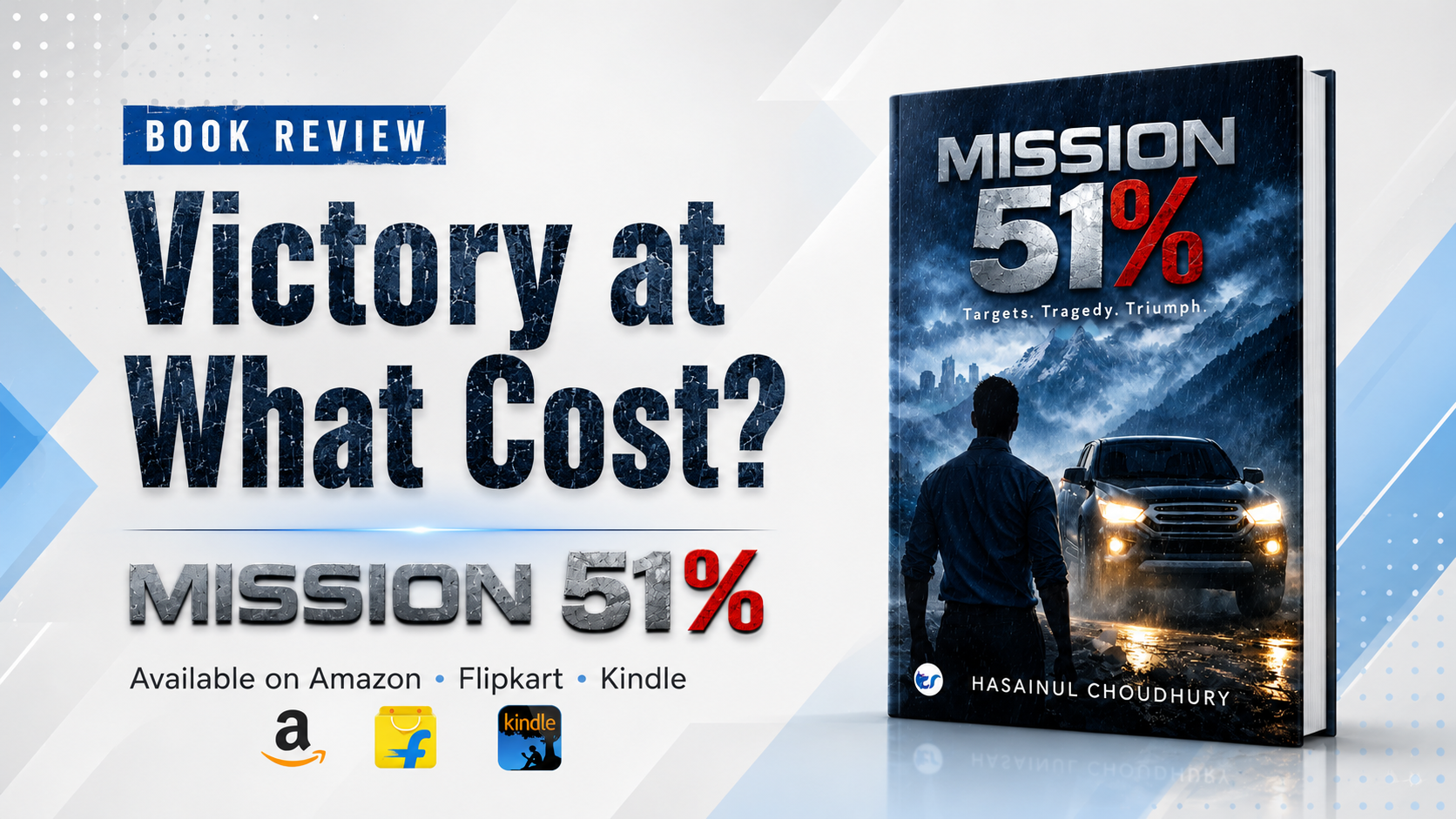
The dealership achieves its target. Arjun emerges as the top performer. A better career opportunity arrives. These are the facts of Mission 51%’s ending — and they are almost irrelevant compared to the question the novel has spent 72,000 words building toward: at what cost?
The Architecture of the Cost
The novel opens with a rescue in a storm — cinematic, immediate, and immediately revealing about who Arjun is. Since 2013, he has not merely sold trucks. He has attended funerals, helped customers navigate financial crises, celebrated harvests, and absorbed the rhythms of rural life into his professional identity. This is not backstory. It is the foundation of the novel’s central argument: that the most durable form of business success is built on human investment, not transactional efficiency. And that the system, eventually, will attempt to consume both.
The Turbo Cheetah is the mechanism of that consumption. Plagued by cracked chassis, faulty engines, and failing tires, the truck is a corporate blunder handed to field sales teams to sell — because the boardroom’s timeline cannot wait for engineering to catch up. This is the novel’s first act of violence, and it is entirely institutional. No individual villain deploys the Turbo Cheetah. The system simply requires it to exist, and assigns its consequences to the person least protected from them.
Arjun does not collapse under this pressure. He manoeuvres, negotiates, humanises, and endures. The thriller mechanics of Mission 51% derive from watching a fundamentally decent person operating inside a system that is systematically indifferent to decency. That is a more disturbing source of tension than any individual antagonist, because it cannot be defeated — only survived.
“Corporate success gets a press release. The cost gets buried. Mission 51% is the story of who does the burying.”
The Whistleblower and What She Represents
Isha is the novel’s moral centre. In a narrative populated by people who have learned to accommodate institutional dysfunction — because the alternatives are too costly — she is the character who refuses accommodation. Her attempt to speak the truth about what the Turbo Cheetah is doing to customers and to the company’s integrity makes her dangerous to the system in the way that only honest people ever are.
Her silencing is Mission 51%’s point of no return. After Isha, the novel is no longer about market share. It is about what remains of a person — and a mission — once the most important thing has been taken. Arjun continues. He exceeds his targets. He achieves the 51%. But the reader, who has been with him through everything that preceded that number, knows exactly what the number does not capture.
This is what separates Mission 51% from inspirational business fiction. It does not argue that sacrifice produces reward in any proportionate or just sense. It argues that some people carry missions that no quarterly report will ever adequately represent — and that this is a fact about the real economy that deserves to be told.
The Sequence That Builds to ‘At What Cost?’
The novel’s three movements work like an escalating thriller. The first establishes the world and the person: Arjun, his customers, his relationships, his market, his product problem. The second deploys the crisis: the Turbo Cheetah’s failures, the legal exposure, the institutional pressure, Isha’s murder. The third is the aftermath: a broken-legged, grief-carrying man who continues to function, continues to sell, and eventually achieves the target that was supposed to be the point of the whole exercise.
Chapter 25, Negotiating Over Bottles, is the novel at its most insider — a forensic portrait of dealer-manufacturer relationships that will resonate with anyone who has worked inside India’s automotive distribution ecosystem. Chapter 33, The Mileage Challenge, is the set piece that encapsulates the entire novel’s spirit: strategy, competition, ethics, and physical endurance colliding in a single scene. And Chapter 40, The Day the Mountains Wept, is where the novel collects all of its emotional debts and pays them in full.
What This Story Says About Indian Business in 2026
India in 2026 is a country that measures its economic health in aggregate figures. GDP. Vehicle sales. Export volumes. Infrastructure investment. These are real and important numbers. What they do not capture — and what Mission 51% insists on capturing — is the human texture of how those numbers are produced. The financial pressures of frontline workers. The mental health toll of targets that were always designed to feel out of reach. The ethical compromises demanded of people who cannot afford to refuse.
Most news stories celebrate the success. Mission 51% covers the story that runs alongside every celebration — the one about the people who made it happen, what it cost them, and why we will not see their names in the press release.
The dealership achieves Mission 51%. Arjun earns his better opportunity. The novel ends. And the question that has been building since Chapter 1 — at what cost? — does not resolve. It echoes. That is exactly what a great business thriller should do.