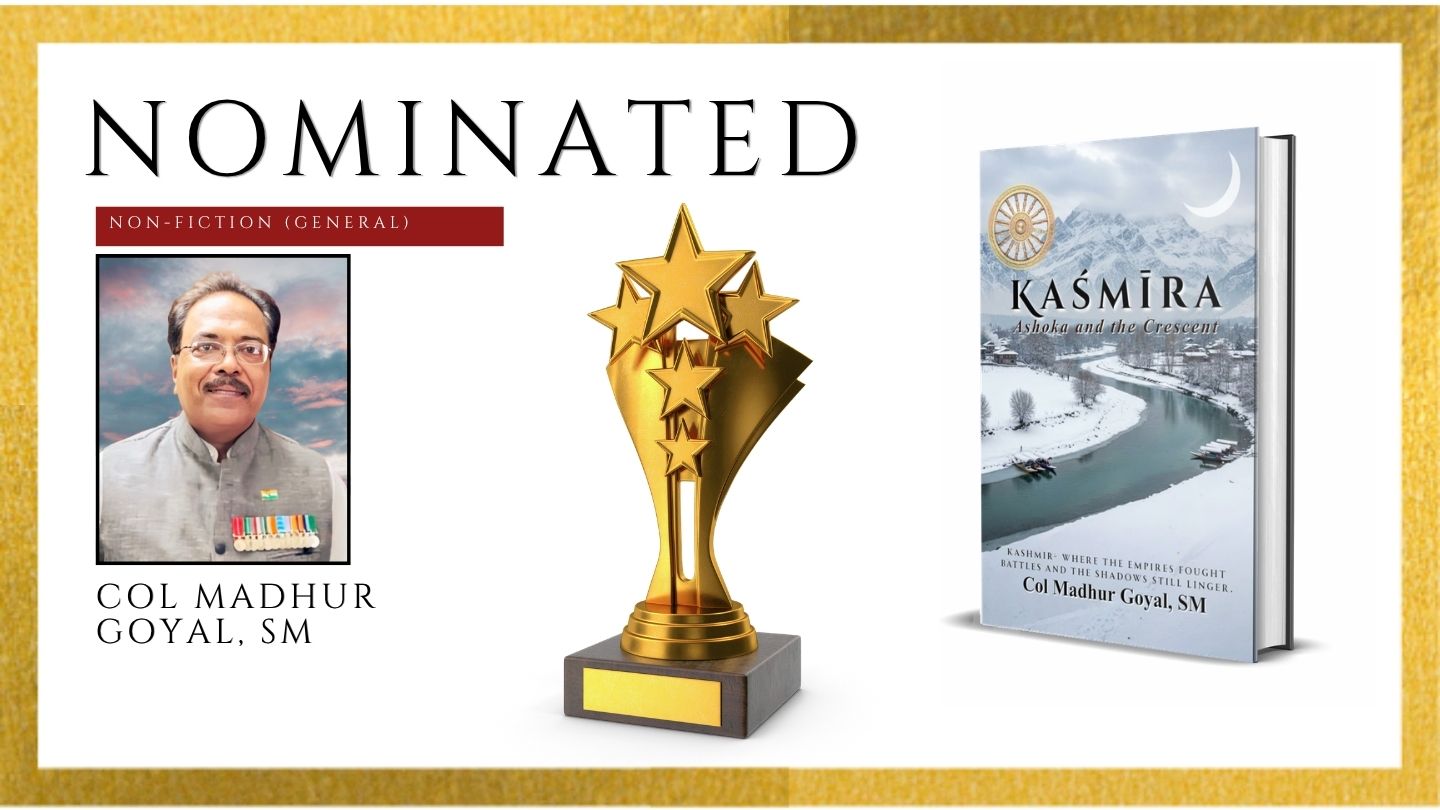
Ananta Press is delighted to congratulate Col Madhur Goyal, SM, on the official nomination of his remarkable non-fiction work, Kaśmīra: Ashoka and the Crescent, for the prestigious Ananta Press Sahitya Ratna Award.
This nomination recognises not only the literary and historical value of the book but also the author’s courageous effort to explore one of the most complex, contested, and emotionally significant regions of the Indian subcontinent. Through an ambitious combination of history, geography, military experience, political analysis, spirituality, and personal reflection, Col Madhur Goyal presents Kashmir not merely as a territory shaped by conflict, but as a civilisation carrying centuries of memory, faith, identity, and unresolved longing.
A Journey into the Soul of Kashmir
Kaśmīra: Ashoka and the Crescent is far more than a conventional historical account. It is a sweeping journey into the soul of Kashmir—from its snow-covered mountains, ancient rivers, and sacred landscapes to its battlefields, shrines, dynasties, religious traditions, and modern geopolitical struggles.
The book begins with the land itself, demonstrating how Kashmir’s mountains, valleys, waterways, and strategic location influenced the development of its kingdoms and cultures. It then moves through ancient dynasties and examines the rise and influence of Buddhism, Hinduism, Sikhism, Islam, and the mystical traditions of Sufism.
By presenting these faiths and philosophies as essential elements of Kashmir’s evolving identity, the author allows readers to understand the region beyond contemporary headlines. Kashmir emerges as a place where different civilisations met, interacted, flourished, competed, and left lasting impressions upon the cultural consciousness of its people.
The narrative gradually enters the turbulent twentieth century, exploring the dilemmas faced by Maharaja Hari Singh, the trauma of Partition, and the wars that permanently altered the political and geographical landscape of the region. The book examines the conflicts of 1947, 1965, and 1971, the rise of militancy in 1989, the painful exodus of Kashmiri Pandits, the Kargil War, and subsequent military and strategic developments.
What makes the book especially powerful is its refusal to treat these events as isolated dates in a historical timeline. Instead, Col Madhur Goyal examines their human, political, military, and psychological consequences.
A Soldier’s Insight and an Author’s Reflection
The award committee found the author’s personal connection with Kashmir particularly significant. Col Madhur Goyal served in the Indian Army and experienced some of the country’s most demanding operational environments, including counter-insurgency operations in the Northeast, service on the Siachen Glacier, operations during Punjab militancy, and multiple tenures in the Kashmir Valley.
In 2002, during an intense anti-terrorist operation in Budgam district, ten heavily armed terrorists, including foreign mercenaries, were eliminated. For his courage and leadership, he was awarded the Sena Medal for Gallantry. His military career and direct exposure to the physical, emotional, and strategic realities of conflict give his writing an authority that cannot be gained through secondary research alone.
His connection with Kashmir is therefore not distant or purely academic. It is shaped by duty, sacrifice, observation, loss, leadership, and lived experience. In Kaśmīra: Ashoka and the Crescent, he returns through literature to the land where he served during four significant tenures and earned recognition for gallantry.
This personal history lends the book both emotional depth and intellectual seriousness. The author writes with the discipline of a soldier, the curiosity of a historian, and the sensitivity of someone who has witnessed the cost of conflict at close quarters.
Beyond a Two-Nation Narrative
One of the most original aspects of the book is its expansion of the Kashmir question beyond the traditional India–Pakistan framework.
Through sections dealing with Siachen, Aksai Chin, the 1962 India–China War, the China–Pakistan Economic Corridor, and the strategic ambitions of global powers, the author demonstrates how Kashmir has become part of a larger triangular and international contest.
The symbols within the title carry powerful meaning. “Ashoka” reflects India’s vision of civilisational unity and historical continuity. The “Crescent” represents Pakistan’s political narrative and its call for self-determination. The “Dragon” symbolises China’s strategic calculations. Alongside these competing national visions are the diverse voices, aspirations, fears, memories, and identities of Kashmiris themselves.
This layered approach gives the book considerable originality. It does not reduce Kashmir to a single political slogan or one-dimensional explanation. Instead, it invites readers to confront multiple histories and competing dreams.
Why the Book Deserves This Nomination
The Ananta Press Sahitya Ratna Award honours literary works that demonstrate originality, intellectual depth, cultural importance, social relevance, and the power to create a meaningful impact upon readers.
Kaśmīra: Ashoka and the Crescent reflects all these qualities.
The award committee selected the book because it combines extensive historical scope with the immediacy of lived experience. It educates readers about Kashmir’s geography, religions, dynasties, wars, political turning points, military challenges, and international significance while continuously returning attention to the human consequences of history.
The chapters on the frozen battlefield of Siachen are especially compelling. Here, soldiers confront not only visible adversaries but frostbite, avalanches, isolation, altitude, and extreme cold. Such passages remind readers that geopolitical boundaries are often defended through extraordinary acts of endurance that remain invisible to the wider public.
The book also makes an important contribution by remembering painful and sensitive episodes, including militancy and the displacement of Kashmiri Pandits. At the same time, it preserves the region’s spiritual and cultural richness, ensuring that Kashmir is not remembered only through war.
Its literary value lies in this balance: the book is expansive yet intimate, factual yet reflective, strategic yet deeply human.
Honouring a Distinguished Literary Contribution
Col Madhur Goyal’s journey as an author began after his retirement from the Indian Army in October 2017. His first literary work, Wayfare of a Soldier – A Memoir, brought together more than three decades of military experience. He subsequently authored The Smoking Hookahs, the poetry collection Sur-Madhur Sankalan, and The Accidental Humourist, displaying an impressive ability to write across memoir, national security, poetry, history, and humour.
With Kaśmīra: Ashoka and the Crescent, he has created a work of lasting relevance—one that encourages informed discussion, historical understanding, national reflection, and empathy.
At the heart of the book stands a haunting question: Can a land of faith and fire ever find peace beyond the shadows of history?
It is this question, and the courage with which the author pursues it, that makes the book especially deserving of recognition.
Ananta Press warmly congratulates Col Madhur Goyal, SM, on his official nomination for the Ananta Press Sahitya Ratna Award. We extend our best wishes to him and honour his distinguished contribution to Indian literature, military writing, historical understanding, and public discourse.
May his words continue to educate readers, preserve important memories, inspire thoughtful dialogue, and illuminate the many dimensions of Kashmir for generations to come.