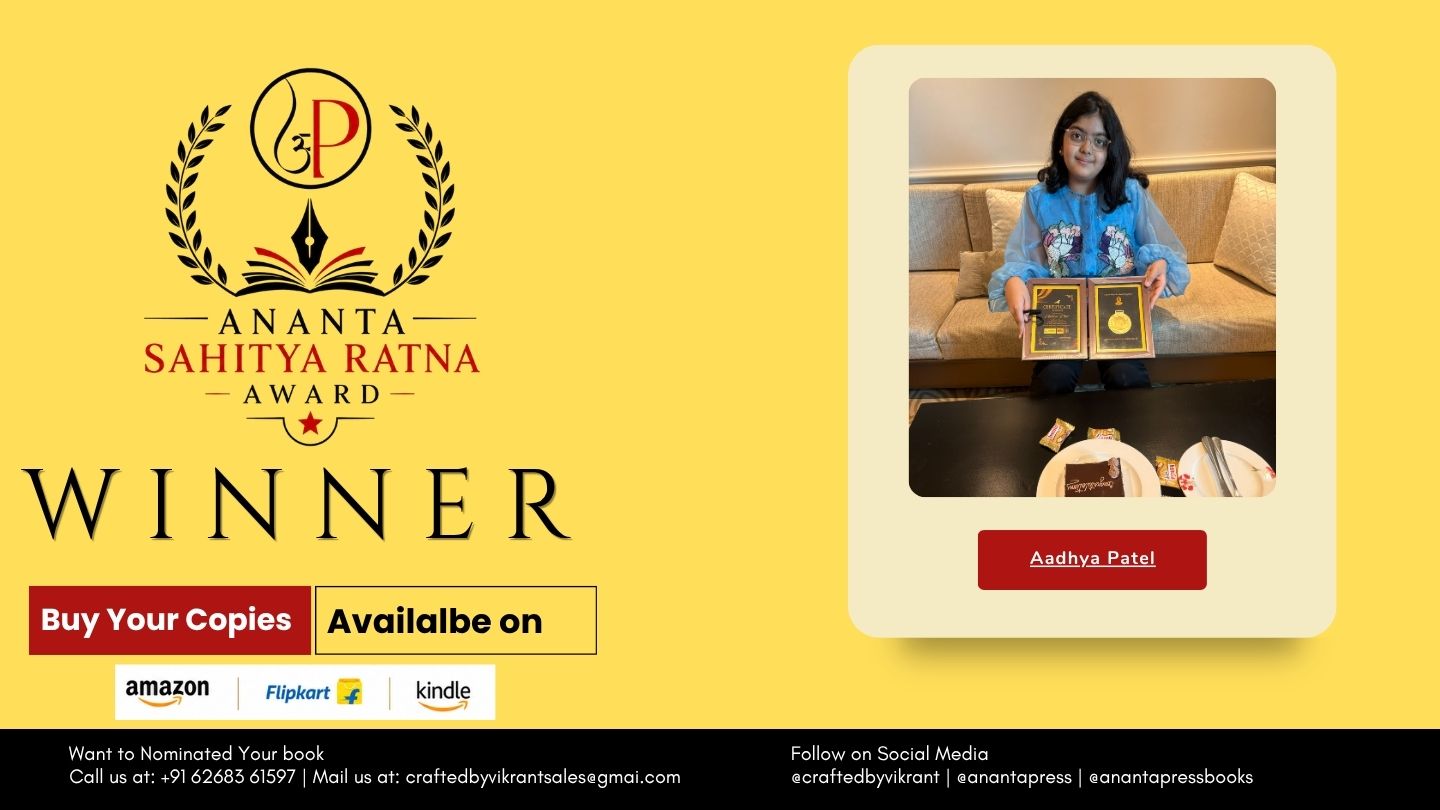
Ananta Press is delighted to congratulate Aadhya Patel on being officially selected as a Winner of the Ananta Press Sahitya Ratna Award for her remarkable non-fiction work, Weirdly Indian – Toilets, Toys & Total Mystery! The Indus Valley Civilization – 2500 BCE to 1900 BCE.
This recognition celebrates a book that approaches Indian history with curiosity, humour, intelligence, and a perspective designed especially for young readers. Rather than presenting the Indus Valley Civilization as a collection of dates, names, and difficult historical terms, Aadhya transforms the subject into an exciting investigation filled with unusual discoveries, unanswered questions, and details from everyday ancient life.
At the heart of Weirdly Indian is a simple but powerful idea: history becomes more meaningful when children are encouraged to ask questions instead of simply memorising answers. Ancient toilets, underground drainage systems, toys with moving parts, mysterious seals, jewellery, farming tools, carefully planned cities, and an undeciphered script become clues through which readers begin to understand a civilization that flourished thousands of years ago.
The award committee found this approach particularly noteworthy. The book does not restrict history to rulers, wars, monuments, or major political events. Instead, it invites children to study ordinary objects and consider what they can reveal about real people. A toy can tell us something about childhood. A drain can reveal the sophistication of a city. A seal can raise questions about language and trade. Even a pile of ancient bricks can become part of a much larger historical story.
One of the most engaging portions of the book is its account of the rediscovery of Harappa, including the extraordinary fact that railway workers once used ancient bricks without knowing that they belonged to a lost civilization. From that fascinating beginning, the reader enters the wider world of Harappa, Mohenjo-daro, archaeology, trade, agriculture, domestic life, sanitation, city planning, and technological innovation.
Equally important is the book’s willingness to acknowledge uncertainty. The Indus script remains undeciphered. Historians still debate who governed these cities and why such an extensive civilization gradually declined. Instead of treating these unanswered questions as weaknesses in our knowledge, Aadhya presents them as opportunities for curiosity.
This quality played an important role in the committee’s appreciation of the book. Weirdly Indian encourages young readers to understand how historical knowledge is created. It asks not only, “What do historians know?” but also, “How do they know it?” That distinction gives the book value beyond the subject itself. It introduces children to observation, evidence, reasoning, investigation, and critical thinking.
Aadhya Patel’s perspective as a young Indian author writing for young readers gives the work additional originality. The narration feels less like a formal lesson and more like an enthusiastic young explorer sharing fascinating discoveries with other children. Humour, comparisons, questions, illustrations, and unusual facts work together to make an ancient civilization feel immediate and surprisingly relatable.
The Ananta Press Sahitya Ratna Award seeks to recognise works that demonstrate originality, meaningful communication, literary or educational value, and the ability to contribute positively to readers. In the case of Weirdly Indian, the committee recognised a work that makes an important part of India’s ancient history accessible without removing its complexity or mystery.
Its contribution lies not only in teaching children about the Indus Valley Civilization, but also in encouraging them to become curious readers. The book reminds them that history is still full of questions and that discovery does not belong only to professional historians or archaeologists. Every child who looks carefully, asks why, compares evidence, and develops a theory is already beginning to think like an investigator.
Through its unusual subject choices and accessible presentation, Weirdly Indian also demonstrates that children’s non-fiction can be entertaining without losing educational depth. Its focus on sanitation, childhood, technology, trade, archaeology, and unresolved mysteries gives young readers several different entry points into the ancient world.
The Ananta Press Sahitya Ratna Award committee is pleased to recognise Aadhya Patel and Weirdly Indian – Toilets, Toys & Total Mystery! for bringing history to young readers with freshness, imagination, humour, and intellectual curiosity.
We extend our warmest congratulations to Aadhya Patel on this achievement. May this recognition encourage her to continue asking questions, exploring ideas, and creating work that helps other young readers discover the joy of learning. We wish her continued success and proudly acknowledge her contribution toward making Indian history engaging, approachable, and meaningful for a new generation of readers.
Jury Member Feedback
Glenville Ashby
Weirdly Indian is a refreshing way to introduce children to one of the world’s earliest urban civilizations. What impressed me most was the choice to begin with details that naturally make young readers curious, such as toilets, drains, toys, seals, and strange symbols. These are not treated as small facts. They become doors into larger questions about how people lived, planned cities, traded, worked, and raised families thousands of years ago. The book also has the confidence to admit where history does not give us clear answers. That is important because children should understand that learning is not only about memorising facts, but also about asking questions and examining evidence. Aadhya’s voice feels lively and approachable, and the humour makes difficult ideas easier to understand. I believe the book has strong educational value because it can make children interested in archaeology and Indian history without making the subject feel heavy or distant.
Kavya Pandey
What I enjoyed about Weirdly Indian is the way it makes history feel close to the everyday life of a child. A reader may begin with curiosity about an ancient toy or toilet, but soon starts thinking about city planning, sanitation, trade, farming, writing, and the lives of people from thousands of years ago. The book does not depend on complicated language or long explanations. Instead, it uses questions, funny observations, and familiar comparisons to help young readers imagine the Indus Valley Civilization. I also appreciated the focus on uncertainty. The unread script, the unknown system of rule, and the mystery of the civilization’s decline are presented as invitations to think rather than problems to hide. This gives the book an investigative quality. It encourages children to become active readers and not just passive learners. The combination of information, humour, and curiosity gives the book a clear identity and makes it suitable for both independent reading and classroom discussion.
Apeksha Gupta
For me, the strongest quality of this book is its perspective. History books for children often simplify information, but Weirdly Indian does something more interesting. It allows a young voice to guide other young readers through the subject. That changes the feeling of the book completely. The questions sound natural, the humour feels spontaneous, and the unusual details have been chosen with a clear understanding of what can capture a child’s attention. The discussion of Harappa’s accidental rediscovery is especially effective because it immediately shows how surprising archaeology can be. I also liked that the book moves beyond kings, battles, and monuments and gives importance to homes, drains, toys, jewellery, seals, and food. These ordinary objects help readers imagine real human lives. The book has educational value, but it also develops curiosity and observation. It shows children that history can be explored through evidence, and that asking a good question can sometimes be as important as knowing an answer.
Kavita Kaushik
Weirdly Indian has a playful title, but behind that playfulness is a thoughtful approach to learning. I found the sections on sanitation, planned cities, moving toys, trade, and mysterious seals especially engaging because they reveal how advanced and inventive the Indus Valley people were. The book makes children notice that ancient life was not simply primitive or unfamiliar. In many ways, people were solving practical problems that still matter today. This connection between the ancient and modern worlds gives the book relevance. I also value the way Aadhya uses humour without making the historical subject feel careless. The fun tone supports the information rather than distracting from it. Another strength is the willingness to leave some mysteries unresolved. Children are encouraged to think about possibilities and form their own theories. That is a valuable habit for any learner. This book can help young readers develop interest not only in history, but also in archaeology, research, invention, and critical thinking.
Neel Preet
This book stands out because it understands that curiosity is often the best starting point for learning. A child may not immediately be excited by the phrase Indus Valley Civilization, but ancient toilets, underground drains, moving toys, mysterious seals, and an unreadable script can instantly create interest. Weirdly Indian uses that curiosity very effectively. It then takes readers deeper into questions about how cities were organised, how people traded, what they ate, and what their daily lives may have looked like. I particularly liked the detective-like quality of the book. Readers are shown clues and are encouraged to think about what those clues might mean. The book does not present history as something completely settled. It respects unanswered questions and makes them part of the reading experience. That approach gives the book originality and intellectual value. Aadhya’s simple, humorous voice should make young readers feel comfortable with the subject, while the historical content gives them many reasons to continue exploring after the book ends.
Deepak Seth
After reading Weirdly Indian, I felt that its greatest achievement is making a very old civilization feel alive and surprisingly relatable. Instead of beginning with a formal timeline, the book draws attention to things people used, built, played with, and left behind. That creates a human connection with the past. The descriptions of organised streets, drainage systems, toilets, toys, jewellery, seals, farming tools, and trading goods help young readers understand that history can be reconstructed from everyday objects. I also appreciated the sections about the rediscovery of Harappa and the archaeologists who helped reveal the importance of the civilization. They show children how historical knowledge is created over time. The unresolved questions are handled particularly well. Rather than pretending that every mystery has an answer, the book allows uncertainty to remain interesting. This encourages independent thinking. The writing is simple, energetic, and accessible, and the subject has been presented in a way that can inspire children to read more about India’s ancient past.