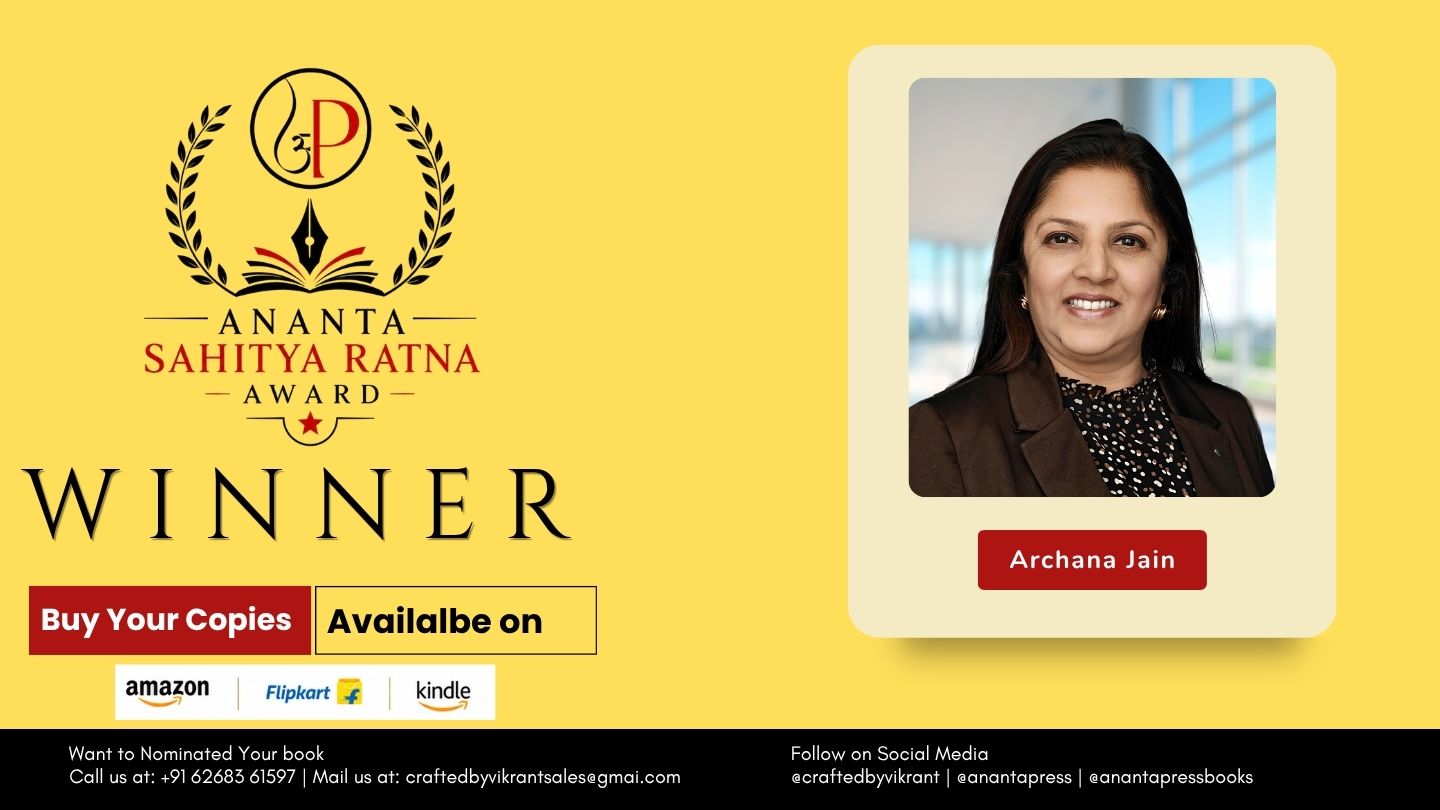
Ananta Press is delighted to congratulate author Archana Jain on being officially recognized as a Winner of the Ananta Press Sahitya Ratna Award for her insightful and timely book, Fungibility: The Art & Science of Adding Value Anywhere.
In an era when Artificial Intelligence, automation, technological disruption, and rapidly changing industries are transforming the professional world, Fungibility addresses one of the most important questions facing professionals today: How can a person continue to remain valuable when jobs, industries, and required skills keep changing?
Archana Jain approaches this question with clarity and purpose. Rather than encouraging readers to simply collect more qualifications or become dependent on one specialized role, the book introduces the idea of becoming “fungible.” In the context of the book, this means developing capabilities that can be transferred across different roles, functions, industries, situations, and challenges while continuing to create meaningful value.
This fresh interpretation gives the book its distinctive identity. Fungibility does not define professional success only through a job title, designation, organization, or technical specialization. Instead, it encourages readers to understand themselves through the value they are capable of creating. This shift from “what I do” to “what value I create” is one of the strongest ideas presented in the book.
The Ananta Press Sahitya Ratna Award recognizes books and authors whose work offers originality, relevance, meaningful thought, and lasting value to readers. The award committee considers not only the subject of a book but also its ability to communicate an important message, contribute to its field, encourage reflection, and positively influence its audience.
Fungibility stood out during the evaluation because it responds directly to the realities of the modern workplace. Skills that were highly valuable a few years ago may become less important as new technologies emerge. Entire job descriptions are changing, and professionals at every stage of their careers are being asked to learn faster and adapt more frequently. Archana Jain does not present change merely as a threat. She shows readers how adaptability, learning agility, transferable capability, and an ability to create value can become powerful professional advantages.
Another important strength of the book is its broad relevance. Its ideas can benefit students preparing to enter the workforce, young professionals building their careers, experienced leaders navigating organizational change, entrepreneurs responding to uncertain markets, and organizations seeking to develop future-ready teams. This wide applicability strengthens the book’s practical and intellectual contribution.
The award committee also appreciates the book’s emphasis on resilience without promoting fear. Instead of asking readers to constantly worry about becoming obsolete, Fungibility encourages them to build qualities that remain useful even when circumstances change. Learning agility, adaptability, transferable skills, curiosity, problem-solving ability, and the capacity to create meaningful impact are presented as resources that can travel with an individual from one professional situation to another.
The book’s message is particularly relevant in the age of AI. Discussions about Artificial Intelligence often focus on which jobs may disappear or which tasks may become automated. Fungibility offers a constructive alternative to this anxiety. It asks readers to focus on what they can continue developing within themselves. The result is a perspective that is both practical and empowering.
The committee also found value in the combination of research, leadership insights, business examples, and practical frameworks described in the book. This approach allows the subject to move beyond motivational advice and toward a more structured understanding of career adaptability. Readers are encouraged not simply to feel inspired but to examine their capabilities, expand their learning, and consciously prepare themselves for changing opportunities.
At its heart, Fungibility carries a meaningful message about professional identity. A person’s long-term value should not depend entirely on one position, one company, one industry, or one set of technical skills. Roles may disappear, organizations may restructure, and industries may evolve, but the capacity to learn, adapt, solve problems, contribute, and create value can continue to grow.
For its timely subject, fresh interpretation of fungibility, practical relevance, motivating message, and contribution to conversations around the future of work, Archana Jain’s Fungibility: The Art & Science of Adding Value Anywhere has earned recognition as a Winner of the Ananta Press Sahitya Ratna Award.
Ananta Press warmly congratulates Archana Jain on this achievement. We wish her continued success as an author and hope Fungibility reaches professionals, students, leaders, entrepreneurs, and organizations seeking greater confidence and clarity in a rapidly changing world.
May the book continue to inspire readers to look beyond fixed job titles, develop transferable capabilities, remain curious, embrace learning, and discover new ways to add value wherever their journey takes them.
Reviewer Feedback
Glenville Ashby
Fungibility is a highly relevant book because it speaks directly to a concern that many professionals have today. People are watching Artificial Intelligence change the nature of work, and many are uncertain about which skills will remain useful. What I appreciated about Archana Jain’s approach is that she does not make the reader fearful of the future. Instead, she encourages the reader to become more adaptable. The idea of moving professional identity away from a particular job title and toward the value a person can create is especially meaningful. It helps the reader understand that a career does not have to be limited to one role or industry. The focus on transferable skills, learning agility, and continuous development makes the book useful for professionals at different career stages. I also found the central idea of fungibility to be presented in a fresh and accessible manner. The book offers readers a positive way to think about career uncertainty and long-term professional relevance.
Kavya Pandey
What stood out to me in Fungibility is the simplicity and strength of its central message. Careers are no longer as predictable as they once appeared to be, and professionals cannot depend only on qualifications or experience gained in one particular role. Archana Jain encourages readers to identify the deeper capabilities that allow them to contribute in different environments. I found this idea practical because it can be applied by students, employees, leaders, and entrepreneurs alike. The book encourages people to learn continuously instead of becoming comfortable with one fixed set of skills. It also presents adaptability as a strength rather than something a person should be forced to develop only during a crisis. The discussion around Artificial Intelligence makes the subject especially timely. Instead of competing with every new technology, readers are encouraged to develop qualities that help them work effectively through change. For me, the book’s greatest value lies in helping readers reconsider how they define their professional identity and future potential.
Apeksha Gupta
Fungibility offers an important perspective on career development by asking readers to think beyond job titles. Many professionals introduce themselves according to their position or organization, but both can change very quickly. Archana Jain encourages the reader to focus instead on capabilities, adaptability, and the ability to create meaningful value. I found this perspective both motivating and practical. The book recognizes the uncertainty created by changing technology and industries, but it does not treat uncertainty as something that should stop progress. It shows how transferable skills can help individuals move between functions, challenges, and opportunities. I particularly liked the emphasis on learning agility because learning is becoming an essential part of every modern career. The book’s usefulness is also increased by its relevance to different readers, including students and experienced professionals. Overall, I see Fungibility as a thoughtful contribution to the self-help and professional development category. It encourages readers to prepare for change through capability, confidence, curiosity, and continuous improvement.
Kavita Kaushik
Archana Jain’s Fungibility is valuable because it addresses the reality that professional success today requires more than expertise in one fixed area. The workplace is evolving rapidly, and people increasingly need to apply their knowledge in new situations. The book’s interpretation of fungibility is therefore both interesting and useful. It encourages readers to understand which abilities they can carry from one role to another and how those abilities can create value in different environments. I appreciated that the book does not suggest abandoning expertise. Rather, it encourages readers to combine expertise with flexibility, curiosity, and the willingness to learn. This is an important distinction. A professional can possess deep knowledge while still remaining open to new methods and opportunities. The book also gives readers a constructive way to respond to changes created by Artificial Intelligence. Instead of focusing entirely on job insecurity, it encourages preparation and personal development. The overall message is positive, practical, and suitable for today’s changing professional world.
Neel Preet
While reading the concept presented in Fungibility, I found the connection between adaptability and long-term value particularly compelling. Many career books concentrate on achieving success within a particular profession, but this book asks a broader question about remaining useful even when the profession itself changes. That gives the subject a distinctive quality. Archana Jain encourages readers to separate their identity from one designation and recognize the abilities that enable them to solve problems and contribute in many different settings. The message is especially valuable for younger readers who may experience several career changes during their working lives. At the same time, experienced professionals can use the ideas to reconsider their own skills and prepare for new responsibilities. I also appreciate the emphasis on learning faster and adapting better rather than simply knowing more. Knowledge remains important, but the ability to update knowledge is becoming equally essential. Fungibility therefore provides readers with a relevant and encouraging philosophy for developing a resilient and future-ready career.
Deepak Seth
Fungibility presents a subject that is likely to become even more important in the coming years. Technology, automation, and Artificial Intelligence are already changing how organizations operate and how people perform their jobs. Archana Jain responds to this situation by encouraging readers to develop capabilities that remain useful across changing circumstances. I found the concept of being known for what value you create rather than only for your job title to be one of the strongest aspects of the book. It encourages greater ownership of one’s professional development. The book also reminds readers that opportunities may exist outside the function or industry in which they currently work. Transferable capability can therefore increase both resilience and possibility. Another positive aspect is the book’s wide audience. Its ideas can support students, working professionals, entrepreneurs, leaders, and organizations. The message is ultimately one of preparation rather than fear. By learning continuously and becoming more adaptable, individuals can approach professional change with greater confidence, awareness, and purpose.