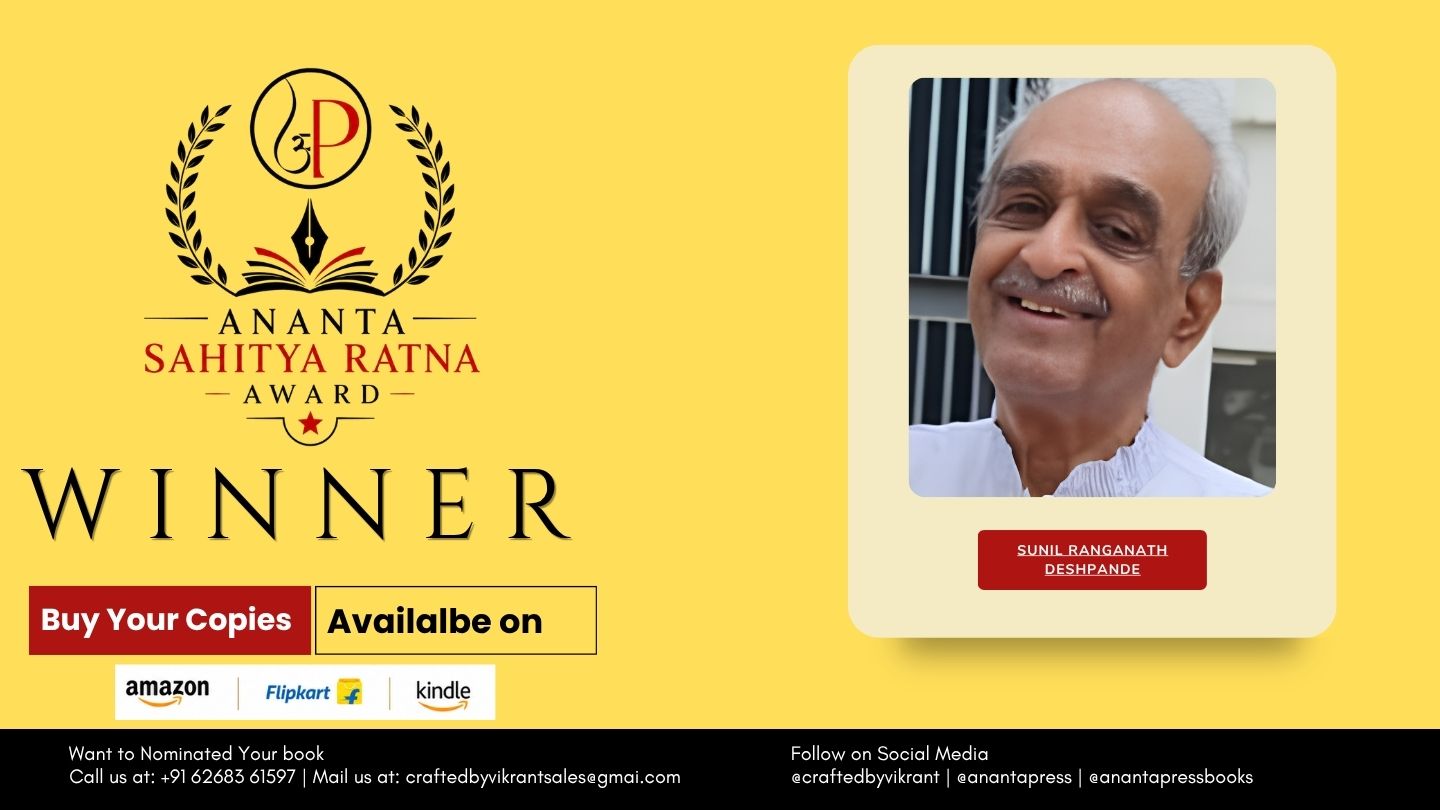
Ananta Press is delighted to officially congratulate Sunil Ranganath Deshpande on being selected as a Winner of the prestigious Ananta Press Sahitya Ratna Award for his meaningful and socially important book, “ORGAN DONATION: A Social Perspective.”
Books have the power to educate, create awareness, influence thought, and encourage positive change in society. Some books entertain us, while others take up subjects that need deeper public attention and understanding. “ORGAN DONATION: A Social Perspective” belongs to the second category. It focuses on an issue that is directly connected with humanity, social responsibility, awareness, and the possibility of saving lives.
Categorized under Non-Fiction (General), the book stands out because of its specific social purpose. According to the information provided by the author, it is designed as a first-of-its-kind textbook for social workers, activists, coordinators, and others working in the field of organ donation. This practical orientation makes the book particularly valuable. Instead of treating organ donation only as a medical subject, Sunil Ranganath Deshpande approaches it from a social perspective and recognizes the important role that awareness workers, coordinators, activists, and members of society can play in this field.
The Ananta Press Sahitya Ratna Award recognizes authors and books that demonstrate meaningful contribution, originality, reader value, social relevance, and the ability to create a lasting impact through written expression. The award committee considers not only the subject of a book but also its purpose, usefulness, uniqueness, message, and potential contribution to readers and society.
“ORGAN DONATION: A Social Perspective” attracted the attention of the award committee because it addresses an important subject through a perspective that is still not commonly represented in general literature. Discussions regarding organ donation are often dominated by medical terminology and clinical information. This book broadens that discussion by bringing social workers, activists, coordinators, and awareness professionals into focus.
One of the strongest qualities of the book is its intention to provide useful knowledge to people who may directly interact with individuals, families, communities, and institutions connected with organ donation. Such people can have an important role in spreading correct awareness, removing misunderstanding, encouraging informed conversations, and helping society develop a more responsible attitude toward organ donation.
The originality of the book lies in its specialized social approach. A textbook created for social workers and activists in this particular field has the potential to become more than reading material. It can become a resource for discussion, education, training, awareness programs, and community initiatives. This practical value was an important factor in its recognition by the Ananta Press Sahitya Ratna Award committee.
The book also carries a deeply humane message. Organ donation is ultimately associated with life, compassion, responsibility, and the willingness to help another human being. Writing seriously about such a subject requires social sensitivity and a clear understanding of how information can influence attitudes. Through this work, Sunil Ranganath Deshpande contributes to an important conversation and encourages readers to look at organ donation not only as an individual decision but also as an issue involving families, communities, institutions, and society.
The award committee appreciated the educational purpose behind the book. Literature and non-fiction become especially meaningful when they help readers understand subjects that can lead to real social improvement. By creating a dedicated text for people working in the field of organ donation, the author has attempted to bridge the gap between knowledge and social action.
The selection of “ORGAN DONATION: A Social Perspective” for the Ananta Press Sahitya Ratna Award therefore recognizes both the subject and the intention behind the work. It acknowledges the author’s effort to contribute useful knowledge to a field where awareness and responsible communication are extremely important.
Ananta Press warmly congratulates Sunil Ranganath Deshpande on this achievement. We hope that this recognition helps the book reach social workers, activists, coordinators, students, institutions, professionals, and general readers who can benefit from its message.
We wish Sunil Ranganath Deshpande continued success in his literary and social journey. May “ORGAN DONATION: A Social Perspective” inspire meaningful conversations, encourage informed awareness, and contribute positively to society for many years to come.
Jury Member Feedback
Glenville Ashby
“ORGAN DONATION: A Social Perspective” impressed me because it addresses an important subject from a viewpoint that deserves greater attention. Organ donation is usually discussed through medical procedures, statistics, hospitals, and transplantation. This book makes us understand that there is also a major social dimension behind the entire process. Social workers, activists, and coordinators often become an important connection between information and the people who need that information. I found the purpose of this book very meaningful because it attempts to provide these individuals with a dedicated source of knowledge. The author has selected a subject that can create awareness and encourage responsible discussion within communities. I especially appreciate that the book is not written merely to discuss an issue but to serve people who are actually working in this area. Sunil Ranganath Deshpande has made a valuable effort to bring social responsibility and education together. The book deserves recognition for its relevance, usefulness, and humanitarian purpose.
Kavya Pandey
What I appreciated most about “ORGAN DONATION: A Social Perspective” is the clear social intention behind the book. It is a subject that affects individuals, families, communities, and institutions, yet many people still have limited understanding about organ donation. Creating a textbook particularly for social workers, activists, and coordinators is therefore a thoughtful idea. These are the people who often communicate directly with society and can play an important role in awareness. The book encourages us to understand that social change does not happen through information alone. Information must reach people in a form that they can understand and trust. This is where the social perspective becomes important. I believe Sunil Ranganath Deshpande has chosen a meaningful area of writing where literature and education can support a larger humanitarian purpose. The book has value not only because of its subject but because of the audience it is trying to serve. It can encourage more informed, sensitive, and responsible conversations about organ donation.
Apeksha Gupta
This book presents a subject that is both serious and socially necessary. While reading “ORGAN DONATION: A Social Perspective,” I was particularly interested in the author’s decision to focus on the people involved in awareness and coordination rather than looking at organ donation only as a medical matter. This gives the book a distinct identity. Social workers and activists require proper understanding when communicating with communities, especially when dealing with subjects that can involve emotions, fear, uncertainty, and family decisions. A focused textbook can therefore become a useful educational resource. I also appreciate the humanitarian foundation of the work. Organ donation represents the possibility of giving another person hope and life, and awareness has an important role in helping society understand that possibility. Sunil Ranganath Deshpande deserves appreciation for selecting a topic where responsible writing can create practical social value. The book has a clear purpose and a meaningful readership. Its contribution lies in helping strengthen awareness through knowledge, sensitivity, and responsible social participation.
Kavita Kaushik
I found “ORGAN DONATION: A Social Perspective” to be an important contribution because the book connects knowledge with social responsibility. Many valuable causes face difficulties not because people are unwilling to help, but because there is a lack of understanding, communication, and proper awareness. Organ donation is one such area where social workers, activists, and coordinators can make a meaningful difference. The idea of creating a specialized textbook for them makes this work stand apart. The author appears to understand that awareness professionals need reliable material that helps them approach the subject with sensitivity and confidence. I also liked the fact that the book expands the conversation beyond hospitals and medical professionals. It reminds readers that society itself has an important role in creating awareness and developing positive attitudes. Sunil Ranganath Deshpande has chosen a subject with strong humanitarian relevance. The work deserves appreciation for attempting to educate people who can further educate many others. Its purpose, originality, and social usefulness make it worthy of recognition.
Neel Preet
The strength of “ORGAN DONATION: A Social Perspective” lies in the importance of its central idea. A book does not always need to deal with a popular subject to create an impact. Sometimes the greatest value comes from addressing an area where good educational material is genuinely needed. This book does exactly that by concentrating on organ donation from the perspective of social workers, activists, and coordinators. I believe this approach can help readers understand that creating awareness is a major part of social development. When people receive proper information through trained and responsible individuals, confusion can be reduced and meaningful conversations can begin. The book also carries a strong message of compassion. At the heart of organ donation is the possibility that one person’s decision may help another person continue living. Presenting this subject from a social perspective adds an important human dimension. Sunil Ranganath Deshpande deserves recognition for creating a work that combines education, awareness, social responsibility, and humanitarian thinking in a focused manner.
Deepak Seth
“ORGAN DONATION: A Social Perspective” is a relevant and purposeful work that brings attention to an area where awareness can have real consequences in people’s lives. What makes the book especially interesting is its intended use as a textbook for social workers, activists, and coordinators. This gives it a practical direction instead of limiting it to general discussion. People working in communities often need structured knowledge before they can effectively guide or educate others. A book created for this purpose can therefore support a much wider chain of awareness. I also appreciate the author’s decision to present organ donation through a social lens. Medical knowledge is essential, but social understanding, communication, public attitudes, family concerns, and awareness are equally significant when discussing organ donation. Sunil Ranganath Deshpande has recognized this wider dimension and developed his work around it. In my view, the book deserves appreciation because of its originality of perspective, educational relevance, and clear intention to contribute positively to society. It is a meaningful choice for this recognition.