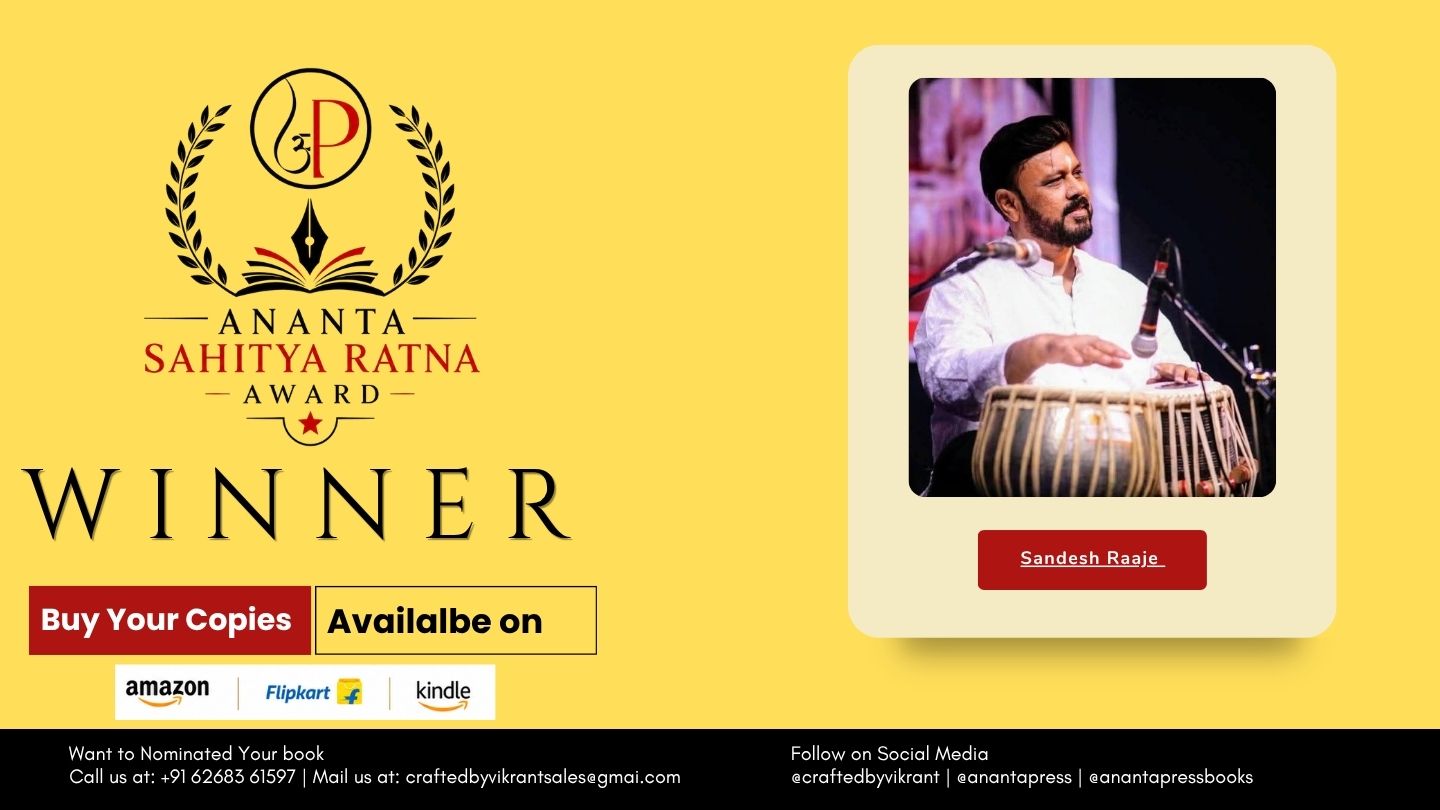
Ananta Press is pleased to congratulate Sandesh Raaje on being officially recognized as a Winner of the Ananta Press Sahitya Ratna Award for his important musical work, शास्त्रीय/उपशास्त्रीय गायना मधील तबला संगत. The recognition celebrates a book that gives serious attention to the role of tabla accompaniment in classical and semi classical Hindustani vocal music and brings a specialized area of musical knowledge to students, performers, and music lovers.
The book focuses on a subject that is central to Hindustani performance but is often understood mainly through direct training and stage experience. Tabla accompaniment is not simply the act of maintaining rhythm. It requires close listening, knowledge of musical form, sensitivity toward the vocalist, control of tempo, and the ability to contribute without overpowering the main performance. By placing this subject at the centre of a dedicated book, Sandesh Raaje gives learners an opportunity to study accompaniment as an art that deserves its own attention, discipline, and understanding.
This practical relevance was an important reason for the book’s selection by the Ananta Press Sahitya Ratna Award committee. The book is useful not only for tabla students and tabla players but also for teachers, vocalists, serious listeners, and anyone who wishes to understand how rhythm supports and enriches Hindustani vocal music. It offers readers a way to look beyond the visible performance and appreciate the musical communication that takes place between the singer and the accompanist.
Sandesh Raaje’s own musical journey adds special value to the work. He comes from a family with a rich legacy of Tabla and Pakhavaj and has received extensive training in this musical tradition. He has been closely associated with legendary Tabla maestro Pt. Bhai Gaitonde and had the privilege of learning under his guidance for many years. This long period of study, practice, observation, and guru-guided learning gives the subject a strong foundation in lived musical experience. The book therefore carries the value of knowledge shaped not only by theory but also by disciplined engagement with the tradition.
The award committee also recognized the originality of the book’s focus. Music literature often gives attention to performers, compositions, instruments, or broad theories of rhythm, but the specific art of accompanying classical and semi classical vocal music deserves deeper documentation. शास्त्रीय/उपशास्त्रीय गायना मधील तबला संगत helps address that need. It preserves and communicates knowledge that is frequently passed from teacher to student through demonstration and repeated practice. Recording such knowledge in book form can help it reach readers beyond a single classroom, institution, or generation.
The literary and educational value of the book lies in this combination of specialization, practical purpose, and cultural preservation. It encourages students to understand that becoming a capable Tabla player is not only about speed, technique, or individual display. Accompaniment asks for maturity, restraint, musical awareness, and respect for the complete performance. This message has relevance for emerging artists because it presents musicianship as a form of collaboration and responsibility.
The Ananta Press Sahitya Ratna Award seeks to recognize authors whose books bring meaningful ideas, knowledge, cultural value, and lasting benefit to readers. Works that preserve specialized traditions and make them more accessible to future learners have an important place in this vision. Sandesh Raaje’s book represents this spirit by contributing to the documentation and understanding of Indian classical music through the focused study of Tabla accompaniment.
The six-member award committee considered the book’s subject, usefulness, originality, educational contribution, and connection with a respected musical tradition. Its relevance for both learners and practitioners, together with the author’s deep engagement with Tabla and Pakhavaj heritage, made it a strong candidate for recognition.
Ananta Press warmly congratulates Sandesh Raaje on this achievement. We wish him continued success in his musical, educational, and literary journey. May शास्त्रीय/उपशास्त्रीय गायना मधील तबला संगत reach Tabla students, performers, teachers, and music lovers across generations and encourage a deeper understanding of the sensitive and essential role of Tabla in Hindustani vocal music. His contribution is not only to readers but also to the preservation and continuation of a rich musical tradition.
Draft Committee Feedback for Reviewer Approval
Glenville Ashby
शास्त्रीय/उपशास्त्रीय गायना मधील तबला संगत is a focused and useful work because it brings attention to an area of music that is often experienced on stage but not always explained carefully for learners. The author presents the role of Tabla in classical and semi classical Hindustani vocal music as a serious subject of study, not merely as background accompaniment. What I found valuable is the practical relevance of the book for Tabla students, performing Tabla players, and listeners who wish to understand the relationship between rhythm and vocal expression. Sandesh Raaje’s long association with the Tabla tradition gives the subject a sense of authenticity and responsibility. The book also helps readers see that good accompaniment requires sensitivity, discipline, listening, and musical understanding. It can encourage young musicians to look beyond technique and understand the larger responsibility of supporting a vocalist. For these reasons, I consider the book a meaningful contribution to music education and a deserving work for recognition.
Kavya Pandey
This book stands out for choosing a specialized subject and presenting it with a clear educational purpose. Tabla is widely admired, yet many readers and even students may not fully understand how carefully a Tabla player must respond while accompanying classical and semi classical vocal music. Sandesh Raaje brings this important subject into focus. The strength of the book lies in its usefulness. It can serve students who are learning Tabla, musicians who are beginning to accompany vocalists, and music lovers who want a deeper appreciation of Hindustani performance. The author’s musical background and years of learning under a respected guru add depth to the work. I also appreciate that the book preserves knowledge connected with a living guru-shishya tradition while making it available to a wider audience through writing. Such books are valuable because they connect practice, experience, and documentation. The work has a clear purpose, a distinct subject, and strong relevance for future generations of musicians.
Apeksha Gupta
I found the book important because it treats Tabla accompaniment as an independent area of understanding within Hindustani music. Many students spend years learning compositions, technique, and rhythm, but accompaniment also demands awareness of the singer, the structure of the performance, and the character of the musical form. This book encourages that broader understanding. Sandesh Raaje’s experience and musical lineage make the discussion especially valuable for learners who want guidance rooted in tradition. The book is not limited to professional performers. It can also help serious listeners understand why Tabla accompaniment changes the energy, balance, and beauty of a vocal presentation. I believe the author has selected a subject that deserves more written attention. By bringing together knowledge, experience, and respect for the tradition, the book becomes both educational and preservational. It can inspire Tabla students to become more thoughtful accompanists and can help music lovers appreciate the discipline behind a successful classical or semi classical performance.
Kavita Kaushik
What impressed me most about शास्त्रीय/उपशास्त्रीय गायना मधील तबला संगत is its commitment to a very specific and meaningful aspect of Indian music. The book recognizes that accompaniment is not a secondary activity. A sensitive Tabla player must listen, understand, respond, and support the vocalist without disturbing the musical expression. This idea gives the book strong educational value. Sandesh Raaje writes from a background shaped by a family tradition of Tabla and Pakhavaj and by many years of learning under his guru. That connection between inherited musical culture and disciplined training gives the work a special character. The book can be useful at different levels. A student can learn from it, a performing musician can reflect on it, and a general music lover can gain a better understanding of what happens during a Hindustani vocal performance. I see the book as a sincere effort to document knowledge that is often passed orally and therefore deserves recognition and wider readership.
Neel Preet
The value of this book lies in the way it brings attention to the dialogue between voice and rhythm. In Hindustani classical and semi classical music, the Tabla player is constantly required to remain alert to the movement, mood, and structure of the singing. Sandesh Raaje has chosen to examine this relationship from the perspective of a musician who has spent years within the tradition. That makes the book especially relevant for students who may know rhythmic exercises but still need to understand the art of accompaniment. I also see an important cultural value in the work. Musical knowledge is often transferred directly from teacher to disciple, and when an experienced practitioner documents that understanding, it creates a resource that can travel beyond one classroom or one generation. The book therefore has both practical and archival importance. It supports learning, encourages respect for the accompanist’s role, and deepens the reader’s appreciation of Hindustani vocal music. It is a thoughtful and worthwhile contribution.
Deepak Seth
This is a book with a clear audience and a clear contribution. It speaks directly to Tabla students and players, but its appeal can extend to anyone who loves Hindustani music. The subject of Tabla accompaniment requires more than knowledge of rhythm. It involves patience, musical judgement, sensitivity, and the ability to support another artist. The book helps place these qualities at the centre of the discussion. Sandesh Raaje’s long training and association with an established Tabla tradition give the work credibility and depth. I particularly value the fact that the book can encourage learners to think about performance as collaboration rather than display. That is an important lesson for young musicians. The work also contributes to the documentation of a specialized area that may otherwise remain dependent on oral teaching alone. By making this knowledge available in book form, the author supports both education and preservation. I believe the book deserves recognition for its focused subject, practical usefulness, and contribution to Indian musical literature.