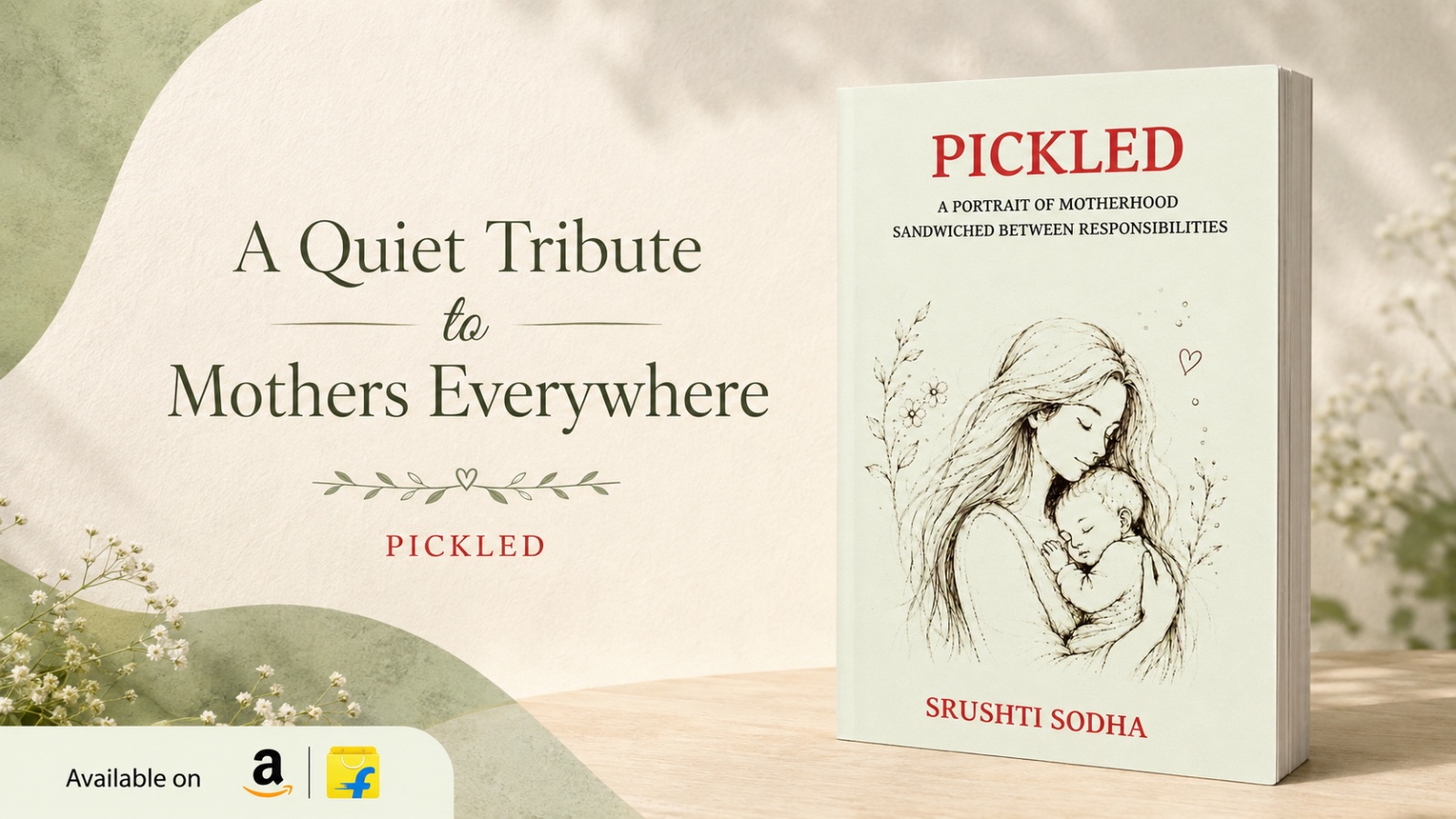
Book: Pickled: A Portrait of Motherhood Sandwiched Between Responsibilities
Author: Srushti Sodha
Pickled: A Portrait of Motherhood Sandwiched Between Responsibilities by Srushti Sodha begins in a deeply recognizable emotional space: the moment when an adult daughter looks at her mother and realizes she has never fully known her. She has known the mother who cooked, called, worried, advised, remembered, sacrificed, and held the household together. But beneath that role lived a woman with her own ambitions, fears, tastes, limitations, and unlived possibilities. Pickled explores the distance between those two understandings and turns it into a moving reflection on inheritance.
The book is important because it does not treat motherhood as a single experience. It looks at motherhood across generations. One generation learned that love meant being endlessly available. Another is beginning to ask whether love can remain deep while allowing a woman to maintain a stronger sense of self. Between them lies gratitude, misunderstanding, guilt, tenderness, admiration, and change. Sodha does not ask readers to choose which generation is “right.” Instead, she examines what each inherited and what each is trying to transform.
The phrase “sandwich generation” usually refers to adults caring for children while also supporting aging parents. In Pickled, that phrase becomes emotionally vivid. The women at the center of the book are not balancing responsibilities on a calendar; they are living inside overlapping claims of love. Their children need guidance. Their parents need attention. Their partners need support. Homes need maintenance. Traditions need preserving. Social expectations continue to operate. The self must somehow survive in whatever space is left.
The book’s great sensitivity comes from understanding that these responsibilities are rarely experienced as purely external burdens. They are tied to love. That is what makes them difficult to refuse. A mother may be exhausted by cooking for everyone, but food is also how she communicates care. She may resent the assumption that she will remember every detail, yet remembering is part of how she creates belonging. The same act can be both labor and affection. Pickled refuses to simplify that contradiction.
Sodha’s use of pregnancy as a reflective threshold gives the book a strong emotional frame. Standing at the edge of motherhood herself, the narrator begins to revisit her childhood differently. She thinks not only about what her mother did but about what her mother was building. Safety, she realizes, is not an abstract quality. It is created by repeated acts of attention. A child grows up believing that home is dependable because someone has absorbed uncertainty on their behalf.
This insight is especially powerful for readers who have reached adulthood and begun recognizing the hidden work of their parents. Childhood naturally centers the child. Food appears. Festivals happen. Problems are solved. Someone remembers appointments. Someone knows when the family is tense and quietly changes the atmosphere. Only later do many of us understand that these things did not happen automatically. Pickled captures the emotional shock of that realization without turning it into accusation.
The book also asks readers to reconsider sacrifice. In many cultures, particularly within traditional family structures, maternal sacrifice is praised so often that it becomes almost invisible. A mother who gives up an ambition is called devoted. A mother who does not rest is called strong. A mother who places herself last is praised for love. The language is flattering, but the consequence can be severe: the woman inside the role becomes difficult to see, even to herself.
Pickled does not condemn mothers for having lived that way. This is crucial. The book recognizes that people make choices within the limits of their time, family, culture, and available opportunities. The woman who did not travel far for education or who placed family expectations ahead of a personal dream may not have experienced those decisions as simple coercion. Life is more complicated. People adapt, find meaning, become skillful, and build identities within the paths available to them. The book’s compassion comes from honoring that complexity.
At the same time, the book makes space for daughters who want something different. A daughter can be grateful for what her mother gave and still decide that she does not want exhaustion to be the proof of her own love. She can preserve tenderness without preserving silence. She can remain emotionally available while protecting parts of herself that are not defined by caregiving. This is one of the most contemporary and necessary messages in the book.
The title Pickled captures the generational theme brilliantly. Pickling preserves, but preservation also changes the thing being preserved. It absorbs flavor. It becomes sharper, deeper, sometimes stronger. The mothers in the book are similarly shaped by years of responsibility. They are “marinated” in other people’s needs, but they are not reduced to those needs. They emerge with humor, authority, instinct, patience, and a particular kind of emotional intelligence that could only have been developed through lived experience.
The domestic imagery gives this theme warmth. Pressure cookers, chai, family meals, parcels, newspaper mornings, temple sounds, and the routines of a Gujarati household create a world where identity is built through repetition. These details matter because intergenerational relationships are rarely shaped by grand speeches. They are shaped by who makes tea when someone is upset, who remembers the preferred snack, who knows when a silence means anger, and who continues calling after a child has moved away.
The book is equally compelling in its understanding of distance. One of the bittersweet achievements of motherhood is that good parenting often produces independence. Children leave home, study elsewhere, build careers, and create adult identities. Mothers who once managed every detail can become spectators to lives unfolding far away. The emotional challenge is enormous: to encourage freedom while remaining the place of return. Pickled captures this paradox with affection rather than melodrama.
Its humor also deserves attention. The book understands that family life is funny precisely because people care so much. Hunger can become theatrical. A snack parcel can become an international operation. Technology changes, but parental concern remains stubbornly analog. The line between advice and interference is negotiated daily. Humor makes the book accessible and prevents reverence from becoming stiffness.
For daughters, Pickled may encourage a new conversation. Instead of asking only, “What did my mother do for me?” the book invites the question, “Who was my mother while she was doing all of that?” What did she postpone? What did she enjoy? What frightened her? What kind of girl was she before motherhood became the most visible part of her identity? These questions can transform gratitude from a general feeling into a more mature form of understanding.
For mothers, the book offers recognition without prescribing perfection. It acknowledges that care can be deeply rewarding and deeply tiring at the same time. It understands the strange mixture of pride and grief that comes with watching children become independent. And it makes room for a mother to imagine that she remains a person beyond the needs she meets.
For readers who are neither mothers nor daughters, the book still matters because its central subject is caregiving. Every family contains people whose invisible work makes other lives easier. Sometimes that person is a father, grandparent, sibling, or partner. The questions Pickled raises—about emotional labor, identity, duty, gratitude, and boundaries—extend far beyond one relationship.
The book’s greatest achievement is its refusal to turn generational difference into generational conflict. It does not say, “They sacrificed too much, so we must do the opposite.” Nor does it say, “They gave everything, so we must repeat their model.” Instead, it suggests that inheritance can be selective and loving. We can keep the warmth, the loyalty, the instinct to care, and the idea of home as safety. We can also question silence, self-erasure, and the expectation that a woman must disappear to prove devotion.
That is why Pickled feels like a bridge. It stands between women who gave everything and women learning to give differently. It allows gratitude and change to occupy the same sentence. It honors the mothers whose strength often went unnamed while giving their daughters permission to create a new definition of strength.
A reader may finish Pickled thinking less about motherhood as a role and more about motherhood as a relationship between generations. We inherit not only habits and recipes but also emotional patterns, definitions of love, ways of worrying, and ideas about what a woman owes to others. Sodha’s book gently asks which of those inheritances should remain untouched and which can be reshaped.
That question gives Pickled its lasting value. It is not only about the women who came before. It is about what we do with what they gave us. The answer, the book suggests, may be neither rejection nor repetition. It may be the more difficult work of understanding: keeping the love, naming the cost, and carrying the inheritance forward in a form that leaves room for the self.
Amazon India: https://www.amazon.in/dp/B0HBD6TR78
Amazon USA: https://www.amazon.com/dp/B0H8WXNCPG